
Overview
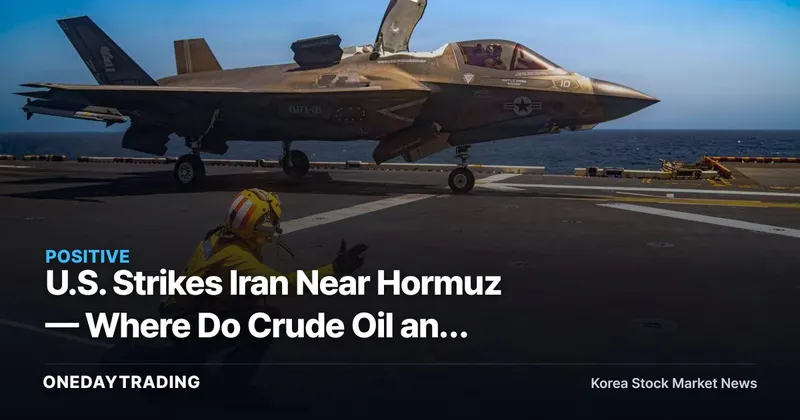
With the U.S. carrying out military strikes against Iran on grounds of ceasefire violations during a 60-day cessation-of-hostilities agreement, geopolitical risk around the Strait of Hormuz has surged back to the forefront. Given that a substantial share of the world's seaborne crude oil transits this chokepoint, the episode should be read not merely as a diplomatic clash but as an event with direct implications for crude supply chains and oil price volatility.
What Happened
The crux of this confrontation is the timing of the alleged agreement breach. Both sides had agreed to suspend hostilities for a set period as part of war-ending negotiations, but the U.S. concluded that Iran had violated the terms and launched strikes near Hormuz. The fact that armed conflict erupted while talks were still nominally under way is a signal that undermines the credibility of the ceasefire framework itself.
The variable markets are watching most closely is the intensity of Iran's response. Should Iran actually deploy options such as closing the Strait of Hormuz or obstructing vessel transit, crude shipping costs and insurance premiums would spike immediately. Conversely, if retaliation remains limited in scope, any sharp gain (surge) in crude prices could reverse in short order. At this stage, it is the question of escalation — not the strike itself — that will drive prices.
Structural Context
The Strait of Hormuz functions as effectively the sole corridor through which Middle Eastern crude reaches Asia. Because Korea is heavily dependent on the Middle East for crude oil imports, uncertainty at this chokepoint ripples through to refinery input costs, fuel expenses for airlines and shippers, and ultimately the inflation trajectory. Crude oil futures and refining margins are the assets that most immediately price in supply disruption fears.
Stock (Ticker) and Industry Sector Impact
- Refining stocks (S-Oil · SK Innovation · GS): Rising crude prices generate near-term inventory valuation gains and wider refining margins, both of which act as positive catalysts for short-term earnings. That said, if higher input costs suppress demand, the magnitude of margin improvement may be capped.
- Defense (Hanwha Aerospace · LIG Nex1): Escalating Middle East tensions historically stimulate global weapons demand and order-book expectations. The key question is whether the current mood translates into actual contract announcements.
- Airlines and Shipping (Korean Air · HMM): Fuel costs represent a major component of operating expenses in these industry sectors, so a sharp gain (surge) in crude prices weighs directly on profitability. The degree of impact will hinge on whether carriers can pass costs through via freight rates and fuel surcharges.
- Large-cap exporters (Samsung Electronics · Hyundai Motor): Safe-haven flows triggered by geopolitical risk and won currency fluctuations affect export-oriented stocks bidirectionally through the exchange rate.
Bull vs. Bear Scenarios
The bull scenario is one in which Iran actually threatens Hormuz transit, prolonging supply disruption fears. In that case, crude prices and refining margins would rise in tandem, and refining, energy, and defense stocks could see relative outperformance. The bear scenario is one in which both sides quickly return to the negotiating table or retaliation proves largely symbolic. If the geopolitical risk premium already priced into crude fades, the near-term strength in refining stocks could also reverse, while a broader market relief rally becomes possible as risk-aversion eases. Either way, elevated volatility is a common risk given the nature of geopolitical events.
Investor Action Points
- Monitor Strait of Hormuz transit conditions and Iran's official response as the first key inflection point.
- Track WTI and Brent crude futures alongside refining margin trends to validate the earnings outlook for refining stocks.
- Assess the direction in which movements in the Korean won/U.S. dollar exchange rate affect the earnings of export-oriented and airline stocks.
- For defense stocks, distinguish winners from laggards based on actual order announcements rather than market sentiment alone.
This content was automatically summarized and analyzed based on the original news source. View original article (CNBC)