
Summary
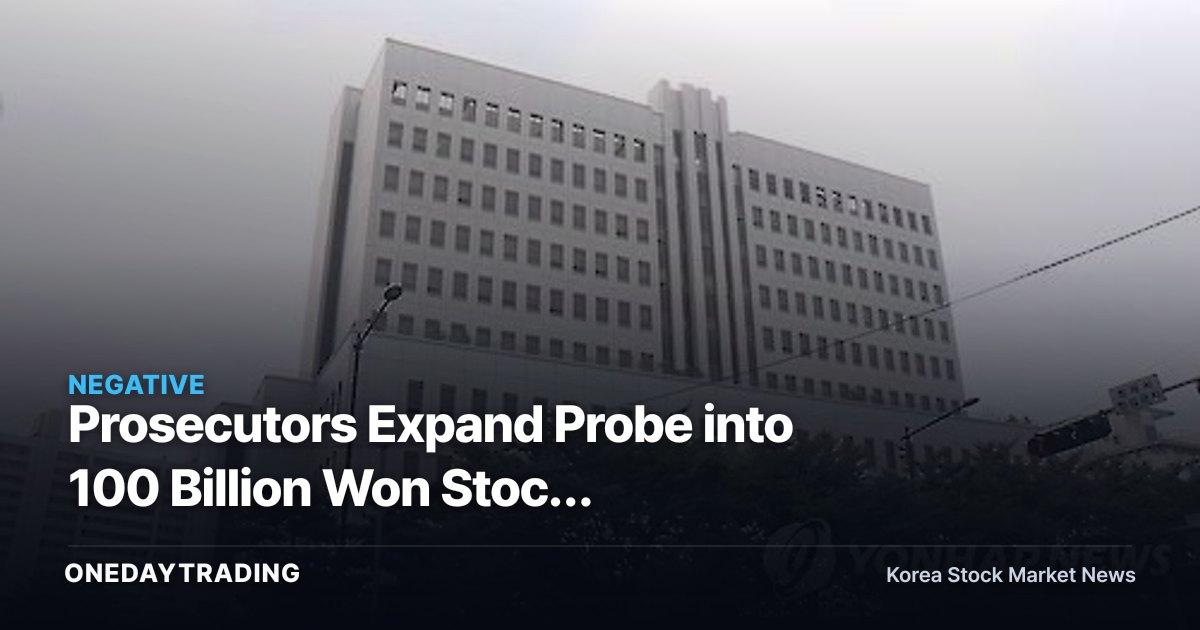
Prosecutors raided three brokerages simultaneously while investigating a stock manipulation case estimated at around 100 billion won in scale. With circumstantial signs that financial professionals were involved overlapping with the symbolism of being the so-called "first ruinous-forfeiture case," the move is read as a signal that enforcement intensity has stepped up a notch. For investors, this is the moment to review the reputation risk across both the low-liquidity stocks (tickers) cited as potentially implicated and the securities industry sector as a whole.
The Full Story
This raid is an extension of the coercive investigation into suspected price manipulation worth 100 billion won involving financial professionals and others. By widening the scope beyond tracing individual accounts to three brokerages that intermediate and execute trades, prosecutors are seen as intending to examine order flow and signs of matched-order trading at the systemic level.
The case is cited as an early instance subject to the so-called "ruinous forfeiture" regime, which strengthens the confiscation and collection of illicit gains under the Capital Markets Act. Because the structure links not merely to fines but also to the clawback of criminal proceeds and the imposition of penalty surcharges, the cost borne by perpetrators upon detection rises sharply compared with the past.
That said, it is necessary to clearly distinguish that the current stage is a procedure to secure evidence for proving the allegations, and that the raid itself does not confirm wrongdoing by any specific company.
Structural Background
Stock manipulation is prone to occur in small-cap stocks with low trading volume and a limited float. This is because even a small amount of capital can prop up bid quotes, and it is easy to engineer short-term sharp gains (surges) by combining catalyst-driven disclosures or themes. The trend of financial authorities raising the expected cost of punishment by deploying abnormal-trading detection systems and the "ruinous forfeiture" regime works to narrow the operating space for manipulation rings.
Stock and Sector Impact
- Securities industry sector: For the small- and mid-cap brokerages cited as raid targets, reputational damage and the cost burden of strengthening internal controls are short-term negative factors. However, large brokerages may be differentiated given their low direct relevance.
- Low-liquidity theme stocks: The group of stocks suspected of price manipulation is exposed to weakening supply-demand (order flow) and widening volatility. In particular, the more a stock has posted sharp gains (surges) without an earnings basis, the greater the risk of a pullback.
- Exchange and market infrastructure: Strengthened surveillance of abnormal trading increases demand for monitoring systems, a favorable medium-to-long-term variable for the related security and data segments.
- Sound, high-quality stocks: If speculative funds retreat, a reallocation of capital toward earnings-based stocks may emerge.
Bullish vs. Bearish Scenarios
On the bullish side, cracking down on price manipulation could raise market trust and, over the long term, lead to a cleansing effect that reduces the burden on KOSDAQ participation by foreign investors and institutional investors. On the bearish side, the burden is that the enforcement phase itself dampens small-cap market sentiment in the short term, and if indiscriminate avoidance of surging stocks spreads, it could translate into slowing KOSDAQ trading value. Uncertainty over the investigation's outcome is also a variable.
Investor Action Points
- Check whether a recent sharp gain (surge) in a holding was based on fundamentals such as earnings or order wins, or was merely a supply-demand (order flow)- or catalyst-driven surge.
- For stocks with a low float relative to trading volume, manage position sizing in light of the potential for widening volatility.
- Verify the progress of the prosecutors' investigation and official disclosures from implicated companies, and avoid chasing trades based on rumors.
- Monitor the schedule of additional crackdowns and regulatory announcements from financial authorities, along with KOSDAQ trading value trends, as sentiment indicators.
This article is auto-summarized and analyzed content based on the original news. View original (Yonhap News)