
Summary
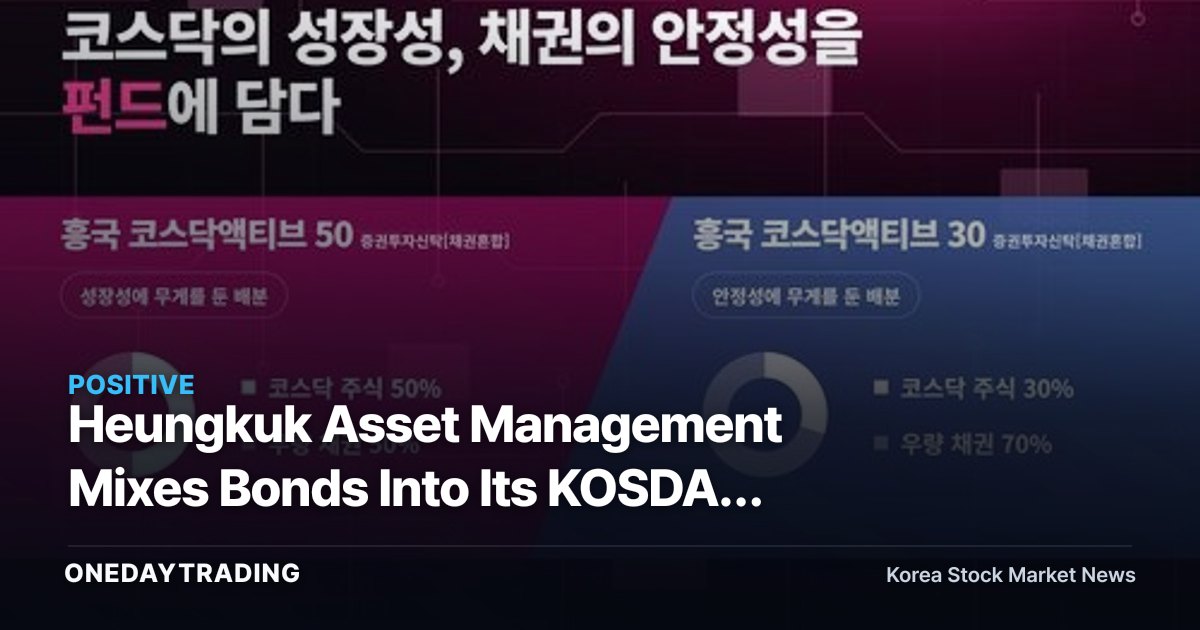
Heungkuk Asset Management has rolled out two bond-mixed funds that invest in KOSDAQ growth stocks on August 6. Bonds cushion losses while KOSDAQ growth stocks chase excess returns — and the fact that this kind of product is emerging now reveals something about market sentiment. Demand for growth stocks is still alive, but that demand is flowing into mixed-asset products rather than pure equity funds.
What Happened
A bond-mixed fund allocates a substantial portion of assets to bonds to lock in a base return, then adds stocks with the remaining allocation to pursue additional upside. This particular product filled that equity sleeve with KOSDAQ growth stocks. KOSDAQ growth stocks trade at higher earnings multiples than KOSPI large-caps and react more sensitively to shifts in interest rates and supply-demand (order flow). In effect, Heungkuk Asset Management chose a sales strategy built around "keeping the upside potential of growth stocks while using bonds to guard against the downside."
It's no coincidence that this kind of structure has emerged now. KOSDAQ growth stocks were the asset class that faced the earliest and heaviest valuation pressure during the recent high-rate period. This can be read as a signal that while investors trust the growth potential of KOSDAQ growth stocks themselves, they remain unconvinced about the interest rate path needed for that growth to be fully reflected in share prices.
Structural Background
Growth stock valuations are most sensitive to the discount rate — that is, the interest rate — used to bring future earnings back to present value. When the benchmark interest rate falls, the discount rate drops, widening room for KOSDAQ growth stock multiples to expand; when cuts are delayed, that expansion gets pushed back. The problem is that the market has already priced in a good deal of this path. The rebound KOSDAQ growth stocks have shown off their recent lows already incorporates some expectation of future rate cuts. Choosing the bond-mixed format should be read as a design meant to let the bond sleeve absorb the downside if those expectations don't play out as planned.
Stock and Sector Impact
- KOSDAQ growth stocks broadly (biotech, EV battery materials, small and mid-cap robotics/AI names, etc.) — a mildly positive factor for supply-demand (order flow), as this opens one more channel for institutional investors' money to flow in through a mixed-asset route rather than pure equity funds.
- Asset management industry — if more mixed-asset products holding KOSDAQ growth stocks follow, competition among asset managers over KOSDAQ growth stock products could intensify.
- Domestic bond market — demand for the bond sleeve in mixed-asset funds also affects supply-demand (order flow) for government bonds and high-grade credit bonds.
- KOSDAQ index — as the AUM of such products grows, passive buying pressure builds on the basket of KOSDAQ growth stocks.
Bull vs. Bear Scenario
Bull scenario If the Bank of Korea actually begins cutting the benchmark interest rate and KOSDAQ value-up and growth stock support policies continue, the equity sleeve of these mixed-asset funds could generate excess returns and draw in follow-on capital. Institutional supply-demand (order flow) in KOSDAQ growth stocks could increasingly replace retail investors' supply-demand (order flow), which may also smooth out index volatility.
Bear scenario If rate cuts are delayed beyond expectations or inflation flares up again, there will be a stretch where expectations for KOSDAQ growth stock multiple expansion get unwound. In that case, even the mixed-asset funds could end up with only the bond sleeve's stable return while the equity sleeve turns negative. If the actual AUM of the two newly launched funds stays small, their real impact on KOSDAQ growth stock supply-demand (order flow) could end up far smaller than the announcement itself suggests.
Investor Action Points
- Check the fund's management report for the actual KOSDAQ growth stocks (tickers) held and the bond-equity allocation ratio (disclosure timing: first settlement and asset management report).
- Check the schedule of the next Monetary Policy Committee benchmark interest rate decision — the timing of a cut is the key variable for KOSDAQ growth stock multiples.
- Examine how much of the recent rebound is already priced into the forward valuations of the KOSDAQ index and individual growth stocks.
- Track fund flows into and out of similar bond-mixed growth stock funds to gauge the direction of institutional supply-demand (order flow).
This article is automatically summarized and analyzed based on the original news report. View original (Yonhap News Agency, Securities)