
Summary
CXMT’s 10-fold increase in first-half revenue means Samsung Electronics and SK hynix can no longer ignore China as a force in the defense of general-purpose DRAM pricing. The real issue here is less about the earnings figures themselves and more about how quickly the Chinese memory maker can clear the hurdles to mass production and customer qualification for DDR5.
The market has already priced in much of the HBM boom, but it has not yet fully priced in a scenario where supply pressure from China returns in general-purpose memory. If CXMT expands DDR5 shipments, Korean memory makers could see pressure on both ASPs and product mix at the same time.
What Happened
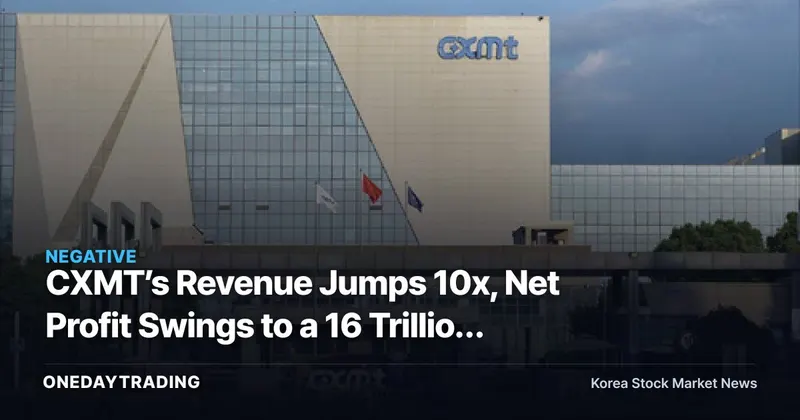
According to reports, CXMT’s revenue in the first half of this year rose 10-fold, and it swung to a 16 trillion won net profit. On the numbers alone, that signals that China’s memory industry has moved past the loss-making survival phase and into a full-scale capacity expansion cycle.
The more sensitive point is DDR5. The claim that CXMT’s DDR5 performance has narrowed to within a 1% gap of SK hynix is not just a technical pitch. For investors, it should be read as a sign that the Chinese company is trying to move beyond being a latecomer in low-cost DDR4 and become a player in the mainstream server and PC standards.
That said, a 1% spec gap does not automatically translate into a 1% market share gap. The real battle is decided by yield, long-term reliability, customer approval, and supply stability. Even so, if mass-production quality improves at this pace, pricing power is already starting to come under pressure.
Structural Background
Memory is an industry linked by materials and equipment, front-end processes, packaging, and customer qualification. HBM is the highest-difficulty segment, but the products that still move the overall cycle are general-purpose items such as DDR5 and LPDDR. If Chinese players accelerate in this segment, Korean makers may hold up through high-value-added HBM, but the overall average selling price could still be dragged down.
What matters here is what changes first. Samsung Electronics and SK hynix are already benefiting from AI server demand through HBM, but if general-purpose DRAM prices weaken, the floor under operating profit will fall. Conversely, if HBM demand holds up, pressure from China is more likely to show up first as valuation pressure rather than an immediate earnings shock.
Stock and Industry Impact
- Samsung Electronics: With a large share of general-purpose DRAM, CXMT’s DDR5 catch-up directly weighs on pricing. HBM expansion is a buffer, but if the pace of product mix improvement slows, earnings estimates could be cut before the stock price moves.
- SK hynix: Its HBM competitiveness is relatively strong, but a weaker pricing environment for DDR5 and server DRAM would still create valuation pressure. Even if the technology gap holds, the industry beta is hard to escape.
- Micron Technology: As a benchmark for global DRAM prices, it is directly exposed to the impact of Chinese capacity expansion. It is likely to move together with Korea as an industry-sensitive stock (ticker).
- Hanmi Semiconductor: The HBM packaging investment cycle still provides support, but if pricing pressure on general-purpose DRAM intensifies, the pace of customer investment becomes a variable.
- Wonik IPS, Techwing: Competition in capacity expansion between China and Korea could stimulate demand for equipment upgrades, but earnings will only follow if actual orders continue.
Bull vs. Bear Scenario
The bullish scenario is straightforward. If HBM demand continues and Samsung Electronics and SK hynix maintain yield while broadening high-stack packaging and server qualification, pressure from China in general-purpose DRAM may remain limited. In that case, the market could reprice the technology gap as a premium again.
The bearish scenario is the opposite. If CXMT expands DDR5 mass production and customer adoption, pricing power in general-purpose DRAM weakens and the profit leverage of Korean memory makers declines. Especially in a period when PC and server demand is soft, price declines can feed through to earnings more quickly.
Investor Action Points
- In the next quarterly results from Samsung Electronics and SK hynix, check memory ASPs, the share of HBM, and inventory commentary.
- Watch for news on CXMT’s DDR5 mass-production expansion and major customer qualification.
- If fixed contract prices for general-purpose DRAM weaken, industry forecasts need to be cut again.
- When looking at equipment stocks, actual order disclosures and delivery schedules matter more than capacity expansion expectations.
Frequently Asked Questions
Why is CXMT’s 1% gap such a big deal?
Memory does not sell on performance numbers alone. But narrowing the gap to 1% in DDR5 means the Chinese company is getting close to customer testing and the threshold for stable mass production. For investors, that should be seen as a phase where price competition could begin in earnest.
Is HBM still safe?
HBM still has high barriers to entry. But “safe” is too strong a word, and the premium only holds if yield and customer qualification are maintained. Even if HBM holds up, a weaker general-purpose DRAM market can still soften overall earnings strength.
What should Korean investors watch first?
In Samsung Electronics’ and SK hynix’s earnings calls, the first things to watch are memory pricing commentary and HBM shipment guidance. After that, look at CXMT’s pace of mass-production expansion and global server demand. If those two axes diverge, the stock reaction will differ as well.
Samsung Electronics Through Real-Time Data
Samsung Electronics recently closed at 257,000 won (-3.38% from the previous day), and the traffic-light signal combining foreign investors, institutional investors, and news/momentum is 🔴 Caution. Negative signals from foreign investors, institutional investors, and momentum mean caution is needed right now.
- ▼ Coordinated selling — foreign investors −500.3 billion won · institutional investors −427.3 billion won, selling together
- ▲ News flow — 13 positive catalyst vs 6 negative catalyst — positive catalyst leads
Recent related news has been favorable, with 13 positive catalyst items and 6 negative catalyst items.
※ Price data and foreign investor/institutional investor supply-demand (order flow) data are provided by Korea Investment & Securities (KIS) and reflect the publication time.
This article is automatically summarized and analyzed based on the original news. View original (Daum)