
Summary
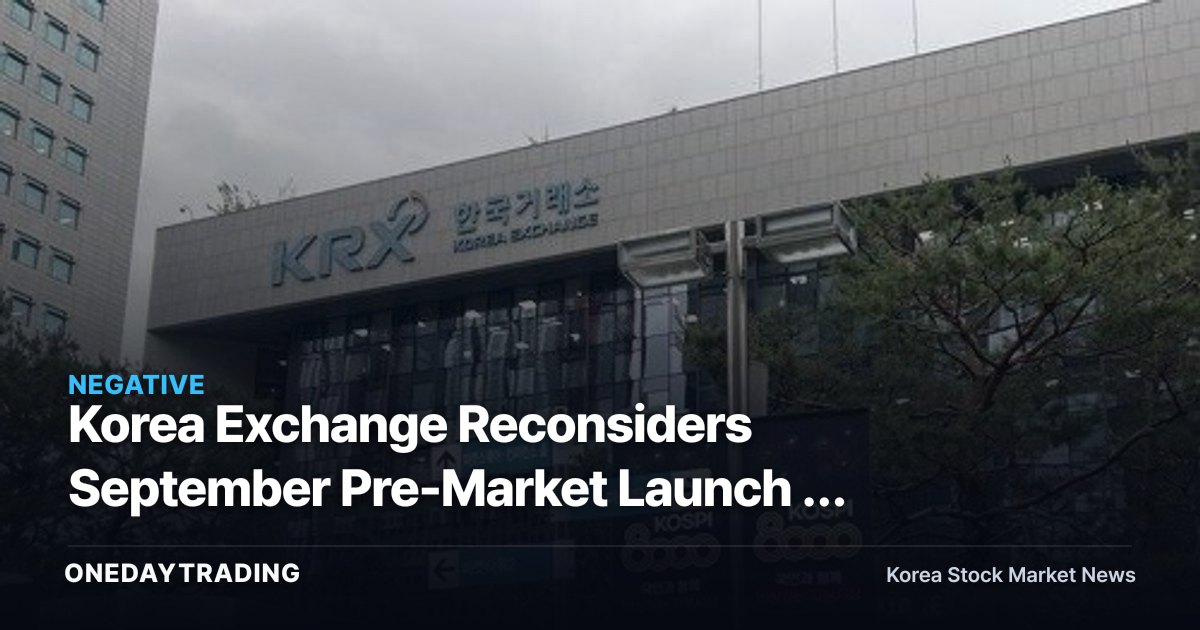
The Korea Exchange (KRX) is taking another look at whether to proceed with the pre-market trading system (trading before the regular session opens) that had been set to launch on September 14. Because expanded trading hours are directly linked to brokerages' brokerage trading value and commission revenue, any shift in the rollout schedule becomes a variable that can shake near-term earnings expectations for retail-heavy brokerage stocks (tickers). The exchange plans to hold a briefing session tomorrow to gather market feedback.
What Happened
The exchange had originally fixed September 14 as the implementation date and had been preparing a pre-market system allowing trading in the hours before the regular session. However, it is reported that, just ahead of the launch, the exchange has shifted back into a stage of reconsidering the introduction itself. Holding a briefing suggests an intent to once again hear from stakeholders across the brokerage industry, system operators, and investor-protection perspectives.
Pre-market trading is common in major overseas markets, but its introduction has also raised concerns such as wider bid-ask volatility, price distortion during thin-liquidity hours, and the need for retail-investor protection measures. The fact that reconsideration began just before the scheduled launch date can be read as a signal that these debates have not been fully settled.
That said, the current stage is a review, not a cancellation, and both a possible launch after schedule adjustments/supplementary measures and a possible postponement remain on the table. It is therefore premature to conclude the system's final form at this point.
Structural Background
The key reason expanded trading hours draw market attention is that trading value directly translates into brokerage revenue. Since brokerage commission income is proportional to trading volume, longer tradable hours raise turnover and, in turn, boost brokerage revenue. This leverage from extended hours is especially pronounced for retail-focused brokerages with a high share of individual (retail investors) trading and turnover.
On the other hand, extending trading hours brings added costs — system stability, overnight/early-morning staffing, and volatility management. If the system is not designed smoothly, both the exchange and brokerages could face operational burdens and complaint risk, which is why cautious and pro-implementation views remain at odds.
Stock (Ticker) and Sector Impact
- Kiwoom Securities: With a high share of retail investors trading and strong reliance on brokerage commissions, this is the stock (ticker) group with the greatest sensitivity in commission income from expanded trading hours. Conversely, if the launch is postponed, the drag on short-term momentum is also relatively larger.
- Mirae Asset Securities · Samsung Securities: With both retail platforms and wealth-management operations, these firms can benefit from higher trading value while also spreading out the burden of volatility management.
- NH Investment & Securities: A large player with a balance between brokerage and investment banking, making its earnings sensitivity to the trading-hours variable more moderate than pure retail brokerages.
- Korea Investment Holdings: As the holding company of Korea Investment & Securities, changes in brokerage turnover flow through to consolidated earnings.
- Trading/clearing infrastructure-related IT: Extended trading hours could spur demand for expanded brokerage trading and risk-management systems, with knock-on effects on financial IT orders.
Bullish vs. Bearish Scenarios
In the bullish scenario, the exchange supplements investor-protection measures and implements the pre-market system as originally scheduled or with only a minor delay. In this case, expanded trading hours act as a clear catalyst that lifts trading-value estimates for brokerage stocks (tickers). In the bearish scenario, the reconsideration effectively results in postponement or indefinite delay, which could trigger a pullback in momentum for brokerage stocks that had partly priced in expectations for the new system. It should also be weighed in a balanced way that brokerage stocks are driven more by overall market trading value and by interest-rate/equity-market direction than by this regulatory variable alone, meaning the share-price impact of the pre-market issue may be limited.
Investor Action Points
- Check tomorrow's exchange briefing results and any subsequent official announcement to see whether the outcome is implementation, delay, or postponement, and if implemented, review the specific schedule and investor-protection provisions.
- The primary gauge for judging brokerage stocks (tickers) is not the regulatory timeline but the trend in average daily market trading value. If trading value is on a rising trend, earnings expectations hold regardless of this regulatory variable.
- In quarterly earnings releases, track brokerage commission income and changes in retail market share to confirm whether the effect of extended hours is actually materializing.
- In case of a postponement, weigh valuation risk and pullback risk for stocks (tickers) that saw a short-term sharp gain (surge) purely on expectations for the new system.
Kiwoom Securities: Real-Time Data Snapshot
Kiwoom Securities's most recent closing price was 350,500 won (-5.01% versus the prior session), and the signal combining foreign investors/institutional investors supply-demand (order flow) with news and momentum reads 🟡 neutral / wait-and-see. With positive and negative signals mixed, this is a name to watch.
- ▲ News flow — positive catalyst 4 vs. negative catalyst 1 — positive catalyst-leaning
Recent related news skews favorable, with 4 positive-catalyst items versus 1 negative-catalyst item.
※ Price and foreign investors/institutional investors supply-demand (order flow) data are provided by Korea Investment & Securities (KIS) and are as of the time of publication.
This article was automatically summarized and analyzed based on the original news source. View original (Yonhap News Securities)