
What the New York Stock Market’s Decline Signals
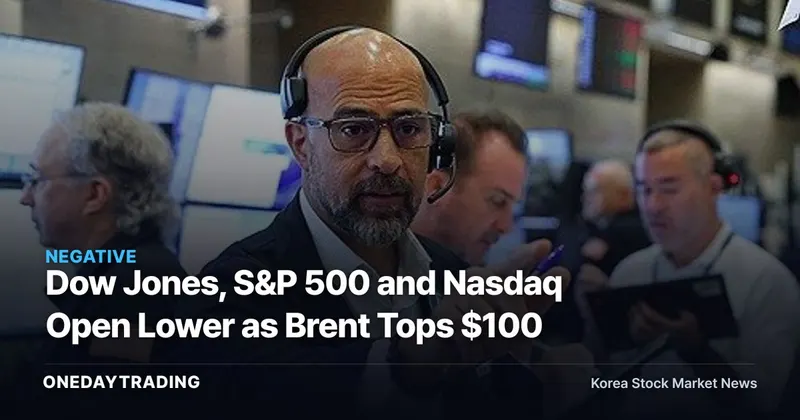
Brent crude futures breaking above $100 lowered the opening price for all three major U.S. stock indexes. Yonhap reported that on Sept. 9, 2026, the Dow Jones Industrial Average, Standard & Poor’s (S&P) 500, and Nasdaq Composite all opened lower as tensions between the United States and Iran continued. The key point for Korean investors is that energy prices and stock (ticker) performance diverged by industry sector, rather than simply focusing on the size of the index declines.
Separating what is confirmed from what is not yet clear makes the picture more distinct. Yonhap reported that higher oil prices and falling stock indexes occurred simultaneously, but the actual causal relationship and future direction between them remain unconfirmed. Therefore, this is a phase in which reactions from indexes, industry sectors, and individual companies should be analyzed separately instead of immediately interpreting a sharp gain (surge) in oil prices as a broader downtrend in equities.
What Happened in New York Trading on Sept. 9
According to Yonhap, at 9:33 a.m. local time on the 9th, the Dow Jones Industrial Average stood at 52,470.35, down 315.72 points, or 0.60%, from the previous session. At the same time, the S&P 500 was 23.89 points, or 0.31%, lower at 7,649.63, while the Nasdaq Composite fell 114.41 points, or 0.43%, to 26,307.01.
The central variable in this session—the oil-price rally—refers to Brent crude futures moving above $100 at the time of the article amid continuing U.S.-Iran tensions. Yonhap reported that West Texas Intermediate (WTI) for October 2026 delivery was up 3.12% from the previous session at $95.93 a barrel at the time of the article. Peter Cardillo, chief market economist at Spartan Capital Securities, also said oil prices were at the center of the market’s moves that day.
Background to U.S.-Iran Tensions and Oil Prices
Yonhap reported that U.S. Central Command (CENTCOM) said the previous day that it had destroyed five Iranian oil tankers in response to an attack by Iran’s Islamic Revolutionary Guard Corps (IRGC) on a U.S. military vessel. The IRGC warned that it would expand its maritime control zone in the Strait of Hormuz. The zone reportedly stretches from near Chabahar in southeastern Iran to parts of the Gulf of Oman and the Arabian Sea, but exact coordinates have not been confirmed.
According to Yonhap, the market has already priced in the continuation of the conflict and the rise in oil prices at the time of the article. What cannot yet be determined is whether the conflict’s future developments and the next direction for oil prices have been priced in. An expansion of the maritime control zone would create conditions for continued tension in oil and stock markets, but the supplied data cannot establish that outcome.
Industry Sectors and Stocks (Tickers) Diverge as Oil Rises
- Energy and technology: Yonhap reported that the energy and technology industry sectors were strong at the time of the article. However, the supplied data do not include sector-specific gains or the impact on individual companies’ earnings, so there is no basis for calculating how sustainable that strength is.
- Consumer goods and financials: Yonhap reported that the consumer goods and financial industry sectors were weak at the time of the article. Their moves matched the index declines, but it has not been confirmed that higher oil prices directly caused weakness in either sector.
- Meta: Yonhap reported that Meta launched its AI agent Muse, and its stock (ticker) price was up 4.25% at the time of the article. It was an example of differentiation driven by individual product news despite broader index weakness.
- Dow: Yonhap reported that Dow’s stock (ticker) price rose 2.54% at the time of the article after reports that it was considering withdrawing from a $20 billion chemical-business partnership with Saudi Aramco. No final decision has been confirmed, so the gain and the fact that the withdrawal is only under consideration must be distinguished.
- Signet Jewelers: Yonhap reported that Signet Jewelers’ second-quarter adjusted earnings per share were $2.19, above the market estimate of $1.74, and its stock (ticker) price rose 18.73% at the time of the article. Confirmed earnings figures had a stronger influence than the broader market’s weakness.
Indicators Korean Investors Should Monitor
- Check whether differentiation among New York industry sectors continues if Brent crude futures remain above the $100 level seen at the time of the article.
- Distinguish whether October 2026 WTI futures maintain their upward trend from $95.93 a barrel at the time of the article or whether the 3.12% gain starts to fade.
- Watch CENTCOM and IRGC’s next statements for signs of an expanded conflict and for the precise coordinates of the maritime control zone.
- Check whether Dow’s consideration of withdrawing from its $20 billion chemical-business partnership with Saudi Aramco turns into a final decision.
The Next Turning Point for Oil and Equities
Yonhap reported that an optimistic scenario would involve the oil rally losing momentum without further escalation in U.S.-Iran tensions. Even then, there is no data to conclude that New York stocks will recover, but the oil-price burden weighing on investor sentiment at the time of the article could ease. Conversely, if the maritime control zone expands and Brent crude futures remain above $100, the gap between energy and non-energy industry sectors could remain the market’s focus.
Europe is also difficult to view separately. Yonhap reported that the Euro Stoxx 50 stood at 6,312.45 at the time of the article, down 1.57% from the previous session, while the U.K. FTSE 100 fell 0.93%, France’s CAC 40 declined 1.54%, and Germany’s DAX dropped 1.44%. The trigger for the next assessment will not be forecasts but the actual direction of oil prices, conflict-related announcements, and industry-sector trends in New York.
Frequently Asked Questions
How did the size of the U.S. Treasury buybacks change?
According to Yonhap, the U.S. Treasury announced last month that it would increase the size of each buyback in the remaining-maturity segment from a previous maximum of $2 billion to at least $4 billion. JPMorgan said some market participants were expecting confirmation of the Treasury’s actual purchase size.
Has the exact scope of the IRGC maritime control zone been disclosed?
Yonhap reported that the IRGC said the zone includes waters from near Chabahar to parts of the Gulf of Oman and the Arabian Sea. However, the supplied data do not confirm the exact maritime coordinates.
Is Dow’s withdrawal from its partnership with Saudi Aramco confirmed?
No. Yonhap reported only that Dow was considering withdrawing from its $20 billion chemical-business partnership with Saudi Aramco; no final decision has been confirmed.
Brent Crude IndicatorAs of 2026-09-10
| Period trend | 1 week +6.92% 1 month +15.37% |
|---|
Indexes, commodities, and exchange rate figures are based on global markets and reflect values at publication.
This article is automatically summarized and analyzed based on the original news report. View original (Yonhap Securities)