
What the Plunge in Samsung Electronics and SK Hynix Signals
Samsung Electronics and SK Hynix fell by more than 4% and 5%, respectively, during the regular session on November 3, 2026. The key takeaway for investors from the moves reported by Yonhap News Agency is not a confirmed change in semiconductor earnings, but that uncertainty over AI investment and foreign selling were simultaneously priced into the stocks. The available data cannot determine the companies’ future earnings or share-price direction.
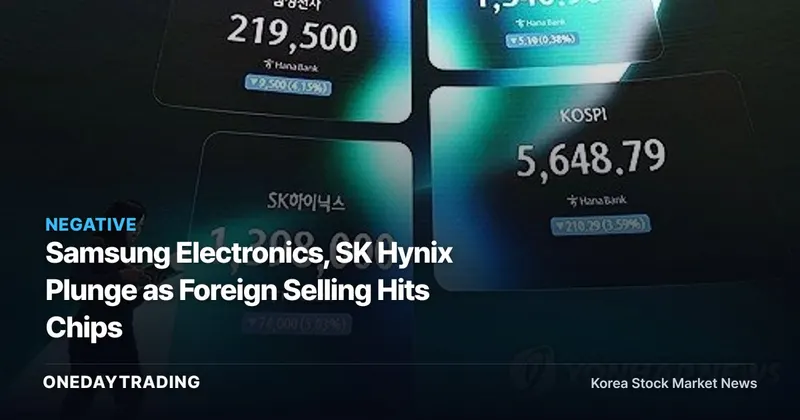
The simultaneous sharp drop (plunge) in semiconductor stocks indicates that price declines at individual companies spread across the industry sector and broader indexes. Samsung Electronics closed at 219,500 won, down 4.15% from the previous session, while SK Hynix fell by more than 5% during the regular session. The KOSPI also ended the day at 5,648.79, down 210.29 points, or 3.59%, from the previous session.
Selling Pressure Intensified After the Open
Samsung Electronics opened at 220,500 won, 3.71% below the previous session, before falling as low as 217,000 won, down 5.24%, intraday. The closing price was above the intraday low but below the opening price. This price trajectory shows that the downward pressure reflected at the open did not ease during the session.
SK Hynix narrowed its loss to 2.65% at 1,433,000 won during the morning session, before trading at 1,379,000 won, down 6.32%, in the afternoon. The provided data does not include its exact closing price or closing price change rate. A direct comparison with Samsung Electronics based on closing losses therefore cannot be made.
Weak U.S. Tech Stocks and Concerns Over AI Investment
In New York trading, Nvidia fell 1.26%, Microsoft 2.83%, and Broadcom 1.18%. AMD dropped 7.52%, Intel recorded -8.83, and the Philadelphia Semiconductor Index closed down 3.37%. This points to broad weakness across U.S. technology and semiconductor stocks, rather than an isolated correction in South Korean chipmakers.
Oracle announced plans to issue $20 billion in stocks and bonds to finance AI infrastructure development, while Anthropic said it plans to spend $895.4 billion on infrastructure purchases and other investments. Planned spending does not necessarily translate into actual profits or semiconductor orders. What the market priced in was less the realized outcome of AI infrastructure expansion than the uncertainty surrounding the enormous capital required.
Foreign Selling Was Concentrated in the Two Chipmakers
In the KOSPI market, foreign investors sold a net 1.5299 trillion won and institutional investors sold a net 514.7 billion won, while retail investors bought a net 1.6644 trillion won. In the KOSPI electrical and electronics sector, foreign investors and institutional investors recorded net selling of 1.154 trillion won and 630.4 billion won, respectively, while retail investors posted net buying of 1.4383 trillion won. This divergence in supply-demand (order flow) was the direct channel connecting the index decline with the correction in semiconductor stocks.
SK Hynix ranked first and Samsung Electronics second among stocks with the largest foreign net selling. Foreign investors sold a net 637.6 billion won of SK Hynix and 206.2 billion won of Samsung Electronics. Morgan Stanley and JPMorgan were also among the leading brokerage channels for selling in both stocks.
How the Impact Spread Through Samsung Electronics and SK Hynix
- Samsung Electronics: The stock closed at 219,500 won, with its intraday loss widening to 5.24%. Combined with 206.2 billion won in foreign net selling, supply-demand (order flow) pressure was evident in short-term price formation.
- SK Hynix: Its intraday loss widened to 6.32% in afternoon trading, while foreign net selling totaled 637.6 billion won, exceeding that of Samsung Electronics. Although a share buyback was underway and other corporations bought a net 334.9 billion won, there was no confirmed reversal into positive territory sufficient to offset foreign selling that day.
- KOSDAQ: The index closed at 704.39, down 29.97 points, or 4.08%, from the previous session. This breadth shows that the decline was not confined to large-cap semiconductor stocks in the KOSPI market.
Conditions Separating Bullish and Bearish Scenarios
The bullish scenario would gain support if net selling by foreign investors and institutional investors in the electrical and electronics sector eases and both stocks recover. For SK Hynix, investors should also watch whether the ongoing share buyback and net buying by other corporations counter foreign selling. These factors do not guarantee gains; they are conditions for assessing whether supply-demand (order flow) is reversing.
The bearish scenario would remain intact if U.S. technology stocks and the Philadelphia Semiconductor Index continue to fall together and foreign net selling expands. Another concern is that the large-scale plans announced by Oracle and Anthropic alone cannot establish the profitability of AI investment or semiconductor demand. No definitive causal relationship was confirmed between the concerns cited in the article and the decline in South Korean shares.
Indicators Investors Should Monitor Next
- Check whether Samsung Electronics and SK Hynix remain among the stocks with the largest foreign net selling.
- Watch whether net selling by foreign investors and institutional investors in the KOSPI electrical and electronics sector diminishes or shifts to net buying.
- Monitor whether weakness continues in the Philadelphia Semiconductor Index and U.S. semiconductor stocks such as Nvidia, AMD, and Intel.
- Because the data does not provide SK Hynix’s exact closing price or closing price change rate, do not compare its decline with Samsung Electronics using unverified figures.
Samsung Electronics Key MetricsAs of 2026-11-03
| Period Returns | 1 Week -1.35% 1 Month -20.65% |
|---|---|
| Trading Value · Trading Volume | 29.3 billion won · 18,692,629 shares |
| Supply-Demand (Order Flow) | Foreign Investors Net selling of 206.3 billion won Institutional Investors Net selling of 38.8 billion won |
| Recent News Tone | 5 positive catalysts · 2 negative catalysts |
Real-time price and supply-demand (order flow) data is provided by Korea Investment & Securities (KIS), while supply-demand (order flow) and news-tone aggregates are calculated independently by One Day Trading.
Supply-Demand and Momentum Assessment🔴 Caution
Foreign-investor, institutional-investor, and momentum indicators are showing negative signals.
- ▼Joint SellingForeign investors sold 206.3 billion won · Institutional investors sold 38.8 billion won
- ▼Trend AlignmentShort- and medium-term trends aligned downward (day -4.4% · 1 week -1.4% · 1 month -20.7%)
- ▲News Flow5 positive catalysts vs 2 negative catalysts — positive catalysts prevail
Upcoming Events to Monitor
- 11.12Index Options ExpirationLowKOSPI200 options expiration
- 11.26Bank of Korea Monetary Policy BoardHighBenchmark interest rate decision meeting
- 12.09FOMC Policy Rate DecisionHighU.S. Federal Reserve monetary policy announcement — direction of interest rates and the dollar
- 12.10Futures and Options ExpirationMediumQuadruple witching — watch for volatility and supply-demand (order flow) disruptions
This content was automatically summarized and analyzed from the original news article. View original article (Yonhap News Agency)