
Summary
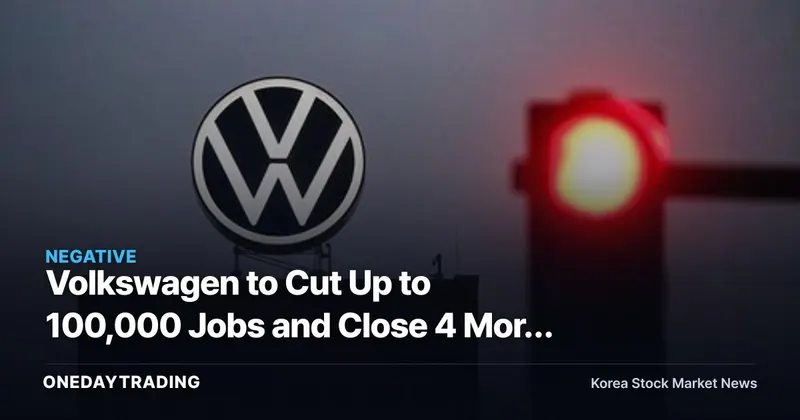
Volkswagen Group's reported plan to cut up to 100,000 workers and shutter four additional plants is more than a single company's cost-reduction exercise — it is a signal that demand across the broader European automotive and EV value chain is decelerating. For Korean investors, the key question is not Volkswagen itself, but how the earnings trajectories of Korean battery makers, automakers, and parts suppliers — those supplying cells to VW or competing against it in European markets — will diverge as a result.
What Happened
Volkswagen Group is pursuing a sweeping restructuring centered on its German home operations. The reported scale — up to 100,000 job cuts and four additional plant closures beyond those already planned — represents a degree of cost reduction that is rare even by European automaker standards.
Multiple pressures are converging. The pace of EV adoption in Europe has come in slower than originally anticipated, weighing on utilization rates at new production lines. The entry of low-cost Chinese EVs into European markets has intensified price competition. At the same time, Germany's elevated labor and energy costs impose a structural burden on per-unit manufacturing expenses, for both internal combustion engine and electric vehicles alike.
While the job cuts and plant closures are a near-term attempt to shed fixed costs and defend profitability, they are also an implicit acknowledgment that European end-market demand has not recovered. Reducing capacity is a signal that forward sales expectations are being set conservatively.
Structural Context
Volkswagen is one of the largest customers of Korea's three major battery manufacturers. A reduction in VW's production capacity could therefore translate into softer cell order volumes — directly affecting the utilization rates and fixed-cost recovery timelines of Korean battery makers that have committed substantial capital to European plant expansions. On the flip side, a structural weakening of Europe's dominant automaker could open competitive space for Hyundai Motor and Kia in terms of market share — two sides of the same coin.
Stock (Ticker) and Industry Sector Implications
- LG Energy Solution, Samsung SDI, SK On: Volkswagen is a key order source for Korea's battery companies. A cutback in European production could lead to slower cell orders and lower utilization at European plants. The more heavily a company's revenue is concentrated in European OEM customers, the more direct the earnings impact.
- Hyundai Motor, Kia: A restructuring by Europe's largest automaker may create a competitive opening. However, if overall European demand is itself contracting, any spillover benefit would be limited — and the risk of simultaneous weakness across the market should not be dismissed.
- Auto Parts Suppliers (electronics, drivetrain components): Korean parts suppliers on the Volkswagen platform face direct exposure to reduced order volumes. Conversely, those with diversified customer bases are better positioned to absorb the shock.
- Materials and Cathode Suppliers: A slowdown in cell demand will eventually flow through — with a lag — to cathode materials, precursors, and other upstream inputs, creating headwinds for momentum across the EV value chain.
Bull vs. Bear Scenarios
The bear case centers on the view that the EV demand slowdown in Europe is structural, and that VW's production cuts will cascade into reduced orders for Korean battery makers and materials suppliers, delaying the recovery of returns on European plant investments. In capital-intensive businesses with high fixed costs, falling utilization rates hit profitability hard.
The bull case holds that VW's cost reductions could eventually restore its price competitiveness, reigniting EV sales and, in turn, recovering cell orders. It also points to the opportunity for Hyundai Motor and Kia to strengthen their European footholds as the dominant local incumbent weakens. Additionally, if EV demand concerns are already substantially priced in, sensitivity to further negative catalysts may be reduced.
Investor Action Points
- Monitor quarterly earnings from Korea's three battery makers for European revenue mix, utilization rates, and management commentary on OEM order trends from customers such as Volkswagen.
- Track monthly European EV registration and sales data to assess whether the demand slowdown is transitory or structural.
- Watch Hyundai Motor and Kia's European market share and incentive trends to determine whether competitive gaps are translating into actual sales gains.
- Treat the formal announcement of restructuring scale and timing — along with any changes to Volkswagen's guidance — as key inflection points for reassessing the intensity of value-chain impacts.
This article is an automatically summarized and analyzed piece based on the original news source. View original article (Yonhap News Finance)