
Summary
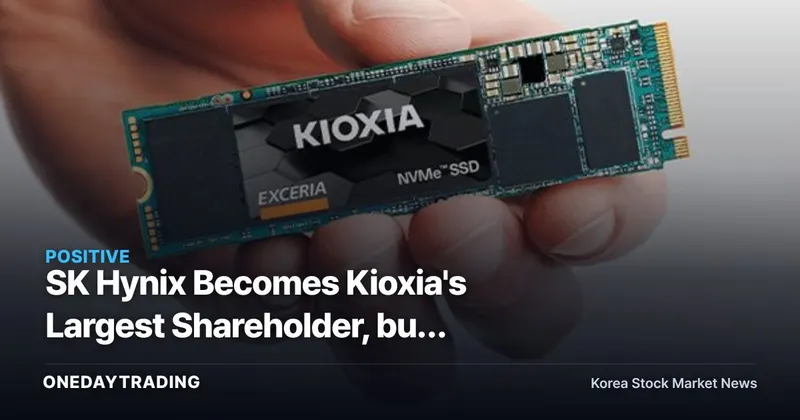
The acquisition consortium backed by SK Hynix has become the largest shareholder in Japanese NAND flash maker Kioxia. The shift occurred as Toshiba continued to sell down its stake to improve its financial structure. If SK Hynix's side converts its convertible bonds (CBs) into common stock, its stake would rise to 14.19% — but the consortium's structure and pushback from Japanese authorities mean this stake won't immediately translate into management control.
How the Shift Happened
The starting point of this reversal in shareholding was Toshiba, not SK Hynix. Toshiba has been gradually selling down its Kioxia stake to improve its financial structure, and as its holdings shrank, the relative stake of the investor group that includes SK Hynix stayed flat or grew. In other words, this isn't a case of a stake changing hands between a seller and a buyer — the ranking flipped because the seller's own position shrank.
The current shareholding alone is on the borderline for cementing the largest-shareholder title, but the moment SK Hynix's side converts its convertible bonds (CBs) into common stock, the stake jumps to 14.19%. In effect, the substance behind the largest-shareholder title lies less in shares currently held than in potential ownership, leaving the timing and scale of CB conversion as the next variable to watch.
Structural Background
The NAND flash market is an oligopoly split among five companies: Samsung Electronics (005930), SK Hynix (including Solidigm), Kioxia, Western Digital (SanDisk), and Micron. Kioxia ranks No. 1 in Japan by semiconductor revenue, making it more than just a financial investment target for SK Hynix — it's a card that could reshape the competitive landscape within the NAND camp itself. This is why the market is reacting so sensitively: if the expanded stake eventually translates into real voting rights and management participation, it could reshuffle the balance of negotiating power across the industry's five major players.
That said, this stake stems from SK Hynix's participation in the 2018 acquisition consortium, and from the outset it carried conditions restricting voting rights and management participation in order to clear antitrust review. In other words, there's a structural gap between holding the largest-shareholder title and wielding actual boardroom influence — and any attempt to close that gap would immediately trigger economic-security review by Japanese authorities.
Impact on Stocks and the Sector
- SK Hynix — There's hope for a re-rating of its Kioxia stake and stronger negotiating power within the NAND camp, but with CB conversion timing still uncertain, the near-term impact on earnings is limited.
- Samsung Electronics (005930) — A governance shift at NAND rival Kioxia could influence coordinated production cuts or increases across the industry, indirectly tying into the NAND pricing cycle.
- Domestic NAND materials and equipment suppliers — If SK Hynix's standing within the NAND camp grows, it could be a favorable long-term signal for order allocation to the domestic supply chain.
Bull vs. Bear Scenarios
In the bull scenario, SK Hynix converts its CBs and gains real influence, such as board representation. That would strengthen the Korean camp's negotiating power within the NAND industry's five-player structure and amplify SK Hynix's voice in coordinating production cuts and pricing policy. In the bear scenario, Japanese authorities continue restricting expanded voting rights on economic-security grounds. In that case, the 14.19% stake would remain purely a financial investment, the management-control premium the market had hoped for would never materialize, and only gains or losses tied to stake-value fluctuations would remain.
Investor Action Points
- Watch for disclosures on the timing and terms of SK Hynix's CB conversion. The volume and timing of conversion will determine the actual stake.
- Track the Japanese government's schedule for foreign investment review announcements. This is the key variable in whether voting-right restrictions get eased.
- Monitor Kioxia's and Samsung Electronics' (005930) NAND production-cut and pricing announcements as well. The actual industry cycle has a more direct bearing on SK Hynix's earnings than the ownership structure does.
- Check whether and how much equity-method gain or loss is recognized in the next quarterly earnings release. That could be the first accounting signal reflecting the change in largest-shareholder status.
SK Hynix in Real-Time Data
SK Hynix's most recent closing price was ₩1,425,000 (0.00% vs. the previous day), and the composite signal — combining foreign/institutional order flow with news and momentum — reads 🟡 Neutral / Wait-and-see. Positive and negative signals are mixed, making this a stretch to watch.
- ▼ Order-Flow Continuity — Foreign investors have been net sellers for four straight days (−₩299.8 billion)
- ▼ Trend Alignment — Short- and medium-term trends aligned to the downside (1-day +0.0% · 1-week -9.6% · 1-month -34.6%)
- ▲ News Flow — 9 positive catalysts vs. 1 negative catalyst — positive catalysts dominate
Recent related news skews favorable, with 9 positive catalysts versus 1 negative catalyst.
※ Price and foreign/institutional order-flow data are provided by Korea Investment & Securities (KIS) and reflect the time of publication.
This article is an automatically summarized and analyzed version based on the original news report. Read original (Maeil Business Newspaper, Corporate)