
Key Takeaways
The key to recapturing the 7,000 level on the KOSPI is not lower volatility, but a recovery in trading. Although August VKOSPI fell to 50.08, average daily trading value slipped to 25.7568 trillion won, a year-to-date low.
What that really says is not that the market has stabilized, but that after leveraged supply-demand (order flow) pulled out, new buyers have not yet stepped in. Kang Si-hyun's view is clear. What has been priced in is easing fear; what has not yet been priced in is the liquidity gap.
What Happened
VKOSPI is an annualized indicator of expected 30-day volatility reflected in KOSPI 200 options prices. Based on Yonhap News reporting, VKOSPI climbed intraday to 97.99 at the end of June 2026, then fell to 50.08 on August 28.
After the financial authorities implemented supplementary measures for single-name leveraged and inverse ETPs on July 31, 2026, the activation of market safeguards also eased. On the securities market, sidecars were triggered 15 times in July and 5 times in August, while circuit breakers were not triggered at all in August.
Even so, the index stalled at the 7,000 level. The KOSPI rose intraday to 9,385.59 on June 19, 2026, then fell intraday to 5,262.77 on July 29, and even after touching 7,216.62 intraday on August 18, it still closed in the 6,000 range.
Background and Context
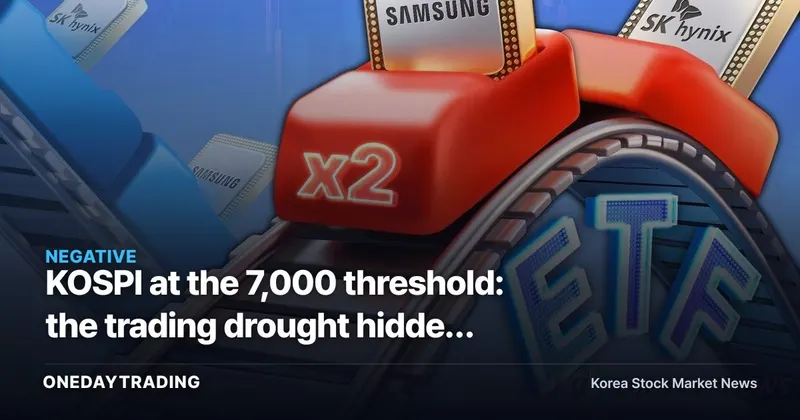
This correction is more about supply-demand (order flow) than interest rates. Single-name leveraged products concentrated trading in large semiconductor names such as Samsung Electronics and SK hynix, and when the semiconductor correction hit, it amplified index swings again.
Authorities raised the base deposit requirement from 10 million won to 30 million won to curb speculative turnover. The policy worked on volatility. But if the space left by leveraged money is not filled by long-term foreign investors, pension funds, and earnings-based institutional investors buying stocks, lower volatility turns into stagnation rather than an upward driver.
Impact on the Market and Stocks
- Samsung Electronics: The center of the KOSPI's concentration in large caps. As leveraged trading eases, short-term sharp gains (surges) and sharp drops (plunges) soften, but lower trading value reduces the fuel for a large-cap-led rally.
- SK hynix: A stock that was hit by both the global semiconductor correction and domestic leveraged supply-demand (order flow). If HBM and AI server demand hold up, the earnings story remains, but the absence of index-style buying limits multiple expansion.
- Kiwoom Securities: It is directly hurt by lower retail trading turnover. The drop in KOSPI turnover from 0.82% in June to 0.54% in August is a signal that brokerage revenue is slowing.
- Mirae Asset Securities: The decline in trading value weighs on brokerage commissions. That said, stable volatility can be supportive for ELS, bond, and wealth-management sales, so the impact differs by business unit.
- KOSPI large-cap exporters: Lower volatility is a positive catalyst because it reduces discount rates, but unless foreign net buying recovers, getting the index to hold above 7,000 will be blocked first by supply-demand (order flow), not earnings.
Investor Checklist
- If Korea Exchange (KRX) KOSPI average daily trading value in September exceeds August's 25.7568 trillion won, part of the liquidity gap can be seen as filled.
- If VKOSPI falls below 50 and stays there, the fear premium will continue to come out. On the other hand, if it moves back above 60, that means anxiety remains even after leveraged trading rules were tightened.
- If foreign net buying in Samsung Electronics and SK hynix continues for more than two weeks, the quality of the rebound improves. A rebound driven only by growing retail margin balances has weak staying power.
- Watch September's additional review of single-name ETPs by the financial authorities together with the won-dollar exchange rate after the Bank of Korea Monetary Policy Board meeting. If the exchange rate turns unstable, foreign supply-demand (order flow) will tighten again.
Outlook
The optimistic scenario is straightforward. Volatility falls, trading value recovers, and the semiconductor earnings outlook does not weaken. In that setup, the KOSPI 7,000 level becomes not a resistance line, but a base for re-rating.
The opposite scenario is more realistic. If trading volume shrinks while investors are only relieved by the drop in VKOSPI, the index will fall back into a range. August turnover of 0.54% is a number that shows the market has lost its fighting power.
It may not be that the KOSPI rose; rather, selling pressure may have just eased temporarily. The next macro triggers are the September Bank of Korea meeting, U.S. inflation data, and the KRW/USD exchange rate level. If rates move higher again, valuation multiples will come under pressure first, and leading stocks will narrow to sectors where earnings are confirmed.
Frequently Asked Questions
Why can't the KOSPI break above 7,000?
The reason the KOSPI cannot hold above 7,000 is trading momentum, not volatility. Based on Yonhap News reporting, average daily KOSPI trading value in August 2026 was 25.7568 trillion won and turnover was 0.54%, both year-to-date lows.
For the index to rise, it is not enough for selling fear to fade. After leveraged money exits, spot buying from foreign investors and institutional investors has to fill the gap.
Is the drop in VKOSPI a positive catalyst for the stock market?
The drop in VKOSPI is a positive catalyst in the sense that fear is easing. The fall in VKOSPI from 97.99 intraday at the end of June 2026 to 50.08 on August 28 means the options market now expects lower near-term volatility.
However, if the decline in VKOSPI does not come with a recovery in trading value, it becomes a signal to wait and watch, not a signal to buy. Even if fear disappears, the index moves slowly when there are no new buyers.
What does this mean for Samsung Electronics and SK hynix shares?
Samsung Electronics and SK hynix were the key axes of both KOSPI concentration and the debate around single-name leveraged ETPs. After the regulations, short-term volatility eases, but for the same reason, rapid inflows can also slow.
Ultimately, both names need confirmation from the semiconductor cycle and spot buying by foreign investors. If AI memory demand holds and foreign net buying continues, they become the first candidates for an index recovery, but if trading value shrinks, share-price momentum will be limited.
Samsung Electronics Key MetricsAs of 2026-08-30
| Period Return | 1 week -8.70% 1 month +23.26% |
|---|---|
| Trading value · trading volume | 3.9259 trillion won · 15,106,746 shares |
| Supply-demand (order flow) | Foreign investors −500.3 billion won net selling Institutional investors −427.3 billion won net selling |
| Recent news tone | positive catalyst 11 · negative catalyst 7 |
Price and supply-demand data are real-time values from Korea Investment & Securities (KIS), and the supply-demand and news-tone counts are calculated by OneDayTrading.
Supply-demand (order flow) · Momentum Assessment🔴 Caution
Foreign investors, institutional investors, and momentum are negative, so caution is needed right now.
- ▼Double sellingForeign investors −500.3 billion won · institutional investors −427.3 billion won in combined selling
- ▲News flowpositive catalyst 11 vs negative catalyst 7 — positive catalyst leads
Upcoming Events to Watch
- 09.10Futures and options simultaneous expirationNormalQuadruple witching — watch for volatility and supply-demand (order flow) disruption
- 09.16FOMC policy rate decisionHighFederal Reserve monetary policy announcement — rate and dollar direction
- 10.08Index options expiration dateLowKOSPI 200 options expiration
- 10.22Bank of Korea Monetary Policy BoardHighBenchmark interest rate decision meeting
This article is automatically summarized and analyzed based on the original news report. View original (Yonhap News Securities)
<