
At a Glance
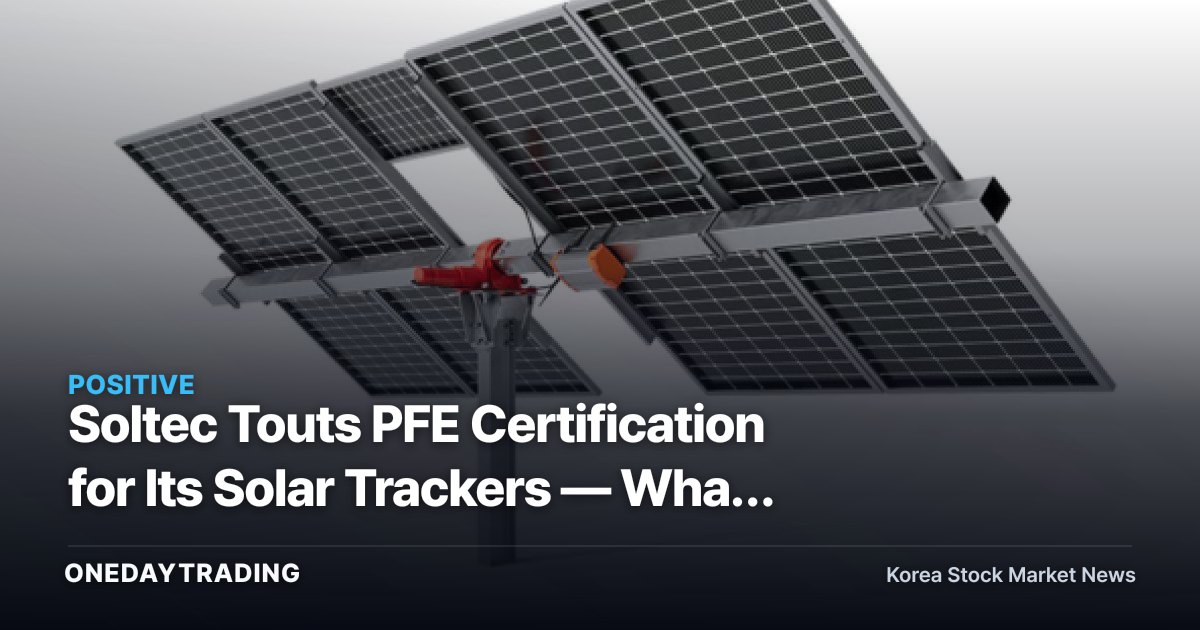
Spanish solar tracker maker Soltec has made the PFE-compliant certification of its sun-tracking mounting systems (trackers) a key marketing point. On the surface it is one company's quality-certification announcement, but it reads as a signal that power-plant buyers are demanding ever-stricter safety and durability standards.
The key takeaway is that certification is becoming a barrier to market entry. Companies that meet standards first earn extra credit in large project bids, while latecomers that fall short are left absorbing redesign costs. For Korean solar stocks, the impact is transmitted indirectly rather than directly.
Why It Matters Now
In large ground-mounted solar, trackers are core equipment that move panel angles to follow the sun's position, boosting power generation for a given footprint. Because they deliver higher generation efficiency than fixed mounts, their adoption has been growing in utility-scale projects across the U.S., the Middle East, and Southern Europe — and that has pushed standards compliance, such as structural safety and resistance to wind load and fire, to the fore as a variable in bid evaluation.
The emphasis on certification matters because of the competitive landscape. The tracker market is decided not by price alone but by standards compliance, track record, and whether a project clears lenders' project-financing review. Companies that secure standards ahead of time stay on the shortlist of eligible bidders, while those with certification gaps are effectively pushed out of contention. This is a shift that moves competition from component pricing toward standards and trust.
That said, this development itself is one company's certification promotion — a qualitative event unaccompanied by concrete figures such as order values or market-share changes, which is a limitation. It is reasonable to view the market impact as a directional read at the thematic level.
Frequently Asked Questions
- Why do trackers matter — they raise generation on the same site, lowering the levelized cost of electricity (LCOE), so they are decisive for the economics of large utility-scale plants.
- Do Korean companies make trackers directly — specialized tracker manufacturing is dominated by overseas players, while Korean firms have greater exposure to modules, polysilicon, and power development. The read-through is therefore indirect.
- Is certification immediately reflected in share prices — a single certification announcement is less a catalyst than a signal of structural change toward standards-based competition.
- Who benefits — high-quality tracker and structure makers that meet standards, and the module supply chains grouped together with them, are relatively favored.
Related Stocks and Sector Impact
- Hanwha Solutions — with solar modules and cells and a U.S. power-generation business, it is the leading Korean stock (ticker) most directly exposed to the trend of tougher utility-scale project standards.
- OCI Holdings — as an upstream materials supply chain including polysilicon, it is tied to demand for premium value chains the more large-project orders align around standards-compliant products.
- HD Hyundai Energy Solutions — with a module-centric business, the strengthening of quality and certification requirements in overseas utility orders acts as a variable in adoption criteria.
- Solar EPC and power-development sector — meeting tracker standards is directly linked to bid eligibility and financing review, feeding into project profitability as a variable.
- Structure and component suppliers — for supply chains tied to tracker mounts and drive units, higher standards simultaneously raise redesign and certification costs and entry barriers.
Points to Watch When Investing
- This announcement lacks quantitative grounds such as order value or market share, making it hard to tie a single certification directly to earnings improvement.
- It should be borne in mind that most Korean stocks (tickers) have module and materials exposure rather than trackers themselves, which dilutes the read-through.
- Policy variables such as the U.S. IRA and tariffs and European subsidies may weigh on short-term share prices more heavily than standards-based competition.
- Cost and financing variables such as polysilicon and module prices, the exchange rate, and project-financing interest rates drive the direction of earnings.
Overall Outlook
From an optimistic view, stronger safety and quality standards could weed out low-cost commodity products and concentrate orders on proven value chains, working favorably for standards-compliant module and materials supply chains. Conversely, the risks are clear. This case amounts to qualitative certification promotion, so earnings visibility is weak, and Korean stocks' direct tracker exposure is limited — meaning there is a pullback risk if thematic expectations get excessively priced in. The checkpoints are next quarter's module and polysilicon shipment results, overseas utility order disclosures, and the U.S. and European policy calendar, and it is reasonable to take an approach that also tracks the exchange rate and materials-price trends.
This article is content automatically summarized and analyzed based on the original news. View Original (Yahoo Finance)