
Key Takeaways
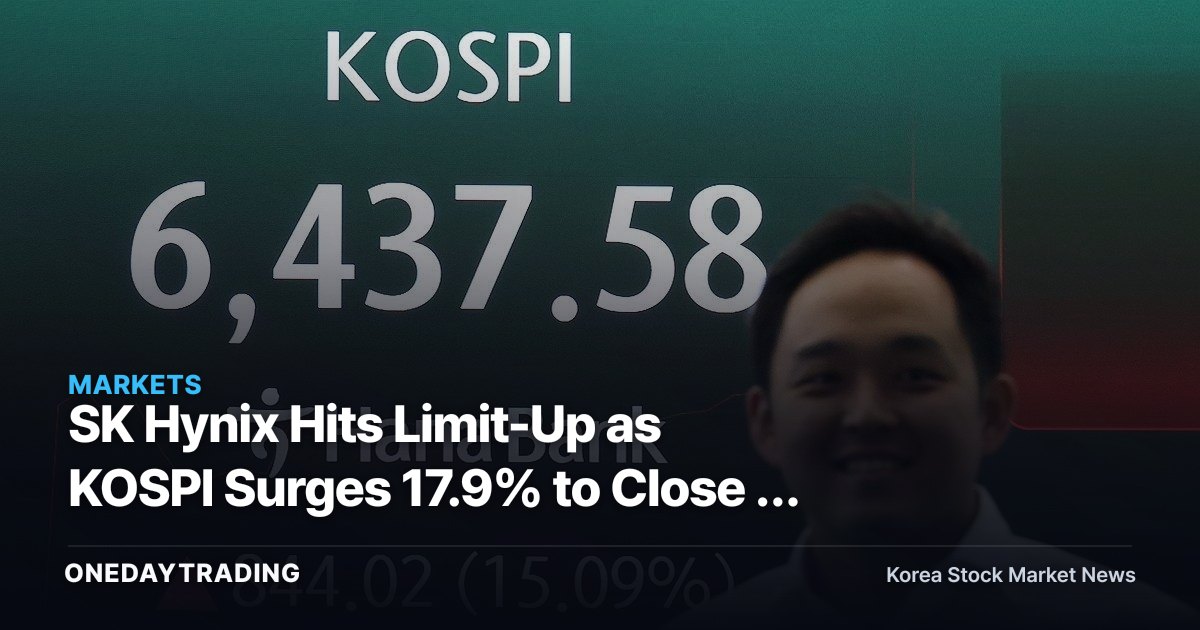
The KOSPI surged 17.9% versus the previous trading session on the 31st, closing up more than 1,000 points. SK Hynix, the second-largest stock by market capitalization, shot all the way up to limit-up (up 29.9% from the previous day), while Samsung Electronics saw strong buying pressure intraday and came close to limit-up itself. The problem is timing. Retail investors who hit the stop-loss button during the preceding sharp drop watched most of the fruits of this rebound slip away before their eyes.
What Happened
An index jumping into the high-teens percentage range in a single day cannot be explained by ordinary supply-demand (order flow). A retracement of this magnitude typically occurs when a sense of oversold conditions coincides with short covering and program buying happening at the same time. If large-cap stocks are what's driving the index higher, then SK Hynix's limit-up and Samsung Electronics' sharp gain (surge) look more like the cause than the result. Given the weight these two stocks carry in the KOSPI's total market capitalization, a large share of this rebound should be understood as a structure in which the retracement of two semiconductor large-caps pushed up the entire index.
More important than the rebound itself is "who sold and who bought." If it was retail investors who dumped shares during the sharp-drop phase, then this rally's gains have already passed into the accounts of other market participants. The fact that the market turned around in a single day does not in itself signal a trend reversal. If anything, the fact that both the drop and the rebound were abnormally large is better read as a sign that the market has yet to find an equilibrium price.
Background and Context
The KOSPI swinging through this much amplitude within a single day is, in itself, a volatility indicator. From a valuation standpoint, one needs to distinguish whether this is simply a return to pre-crash levels or whether new grounds for buying have emerged. If it's the former, this surge is a technical retracement — buying back shares sold cheap; if it's the latter, it means the interest-rate and supply-demand environment itself has shifted. Since no new macro catalyst has yet been confirmed to support the latter, it's reasonable to view the market as still in a confirmation phase.
Impact on the Market and Individual Stocks
- SK Hynix: Hit limit-up and led the rebound, becoming a barometer for whether investor sentiment across the semiconductor industry sector is recovering
- Samsung Electronics: As the No. 1 stock by market capitalization, it accounts for an outsized share of the index retracement, explaining much of the KOSPI's sharp gain
- Semiconductor-related materials, parts, and equipment stocks: May see short-term supply-demand improvement expectations flow in, trailing the sector bellwethers' surge
- KOSPI 200 and semiconductor-related ETFs: Tracking-driven buying and redemption flows tied to the sharp index swing could amplify short-term volatility
- Retail investors with high margin-trading and short-margin exposure: Those forced into margin calls or stop-losses during the preceding sharp drop (plunge) may have been left out of the benefits of this rebound
Investor Checkpoints
- Foreign investor and institutional investor supply-demand trends in the next trading session — to confirm whether this rebound is driven by program buying or a genuine shift to real buying
- Next-day trading volume and order-book depth for SK Hynix and Samsung Electronics — to gauge whether selling emerges after limit-up, which would determine how durable the rebound is
- KRW/USD exchange rate levels — if the surge was accompanied by foreign net buying, the direction of the exchange rate will determine whether that flow persists
- The schedule for the next Monetary Policy Board meeting and key economic indicators — to check whether new macro catalysts emerge to support this rebound
Outlook
The optimistic scenario is one in which this surge goes beyond resolving oversold conditions and turns into a genuine inflow of new buyers. In that case, there is room for a sustained rebound centered on semiconductor large-caps. The risk scenario is that this rebound turns out to be nothing more than a one-off retracement driven by short-term supply-demand. In a market capable of swinging 17.9% in a single day, a retracement of the same magnitude could just as easily happen again. If the pattern repeats — investors who stopped out during the crash now chasing the rally too late — volatility could actually intensify in the next phase.
SK Hynix: Real-Time Data Snapshot
SK Hynix's most recent closing price is KRW 1,718,000 (up 29.95% from the previous day), and the composite signal combining foreign/institutional investor supply-demand (order flow) with news and momentum reads 🟢 Buy-leaning. With foreign investors, institutional investors, news flow, and momentum all positive, this is a stock worth watching.
- ▲ Dual buying — Foreign investors +KRW 3,588.3 billion and institutional investors +KRW 544.7 billion in combined net buying
- ▲ News flow — 14 positive catalysts vs. 8 negative catalysts — positive catalysts dominate
Recent related news skews favorable, with 14 positive catalysts versus 8 negative catalysts.
※ Price and foreign/institutional investor supply-demand data are provided by Korea Investment & Securities (KIS) and are current as of publication time.
This article is automatically summarized and analyzed content based on the original news report. View original (Maeil Business Newspaper, Securities)