
Key Takeaways
In a structure where the vast majority of Korea's import-export volume passes through its ports, a port's handling capacity is not a mere administrative issue but a variable directly tied to the delivery schedules and costs of exporting companies. The fact that ports run around the clock without stopping is a question of the utilization rate across the entire supply chain — from shipping to port operations to inland logistics — and it bears directly on the earnings strength of logistics stocks such as HMM, Hyundai Glovis, and CJ Logistics.
What Happened
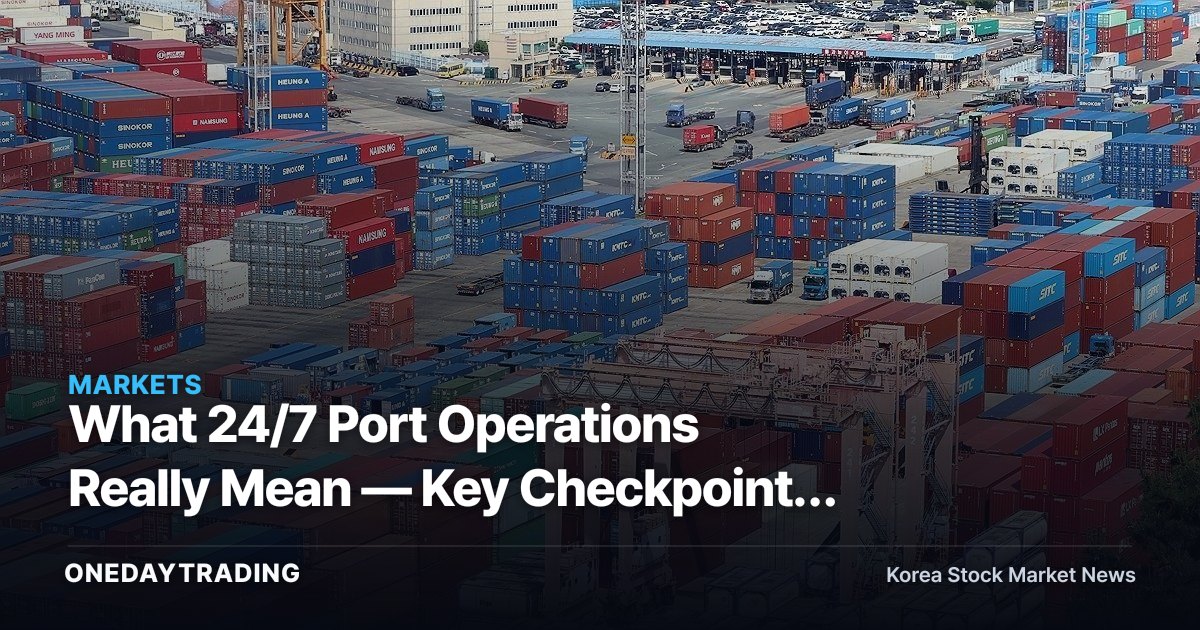
The Ministry of Oceans and Fisheries, which has relocated to Busan, marked its 30th anniversary with a feature highlighting how port logistics actually works. The core message is clear: when ports clog up, exports grind to a halt. Container ship arrivals and departures, cargo handling, storage, and inland transshipment must run seamlessly 24 hours a day for import-export cargo to flow on schedule.
Korea has an economic structure with a high dependence on trade, and most of its import-export cargo is transported by ship. In other words, the efficiency and stability of port infrastructure is not the concern of any single company but a foundational facility that affects the costs and competitiveness of the entire manufacturing and export sector. Among these, the Port of Busan is a Northeast Asian hub with a large share of transshipment cargo, making it highly sensitive to shifts in the port-of-call patterns of global shipping alliances.
Background and Context
Port logistics is typically a cyclical industry sector with large swings between boom and bust. The profitability of shipping companies fluctuates sharply depending on global trade volume, freight rate indices, and whether there is an oversupply of vessel capacity. Port operations and inland logistics, by contrast, tend to have a relatively stable revenue structure based on cargo volume, so even within the same logistics theme, it is worth distinguishing that earnings volatility differs by business segment.
Impact on the Market and Stocks
- HMM: As Korea's largest container carrier, it is directly exposed to port handling efficiency and the freight rate environment. When freight rate indices are rising, strong operating leverage kicks in, but conversely, in a phase of vessel oversupply, falling freight rates can quickly erode earnings — a double-edged structure.
- Hyundai Glovis: Engaged in finished-vehicle maritime transport and integrated logistics, it is linked simultaneously to export cargo flows and the auto industry cycle. Its strength is stable revenue based on group-affiliate volume, but that same reliance on downstream industries is a variable.
- CJ Logistics: As an integrated logistics operator spanning port cargo handling, inland transport, and parcel delivery, its path to benefiting from rising cargo volume is relatively direct.
- Pan Ocean and Korea Line: Centered on bulk shipping, they ride a different freight rate cycle from container carriers and are more sensitive to commodity trade volumes and charter market conditions.
- Export manufacturing broadly: Companies with a large export share — such as semiconductors, autos, and chemicals — see indirect benefits as port efficiency translates into on-time delivery and lower logistics costs.
Investor Checkpoints
- Freight rate indices: Regularly track the trends of the Shanghai Containerized Freight Index (SCFI) and the Baltic Dry Index (BDI), using them as leading indicators for the direction of shipping stocks' earnings.
- Cargo volume statistics: Monitor monthly container throughput and changes in transshipment share as reported by the Busan Port Authority and others.
- Quarterly earnings: Since freight rate swings are immediately reflected in shipping stocks' results, look at operating profit margins together with guidance in the next earnings release.
- External variables: Keep an eye on a slowdown in global trade, route changes driven by geopolitical risk, and fuel cost trends that move with oil prices.
Outlook
In a phase where trade volume recovers and freight rates show strength, shipping stocks see greater earnings elasticity, and integrated logistics firms can also benefit from rising cargo volume. The key risk, however, is that container carriers face an ever-present concern of vessel oversupply from newbuilding deliveries, and if freight rates fall, the burden of fixed costs can quickly pressure profitability. Stable port infrastructure operations are the foundation of industrial competitiveness, but since that does not in itself guarantee a rise in any individual logistics stock's share price, an approach that weighs the freight rate cycle against valuation pressure is needed.
HMM Through Real-Time Data
HMM's latest closing price is 20,150 won (-1.47% versus the prior day), and the traffic-light signal — combining foreign and institutional order flow with news and momentum — is 🔴 Caution. With foreign investors, institutional investors, and momentum all negative, caution is warranted right now.
- ▼ Dual-engine selling — foreign investors −1.8 billion won and institutional investors −2.8 billion won selling in tandem
- ▲ News flow — 6 positive catalysts vs. 0 negative catalysts — positive catalysts dominate
Recent related news is favorable, with 6 positive catalysts and 0 negative catalysts.
※ Price and foreign/institutional order-flow data are provided by Korea Investment & Securities (KIS) and are as of the time of publication.
This article is content automatically summarized and analyzed based on the original news report. View original (Yonhap News)