
At a Glance
Henry Ford's mass production of the Model T turned the automobile from an aristocrat's luxury into an everyday item for the middle class, but the more important implication for investors lies in how cost reduction and mass standardization reshape an entire industry's profit structure. More than a century later, the same mechanism is at work again amid EV price competition and rising labor-cost burdens.
Given that the valuations of automakers like Ford (F) and Hyundai Motor/Kia ultimately come down to a function of per-unit margin and production efficiency, this historical case is not merely an anecdote but a useful framework for analyzing today's auto stocks (tickers).
Why It Matters Now
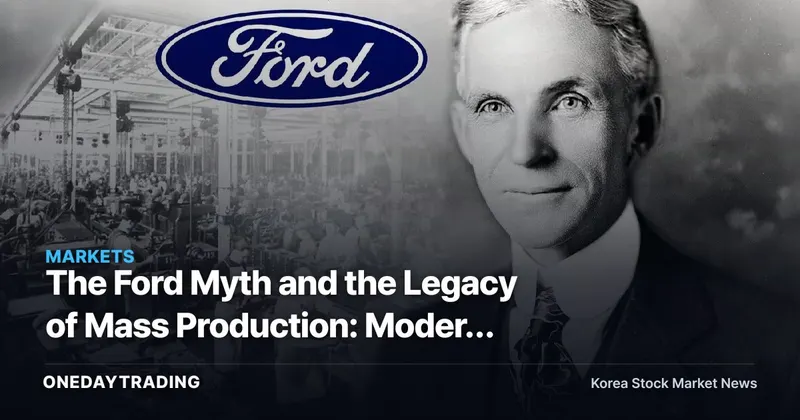
The key to Ford's introduction of the conveyor-belt assembly line — which dramatically cut Model T production time and lowered prices — was spreading fixed costs across mass sales volume. As the cost per vehicle fell, demand surged, creating a virtuous cycle that further reinforced economies of scale. This structure is fundamentally the same as today's EV makers' strategy of scaling up production to lower battery and platform unit costs.
At the same time, Ford is famous for dramatically raising worker wages so his own employees could afford to buy the cars they built. This reflected a view of labor cost as a demand driver rather than a pure expense — but conversely, it also means the automaker industry started out structurally burdened with high labor costs. The U.S. auto industry's recurring clashes with the United Auto Workers (UAW) are an extension of this legacy.
This matters for Korean investors because U.S. automakers' labor-cost and labor-relations variables directly affect the relative cost competitiveness of Hyundai Motor and Kia. If UAW negotiations push up hourly labor costs at the U.S. Big Three, the pricing and margin position of Korean automakers competing in the same market could stand out by comparison.
FAQ
- Why does a 100-year-old story matter for investing? Because Ford's formula of mass production and cost-spreading applies directly to today's EV scale race. The principle that production efficiency determines margin hasn't changed.
- What kind of cost does the UAW dispute represent? Wage and benefit increases raise the per-unit fixed cost for U.S. automakers. If a full-scale strike like the one in 2023 recurs, production disruption and profitability pressure would hit simultaneously.
- Is this a positive catalyst for Korean automakers? Rising U.S. labor costs could highlight the relative cost advantage of Hyundai Motor and Kia, but the effect depends on the exchange rate and the share of U.S. local production.
- How does this relate to the EV transition? Ford's economies-of-scale logic is being replayed in battery and platform unit-cost competition, and whichever manufacturer secures scale gains pricing power.
Related Stocks (Tickers) and Sector Impact
- Ford (F): The subject of the article. A traditional internal-combustion powerhouse now carrying both the EV transition and labor-cost burdens at once, with per-unit margin and pickup truck profitability as key variables.
- General Motors (GM): As a fellow member of the U.S. Big Three, it shares UAW negotiations and labor-cost structure with Ford, giving it similar cost sensitivity.
- Hyundai Motor: As it expands U.S. market share, the Big Three's labor-cost burden could work as a relative competitive advantage. Utilization rates at its U.S. local plants are a key point to watch.
- Kia: North American margins are improving on its SUV and EV lineup, but its resilience will be tested if price competition intensifies.
- Tesla (TSLA): The most aggressive practitioner of the mass-production, cost-reduction formula, driving price cuts and acting as a margin-pressure factor across the entire auto industry.
Investment Considerations
- Automaker stocks (tickers) are a cyclical sector whose demand fluctuates with interest rates and consumer sentiment. Watch new-vehicle sales volumes alongside incentive (sales promotion) trends.
- If EV price competition drags on, per-unit margin can erode even as top-line growth continues, so investors should prioritize checking the direction of operating profit margin over revenue.
- Korean automakers with a large U.S. business exposure see earnings swing significantly with the won-dollar exchange rate level. Exchange-rate moves should be interpreted separately from underlying earnings.
- Since UAW negotiation schedules and outcomes are typically pre-disclosed through filings and news, it is safer to confirm whether there is a structural shift in cost structure rather than betting on short-term events.
Overall Outlook
Under the optimistic scenario, rising U.S. automaker labor costs and the EV scale race could actually enhance the relative appeal of more efficient Korean manufacturers. If Hyundai Motor and Kia can defend both market share and margin in North America at the same time, there is room for a valuation re-rating. Conversely, if EV price-cutting competition intensifies and global demand slows, even manufacturers with scale will struggle to avoid margin erosion. A reasonable way to monitor this is to track three things side by side: next quarter's per-unit margin, the outcome of UAW negotiations, and the won-dollar exchange rate.
This article was automatically summarized and analyzed based on the original news report. View original (Maeil Business Newspaper, Corporate)