
At a Glance
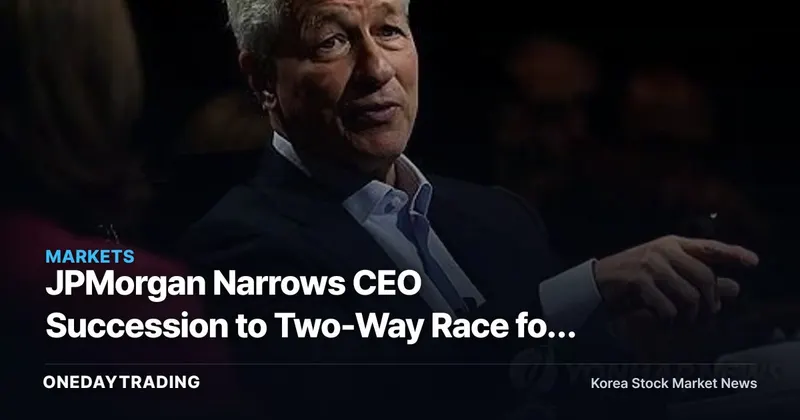
JPMorgan Chase has narrowed its search for a successor to CEO Jamie Dimon down to a two-candidate race. The replacement of Dimon — who has led the largest U.S. bank for roughly two decades — is not merely a personnel matter; it is an event that will help gauge investor sentiment toward global financial stocks and the direction of capital-allocation and risk strategy at large U.S. banks. For Korean investors, it is a signal to review U.S. bank ETFs alongside stocks sensitive to exchange rates and interest rates.
Why It Matters Now
Dimon is widely credited with building JPMorgan into the industry leader in both assets and profitability through the 2008 financial crisis and the COVID shock. Because the market has come to regard him as a kind of stability premium, his replacement could heighten uncertainty over management continuity. Given how heavily the company has relied on a single CEO, the succession process itself becomes a source of share-price volatility.
That said, the fact that the candidate field has been consolidated into a two-person race centered on internal executives — rather than an outside hire — suggests continuity of the existing course is more likely than a sharp shift in strategy. Whoever is ultimately chosen, the key thing to watch is how they will balance core business units such as lending, trading, and asset management. Because earnings at large U.S. banks hinge on net interest margins, investment banking (IB) fees, and provisioning policy, the new CEO's priorities will effectively form the basis for any re-rating of the valuation.
Frequently Asked Questions
- Does a succession automatically amount to a negative catalyst for the stock? Not necessarily. If a vetted internal executive takes over, strategic continuity is maintained and the impact may be limited — but the uncertainty before the appointment is confirmed does heighten short-term volatility.
- Will Dimon step down immediately? Successions typically proceed in stages, and during transition periods there are many cases where the outgoing leader retains influence through a role such as chairman. Investors should check the specific timeline and any changes in title.
- What does this have to do with the Korean market? Trends at large U.S. banks reflect global risk appetite and investor sentiment toward financial stocks, and can therefore indirectly affect foreign investors' order flow into domestic bank and brokerage stocks.
- Is this separate from earnings? It is a corporate-governance issue, but the new CEO's capital-allocation, dividend, and buyback policies could change the scale of future shareholder returns — linking it to earnings assessments.
Impact on Related Stocks and Sectors
- JPMorgan Chase — The direct subject of the issue. A re-rating of its governance premium is underway ahead of a confirmed succession, with potential for heightened short-term volatility.
- Large U.S. banks (Bank of America, Wells Fargo, etc.) — A leadership transition at the industry's No. 1 player shakes up the benchmark for relative valuation comparisons among peer banks.
- Investment banks (Goldman Sachs, Morgan Stanley) — In the IB and trading competitive landscape, whether JPMorgan changes its strategy will affect market-share expectations.
- Domestic financial stocks (banks, brokerages) — Potential for indirect linkage via investor sentiment toward global financial stocks and foreign investors' order flow.
Points to Watch When Investing
- Governance events are directionally ambiguous, so overly aggressive bets before a confirmed announcement carry significant volatility risk.
- U.S. bank stocks are more sensitive to the interest-rate and net-interest-margin cycle, so don't judge them on the succession issue alone.
- Until the new CEO's first earnings release and shareholder-return policy guidelines emerge, it is difficult to draw firm conclusions about any actual change in strategy.
- Exchange rates and the level of long-term U.S. interest rates may be bigger variables for foreign investors' order flow into financial stocks.
Overall Outlook
The optimistic scenario is one in which a vetted internal executive takes over smoothly, preserving strategic continuity and stable shareholder returns — in which case the removal of governance uncertainty could itself serve as a catalyst for a re-rating. Conversely, if the appointment is delayed, key personnel depart, or market concerns over reliance on Dimon come to the fore, short-term volatility will rise. For investors, the sensible approach is to respond by checking, in order, the succession-timeline disclosures, the new CEO's capital-allocation direction, and the next quarter's earnings along with dividend and buyback policies.
This article is content automatically summarized and analyzed based on the original news report. View original (Yonhap News, Securities)