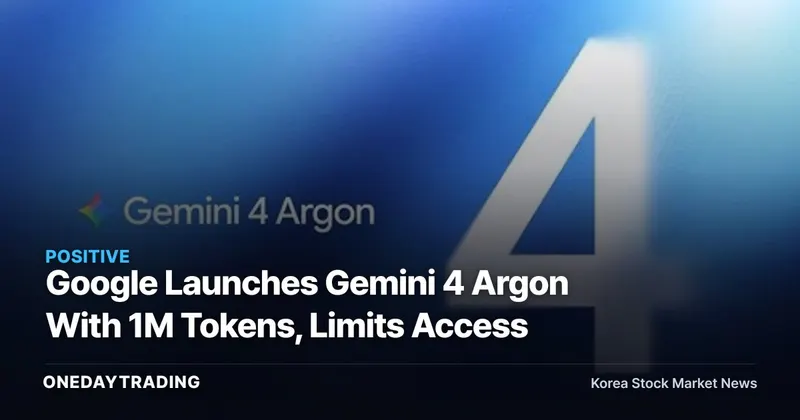

Google Gemini 4 Argon Sends Alphabet Shares Higher
For Alphabet investors, this announcement means more than simply a renewed race for AI performance. According to Yonhap News Agency’s financial news coverage, Google launched its next-generation flagship AI model, “Gemini 4 Argon,” on the 30th local time, but decided to restrict access for general users for the time being. Technical evaluations have begun and the share price has moved, but the actual rollout scope and usage fees have yet to be quantified.
Gemini 4 Argon is Google’s flagship AI model, with an expanded output capacity designed to handle complex, extended tasks. Investors should distinguish between the model’s capabilities and the extent to which those capabilities are made available to users. The former is reflected in benchmarks and token limits, while the latter remains constrained by phased access.
The Significance of a New Flagship Model After About Seven Months
The fact that Google added a flagship model roughly seven months after releasing Gemini 3.1 Pro in February 2026 suggests that the lull in product competition is effectively over. Given that Google had released only lightweight models for more than six months before the launch, the announcement provides grounds for reassessing Alphabet’s AI competitiveness.
This also explains the market’s immediate reaction. Alphabet shares posted a sharp gain (surge) of more than 3% within minutes of the model’s launch being reported. As of 5:50 p.m. Eastern Time, the stock was trading around $348, up 1.2% from its closing price. The smaller gain compared with the initial reaction shows that a valuation gap remains between expectations for the technology and confirmation of its commercial potential.
One Million Tokens: Focus on Availability, Not Just Performance
Google expanded Gemini 4 Argon’s output limit from 64,000 tokens to 1 million tokens. This figure represents more than simply longer responses; it expands the scope of work that can be processed in a single request. For tasks such as coding and analysis that generate lengthy outputs, the output limit can determine whether a task can be completed end to end.
However, there is no basis yet to conclude that the 1 million-token limit will immediately translate into higher revenue or broader adoption. Google has not disclosed the model’s price, usage fees, or full rollout scope. Expanded access would provide evidence for assessing the potential user base, but if restrictions remain, the higher output limit will continue to represent technical potential rather than near-term commercialization.
Benchmark Strengths and Differing Evaluation Criteria
- Gemini 4 Argon scored higher than OpenAI and Anthropic models on “DeepSWE v1.1” and “VibeCode Bench.”
- It ranked at a joint first-place level with GPT-6 Astra on cybersecurity evaluations including “CWE-Bench v1.”
- AI model evaluation company Artificial Analysis assigned Gemini 4 Argon an Intelligence Index score of 53, placing it in a tie for third.
- Specific raw scores for the individual performance metrics were not provided, making it impossible to compare the extent of its lead.
An easily overlooked point is that different evaluations produced different conclusions. Leading results in certain coding and security benchmarks do not conflict with a joint third-place ranking on the overall Intelligence Index. Because each evaluation measures different capabilities, investment decisions should focus on which advantages were demonstrated in specific tasks rather than relying on a blanket claim of “best performance.”
Implications and Constraints for Alphabet
- Alphabet: The launch of a flagship model and the subsequent rise in the share price confirmed market expectations for the company’s AI competitiveness. The narrowing of the gain from more than 3% to 1.2% at the stated time also signals that the market wants further validation.
- AI model competition: Coding benchmarks that exceeded the scores of OpenAI and Anthropic models provide evidence that Google has demonstrated a comparative advantage in specific technical areas. Because it tied for third in the overall evaluation, it is too early to interpret the results as superiority across every area.
- Cybersecurity applications: Google plans to provide priority access to vetted cybersecurity professionals through its “Fairwind Program.” The selection criteria have not been disclosed, leaving insufficient information to estimate the actual scope of access.
Phased Access Defines the Limits of the Investment Case
Koray Kavukcuoglu, a senior vice president who leads Google DeepMind, said, “A phased approach is necessary to safely release cutting-edge capabilities at this level.” He added that access would be expanded gradually and that Google was voluntarily participating in the U.S. government’s model pre-submission process.
Although these safeguards govern how advanced models are released, they also make it harder for investors to assess the pace of commercialization. With both the date for general-user access and the specific criteria for selecting experts still undecided, investors should not use benchmark results alone to estimate the pace of adoption.
The Next Metric to Watch Is Deployment, Not Ranking
- The specific date when access will be opened to general users
- Whether pricing and usage fees for Gemini 4 Argon are disclosed
- The Fairwind Program’s expert selection criteria and scope of access
- Whether the full rollout actually expands
In the optimistic scenario, Gemini 4 Argon maintains its strengths in coding and cybersecurity benchmarks while access broadens. In the opposing scenario, limited availability persists, delaying evidence that its technical achievements can translate into meaningful user scale. Alphabet’s share price has already rewarded the launch itself. The next question is who will gain access to Gemini 4 Argon, under what terms, and how broadly it will be deployed.
This article was automatically summarized and analyzed based on the original news report. View the original article (Yonhap News Agency Financial News)