
3-Line Briefing
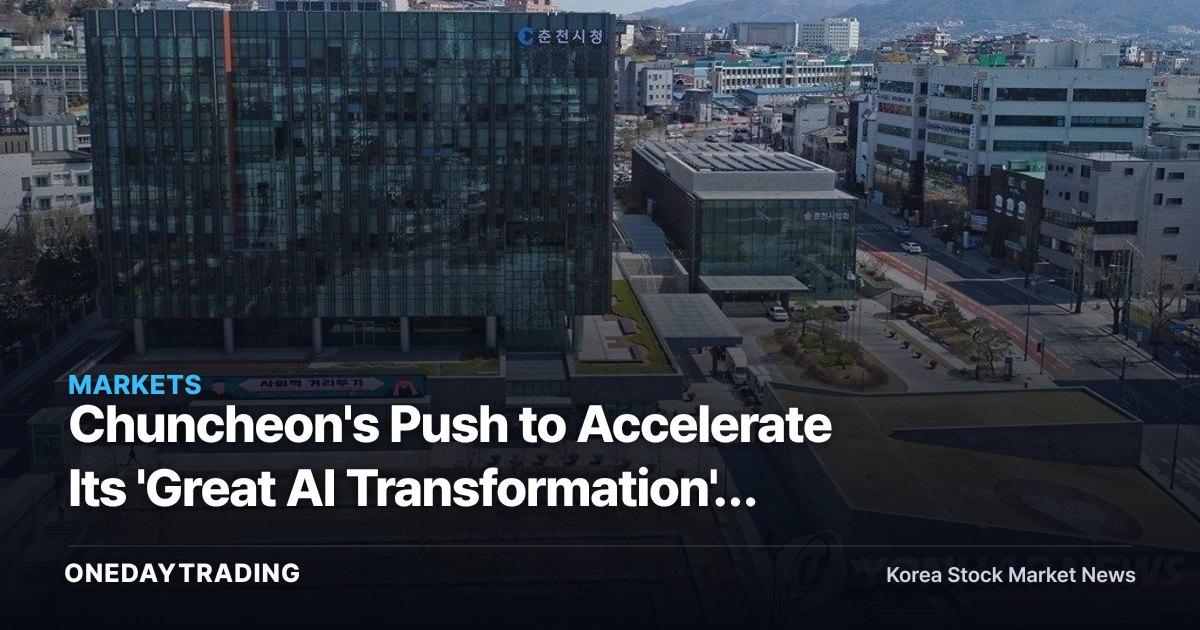
- Chuncheon City is launching a Chuncheon-style Great AI Transformation that applies AI to care, safety, transportation, and administration—and now extends to the biotech industry.
- Public-sector AI demand driven by local governments is not a one-off event but a structure that leads to system development, operation, and data projects, creating medium- to long-term opportunities for related software and bio-infrastructure companies.
- That said, given that public projects rely heavily on local government budgets, their profitability and sustainability require verification, so approaching them on theme-driven expectations alone is risky.
What Is Changing
The crux of this announcement is that AI has been elevated from a tool for specific departments to a city-operations framework spanning care, safety, transportation, administration, and industry. From an investor's perspective, the important shift is in the nature of the demand. As local governments move from a stage of sporadically adopting individual solutions to demand for integrated platforms that bind and operate city-wide data, both build-out unit costs and the scale of maintenance contracts grow in tandem.
In particular, the plan to combine AI with Chuncheon's existing biotech industry base is qualitatively different from mere administrative digitalization. In drug development, diagnostics, and healthcare, AI works directly in areas that determine costs and development timelines—such as candidate compound discovery, clinical data analysis, and diagnostic assistance. If a regional bio cluster internalizes AI analytical capabilities, a pathway emerges for improving the research efficiency of resident and partner companies.
Viewed from the other side, however, this is closer to a "statement of intent by a local government," and the actual order size, schedule, and contractor selection method have yet to be disclosed. Because this is a field with a wide gap between policy declarations and actual execution, it requires a perspective that distinguishes thematic expectations from real revenue.
Reading the Numbers and Context
This matter is an announcement at the policy-promotion stage, with no specific project budget or order size presented. It is therefore difficult to draw firm conclusions about figure-based earnings effects. Instead, it should be read in context. Amid a spreading trend of local governments nationwide adopting AI in administration, welfare, and transportation, the Chuncheon case—targeting both care and bio simultaneously—can be seen as an indicator that public AI demand is broadening across both welfare and industry.
Beneficiary and Affected Stocks
- Public and administrative AI solution companies: With a structure in which winning local-government integrated platform, chatbot, and civil-service automation contracts translates directly into revenue, they hold the most direct path to benefit if orders expand.
- AI healthcare and medical data analytics companies: If demand for integration with the bio cluster materializes, collaboration opportunities will emerge in diagnostic assistance and clinical data.
- Cloud and data center infrastructure providers: Since demand for the computing and storage infrastructure that underpins AI operations follows, there is potential for indirect benefit.
- Smart city, CCTV, and traffic-control equipment companies: Applying AI to safety and transportation could connect to upstream demand, with increased orders for video analytics and sensors.
- Small and mid-sized pharma and diagnostics companies linked to the regional bio cluster: There is room to improve development efficiency by internalizing AI analytical capabilities, but their small scale limits the impact.
Risk Check
- With specific budgets and order schedules undisclosed, the timing and scale of actual revenue contribution are uncertain.
- Public projects face fierce bidding competition and low margins, so winning a contract does not immediately translate into profitability.
- Project sustainability can hinge on changes in local government fiscal conditions and policy priorities.
- The valuation burden of the AI and bio themes themselves is heavy, so volatility could widen if expectations are priced in ahead of time.
Bottom Line
The trend of local-government AI demand broadening from welfare to industry is a favorable backdrop for the public AI and healthcare ecosystem, but until order sizes and profitability are confirmed, it is safer to approach by separating thematic expectations from earnings.
This article is content automatically summarized and analyzed based on the original news. View original (Yonhap News, Industry)