
Summary
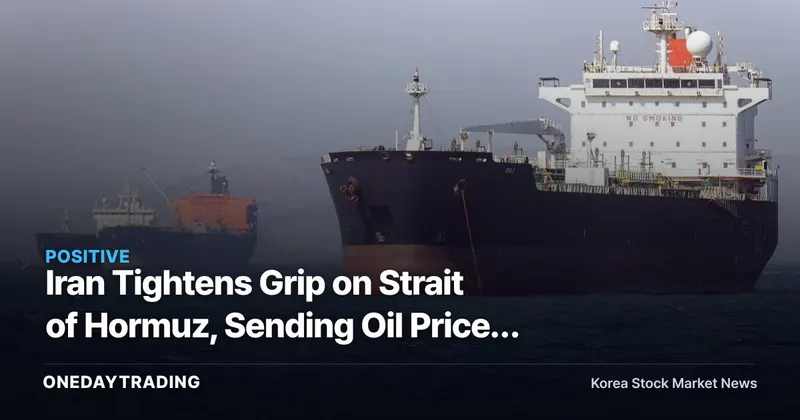
As Iran shows signs of tightening its grip on the Strait of Hormuz, international oil prices are bouncing higher again. This is more than a geopolitical headline — it's a variable reshaping the cost structure and margins across Korean industries that buy, refine, transport, and consume crude oil. The key issue isn't the rise in oil prices itself, but the differentiation between who sees wider margins and who faces rising costs.
What Happened
The Strait of Hormuz is a bottleneck through which a significant share of the world's seaborne crude oil volume passes. As signals emerged of Iran flexing its influence over this waterway, the market began pricing in the possibility of supply disruption even without an actual blockade. Even without physical obstruction, rising insurance premiums, freight rates, and detour costs push up the effective price of oil.
What matters here is that this rally isn't being driven by strong demand — it's a risk premium created by supply-side uncertainty. Gains of this nature tend to be highly volatile and can quickly reverse once tensions ease. In other words, investors need to distinguish between a sustained uptrend and an event-driven spike.
Structural Background
Korea is a pure net importer that depends on the Middle East for most of its crude oil. Hormuz-related risk translates directly into higher import unit costs and pressure on the trade balance and inflation. At the same time, higher oil prices can temporarily widen refining margins (crack spreads), which can be a positive for refiners' earnings — meaning the same event produces opposite profit-and-loss outcomes across industries.
Impact by Stock and Sector
- Refining (S-Oil, SK Innovation, GS, HD Hyundai Oilbank): Could see near-term benefits from inventory valuation gains and wider refining margins. However, this is a double-edged sword — a sharp reversal in oil prices could flip these into inventory losses.
- Airlines (Korean Air, Asiana, Jeju Air): Since fuel costs are a major component of operating expenses, rising oil prices are a direct cost burden. The hedge ratio and the speed of passing costs through via fuel surcharges will be key to defending earnings.
- Shipping (HMM): Bunker fuel costs will rise, but if detour routes and higher freight rates accompany the disruption, there is room for offsetting gains on the freight side, making the direction mixed.
- Shipbuilding (HD Korea Shipbuilding & Offshore Engineering, Samsung Heavy Industries): If oil and LNG price strength persists, it could stimulate expectations for gas carrier and offshore plant orders — an indirect beneficiary channel.
- Chemicals (Lotte Chemical, LG Chem): If naphtha feedstock prices rise in tandem, higher input costs could compress spreads.
Bullish vs. Bearish Scenarios
Bullish scenario: If tensions persist and signs of actual shipping disruption accumulate, the risk premium becomes entrenched and oil prices stay elevated for longer. In this case, refiners' margins and energy-related stocks would gain further momentum.
Bearish scenario: If diplomatic de-escalation or supply adjustments from the US and OPEC+ ease tensions, the premium could unwind quickly. Refining stocks that have already surged in the short term could face profit-taking pressure and renewed concern over inventory losses, while airlines and chemical makers would get some breathing room as cost pressure eases. There is also a risk that a prolonged spike in oil prices weighs on the broader stock market through the inflation and interest-rate channel.
Action Points for Investors
- Track daily Brent and WTI levels alongside refining margin trends (Singapore composite refining margin) separately — if margins don't follow oil prices higher, the benefit to refiners will be limited.
- Check whether actual logistics disruption signals — Hormuz-related shipping activity, insurance premiums, detour trends — show up in the data, not just in headlines.
- For airline and shipping stocks, compare next-quarter earnings for the increase in fuel costs versus the degree of pass-through via fuel surcharges and freight rates to gauge the real impact.
- Monitor the KRW/USD exchange rate level in parallel — if rising oil prices coincide with won weakness, the burden of import costs compounds.
S-Oil: A Real-Time Data Snapshot
S-Oil's most recent closing price was 98,200 won (-8.48% from the previous day), and the signal combining foreign/institutional investor supply-demand (order flow) with news and momentum reads 🟡 neutral, wait-and-see. With positive and negative signals mixed, this is a zone to watch.
- ▲ Supply-demand (order flow) continuity — Foreign investors net buying for 10 consecutive days (+4.7 billion won)
- ▼ Trend alignment — Short- and medium-term downtrend alignment (same day -8.5% · 1 week -10.6% · 1 month -9.9%)
- ▲ News flow — 5 positive catalysts vs. 2 negative catalysts — positive catalysts prevail
Recent related news skews favorable, with 5 positive-catalyst stories versus 2 negative-catalyst stories.
※ Price and foreign/institutional investor supply-demand (order flow) data are provided by Korea Investment & Securities (KIS) and reflect figures as of publication time.
This article was automatically summarized and analyzed based on the original news source. Read the original article (MarketWatch)