
3-Line Briefing
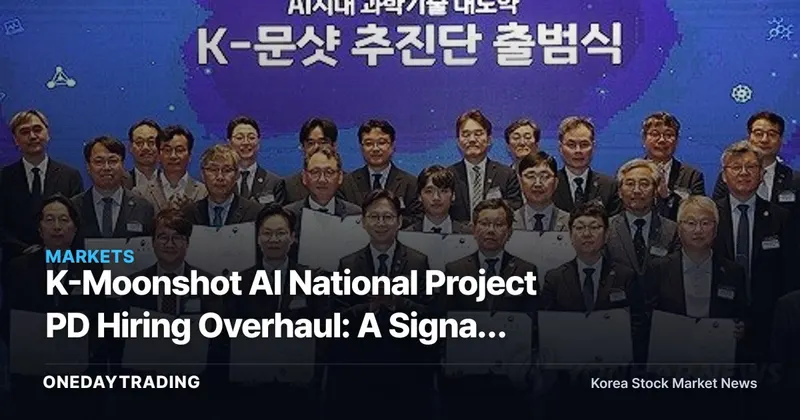
- The Ministry of Science and ICT is overhauling the Project Director (PD) hiring process for the K-Moonshot national AI project to resolve conflict-of-interest concerns.
- The core issue is closing off the structural risk that a PD who designs and executes the program could direct funding toward projects in which they have a personal stake.
- This is fundamentally a matter of execution credibility for a large R&D budget, and should be read as a shift in the policy environment for the broader domestic AI ecosystem rather than a case with a clear direct beneficiary stock (ticker).
What's Changing
The crux of this issue isn't the money itself but who controls how it flows. In large, cross-ministry AI R&D programs like K-Moonshot, the PD holds the key levers of setting research direction, selecting projects, and allocating budget. Bringing in industry and academic experts for this role improves real-world relevance, but it also raises a conflict-of-interest risk: the companies or labs those experts are affiliated with could end up as project beneficiaries.
The hiring overhaul signals an institutional effort to cut off this conflict. From an investor's standpoint, what matters is whether the reform leads to schedule delays and stalled budget execution, or instead reduces noise and becomes a catalyst for funding to flow more transparently and quickly. In the short term, a variable to watch is that project solicitations could be delayed during the PD vacancy and reselection process.
Numbers in Context
At this stage, specific budget size and execution timing remain limited in public disclosure, making it premature to quantify benefits at the individual stock (ticker) level. That said, government-led AI R&D structurally channels funding toward data centers, semiconductors, software, and training infrastructure — the key implication is that as program governance stabilizes, the predictability of downstream orders should improve.
Stocks to Watch: Beneficiaries and Laggards
- Naver: With its own large language model and cloud business, Naver has significant direct exposure to winning and demonstrating public-sector AI projects.
- Kakao: As it scales its AI services and model business, an expansion in national project orders could serve as a channel for building reference cases.
- Samsung Electronics, SK Hynix: Downstream demand from expanding AI training infrastructure. However, given the scale of national R&D budgets relative to overall company revenue, the earnings impact is likely limited.
- KT, SK Telecom: As operators of AI data center and cloud infrastructure, they stand to benefit indirectly from public infrastructure orders.
Risk Check
- The governance overhaul itself is a procedural matter — neither a clear positive catalyst nor a negative catalyst — with a weak direct link to individual stock (ticker) earnings.
- If project solicitations are delayed during PD reselection and institutional restructuring, near-term order expectations could recede.
- National R&D budgets represent only a small share of total corporate revenue, so thematic expectations risk failing to translate into actual earnings.
- Policy direction may shift depending on the administration and budget review schedule, leaving continuity uncertain.
Bottom Line
The governance overhaul is a positive factor for building long-term trust in AI R&D fund execution, but it's difficult to view as an immediate earnings catalyst for individual stocks. Going forward, a reasonable approach is to track the finalization of the K-Moonshot budget, disclosures of specific project solicitations, and the PD reselection timeline, checking step by step whether these translate into actual contract wins.
Naver: Real-Time Data Snapshot
Naver's most recent closing price was 243,500 won (0.00% versus the previous day), and the signal combining foreign investor/institutional investor supply-demand (order flow) with news and momentum reads 🟡 neutral / wait-and-see. With positive and negative signals mixed, this is a zone to watch.
- ▲ News flow — 5 positive catalysts vs. 2 negative catalysts — positive catalysts prevail
Recent related news skews favorable, with 5 positive-catalyst items versus 2 negative-catalyst items.
※ Price and foreign/institutional investor supply-demand (order flow) data are provided by Korea Investment & Securities (KIS) and reflect figures as of publication time.
This article was automatically summarized and analyzed based on the original news report. View original (Yonhap News, Industry)