
Key Takeaways
What matters at SK Hynix is not how much the chairman bought, but the signal that an insider put his own money into the stock for the first time during a sharp drop in AI semiconductor valuations. At 4.8 billion won, the purchase is small relative to the company's size, but for investor sentiment it reads as a cycle judgment from someone at the very top of the supply chain.
Still, a share purchase cannot substitute for yield rates and shipment volumes. If HBM pricing, customer orders, or the DRAM market weaken, the share-price support from this responsible-management signal will not last long.
What Happened
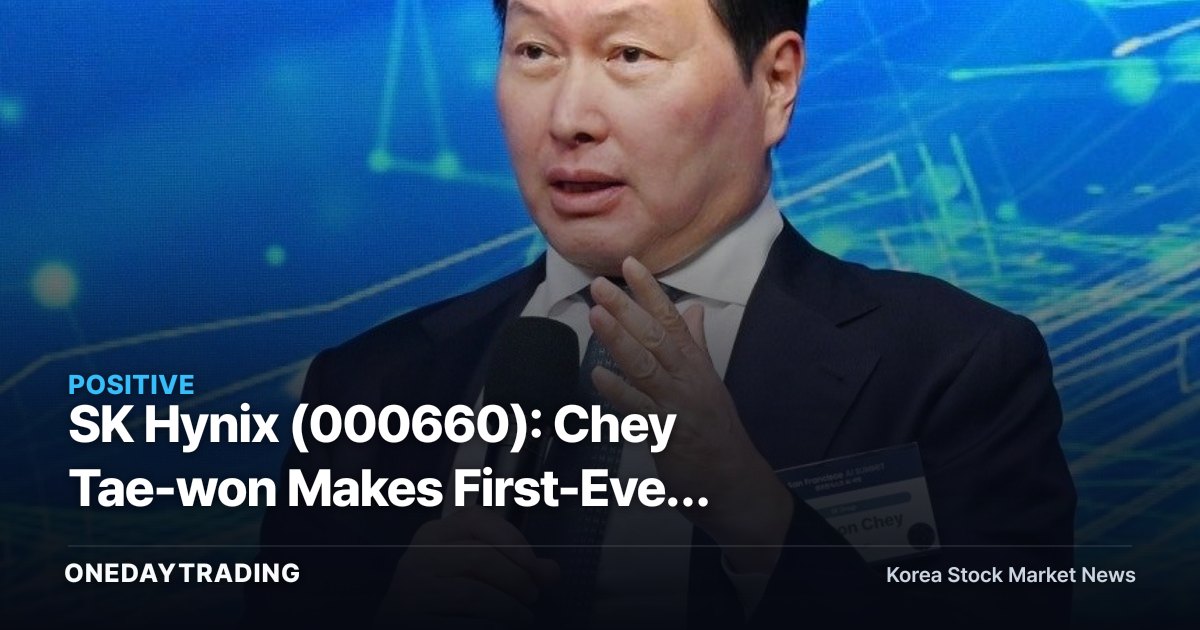
SK Group Chairman Chey Tae-won purchased about 4.8 billion won worth of SK Hynix shares on the open market on the 30th. Since this is the first purchase to emerge after large-cap chip stocks, including SK Hynix, suffered a sharp drop, the market is reading it less as a routine personal transaction and more as a responsible-management message.
Narratives move quickly in chip stocks. As AI server investment rises, HBM demand rises with it, and HBM improves the mix toward higher-value-added DRAM. The market has already priced in much of this. The real question comes when the share price falls: investors first need to determine whether AI demand itself has turned down, or whether an elevated multiple is simply undergoing a correction.
This purchase is a gesture that lends weight to the latter view — that is, it can be read as the company's top decision-maker focusing more on the scale of the price correction than on any deterioration in the industry itself. But that is only an interpretation. The real confirmation will come from quarterly earnings and customer orders.
Background and Context
The key driver of SK Hynix's share price is not commodity memory but high-bandwidth memory (HBM) for AI applications. For HBM, profitability is determined less by how many layers a chip stacks and more by whether the company can maintain yield while delivering the volumes customers want on time. In a supply-constrained environment, the higher the HBM share within the same wafer output, the higher the average selling price and margin.
This is also where the meaning of the insider purchase diverges. The 4.8 billion won purchase itself does not change earnings. But if the market is in a phase of pricing in an AI semiconductor peak-out ahead of time, the chairman's purchase could act as a catalyst that suppresses downside sentiment. Conversely, if customer orders slow or competitors' HBM supply increases faster than expected, this signal will struggle to hold up for long.
Impact on the Market and Stocks (Tickers)
- SK Hynix: The direct beneficiary. The chairman's first open-market purchase can serve as a confidence-recovery signal after the sharp drop. Still, the essence of the share price remains HBM shipments, selling prices, and yield.
- SK Square: An investment holding company sensitive to the value of its SK Hynix stake. If SK Hynix shares stabilize, the case for narrowing its net asset value discount could strengthen.
- Samsung Electronics (005930): Another large-cap memory stock affected by shifts in investor sentiment. However, its share-price reaction will depend on HBM customer qualification and mass-production competitiveness.
- Semiconductor equipment and materials stocks: If expectations for HBM capacity expansion hold, demand expectations for back-end, packaging, and inspection equipment revive. But any short-term share rebound remains dependent on the visibility of SK Hynix's earnings.
Investor Checkpoints
- Next earnings release: Check whether HBM's share of revenue, DRAM average selling price, and operating profit margin all improve at the same time.
- Customer orders: The key is whether orders from AI accelerator makers and cloud customers remain steady. If orders slip, the HBM premium will narrow.
- Yield and supply: Watch whether yield on high-layer-count HBM mass production holds up. Capacity expansion only boosts margins when yield keeps pace.
- Share-price reaction: Distinguish whether the rebound following the insider purchase is accompanied by rising trading value, or whether it is merely short-term short-covering.
Outlook
The optimistic scenario is simple. If AI server investment continues and SK Hynix maintains its HBM supply advantage, this purchase becomes an event that reinforces confidence in a market bottom during the plunge. In that case, the market may place more weight on the direction of the cycle as the insider sees it than on the 4.8 billion won size of the purchase itself.
The risk is just as clear. If the share price has already priced in AI semiconductors' long-term growth, the chairman's purchase alone cannot remove the valuation-multiple burden. The next confirmation point is not sentiment but numbers. This signal will only hold up as a bottoming case for the share price if quarterly HBM shipments, customer inventory, and memory pricing trends all hold together.
SK Hynix by the Numbers: Real-Time Data
SK Hynix's most recent closing price is 1,322,000 won (-5.64% from the previous day), and the signal combining foreign-investor/institutional-investor supply-demand (order flow) with news and momentum reads 🟡 Neutral / Wait-and-See. With positive and negative signals mixed, this is a segment to watch.
- ▼ Trend Alignment — Short- and medium-term downward alignment (Today -5.6% · 1 Week -31.1% · 1 Month -50.1%)
Recent related news skews favorable, with 12 positive-catalyst items versus 10 negative-catalyst items.
※ Price and foreign/institutional investor supply-demand (order flow) data are provided by Korea Investment & Securities (KIS), as of the time of publication.
This article is automatically summarized and analyzed content based on the original news report. View Original (Maeil Business Newspaper, Securities)