
At a Glance
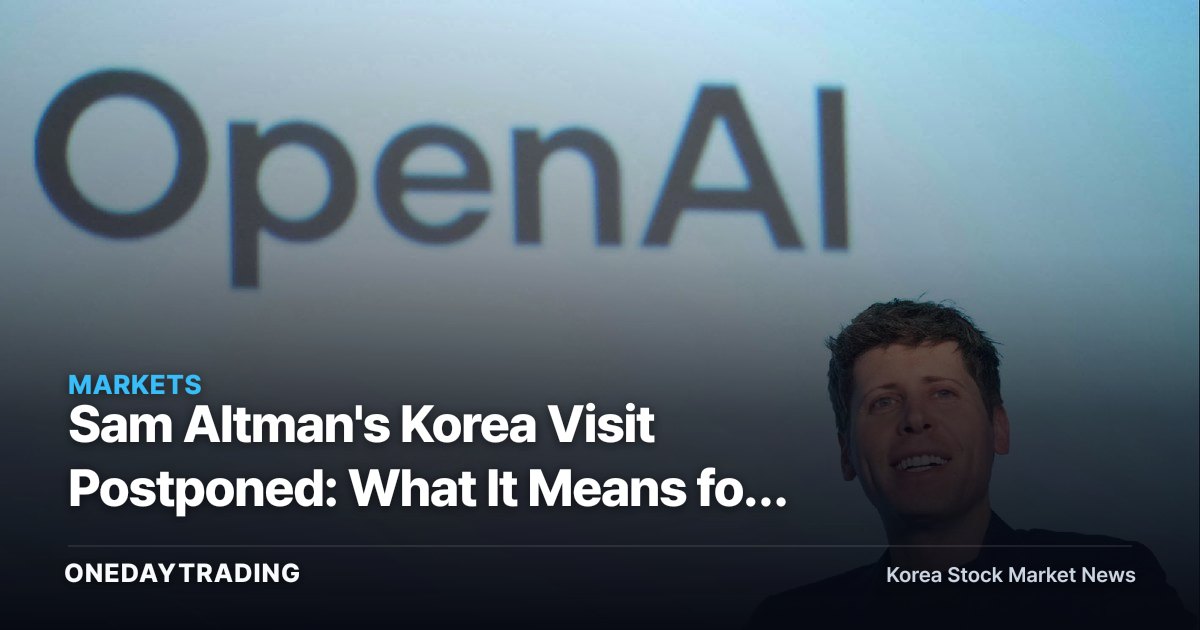
OpenAI CEO Sam Altman has abruptly postponed his planned visit to Korea, where he was scheduled for a series of meetings with executives at leading domestic tech firms including Samsung Electronics, Naver, and Kakao. Because what the market was anticipating was not mere protocol but concrete signals of cooperation on AI infrastructure and memory supply, this postponement reads as a gap in short-term momentum.
Why It Matters Now
At the heart of this is the link between OpenAI's push to build large-scale AI data centers and Korea's semiconductor industry. Next-generation AI accelerators require high-bandwidth memory (HBM), a market that is effectively split between SK Hynix and Samsung Electronics. Altman's visit drew attention precisely because the meetings themselves could have served as a starting point for long-term memory supply contracts or data center infrastructure partnerships.
For Naver and Kakao, the stakes were different. Both companies are building out their own large language models (LLMs) and cloud businesses while simultaneously weighing the possibility of partnering with—or adopting the models of—global model providers like OpenAI. Had the meetings gone ahead, they would have offered material for gauging the direction of the collaboration-versus-competition dynamic, but the postponement has pushed that timing back.
That said, it is important to distinguish that this is a scheduling adjustment, not the collapse of any deal itself. The structural drivers—demand for AI computing and the resulting demand for memory—remain intact. The impact on share prices therefore stems not from any damage to fundamentals but from the delay of an anticipated short-term catalyst.
Frequently Asked Questions
- Why are Samsung Electronics and SK Hynix mentioned? — Because they are the key suppliers of HBM, which determines AI accelerator performance. OpenAI's data center expansion translates directly into rising HBM demand.
- Does the postponed visit mean a deal has fallen through? — For now it amounts to a schedule delay, and it is hard to conclude that the cooperation talks themselves have broken down.
- Is this a positive catalyst or a negative catalyst for Naver and Kakao? — A partnership would create opportunities to expand cloud and services, but adopting a global model also introduces a competitive element against their own LLM businesses.
- What should investors watch? — The key questions are whether a rescheduled visit is confirmed and whether any actual supply contracts or partnership disclosures emerge.
Impact on Related Stocks and Sectors
- Samsung Electronics — A direct beneficiary of AI demand on both the HBM and foundry fronts. That said, proving HBM competitiveness and making progress on customer qualification are prerequisites for any share-price catalyst.
- SK Hynix — As the leader in the HBM market, it is a core beneficiary of rising AI memory demand. Its earnings are highly sensitive to the outcome of price and volume negotiations.
- Naver — Opportunities to expand cloud and AI services coexist with the burden of competing with its own models.
- Kakao — Expectations for broader AI service adoption come alongside uncertainty over the timing of monetization.
- Semiconductor materials/parts/equipment — Demand could ripple out to firms making equipment and materials for HBM back-end processing and packaging.
Points to Watch When Investing
- Event-driven catalysts such as meetings and visits are vulnerable to schedule changes and can amplify short-term volatility.
- The HBM benefit is already substantially priced into the shares, and valuation concerns are being raised.
- OpenAI is a private company, so the details of any cooperation often cannot be confirmed immediately through disclosures—investors should be mindful of information asymmetry.
- For Korea's big-tech names, a partnership with a global model is both an opportunity and a competitive threat, and these two sides need to be considered separately.
Overall Outlook
The optimistic scenario is one in which the visit is rescheduled and leads to substantive developments such as long-term memory supply or data center cooperation. In that case, demand visibility across the entire HBM supply chain would improve considerably. Conversely, if the schedule keeps slipping or the meetings end without concrete results, a pullback in the gains driven by expectations and profit-taking pressure could emerge. Ultimately, it is the presence or absence of actual orders and supply contracts—rather than the symbolism of the event—that will determine the direction.
Samsung Electronics Through Real-Time Data
Samsung Electronics recently closed at 354,000 won (-2.34% from the prior day), and the traffic-light signal—combining foreign and institutional order flow with news and momentum—is 🔴 Caution. With foreign investors, institutional investors, and momentum all negative, caution is warranted at this time.
- ▼ Dual selling — Foreign investors −899.5 billion won and institutional investors −501.6 billion won selling in tandem
- ▲ 52-week position — 94% of the 52-week high — new-high territory
- ▲ News flow — 31 positive catalysts vs. 13 negative catalysts — positive bias
Recent related news is favorable, with 31 positive items and 13 negative items.
※ Price and foreign/institutional order-flow data are provided by Korea Investment & Securities (KIS) and are as of the time of publication.
This article is content automatically summarized and analyzed based on the original news. View original (Maeil Business Newspaper, Corporate)