
Three-Line Briefing
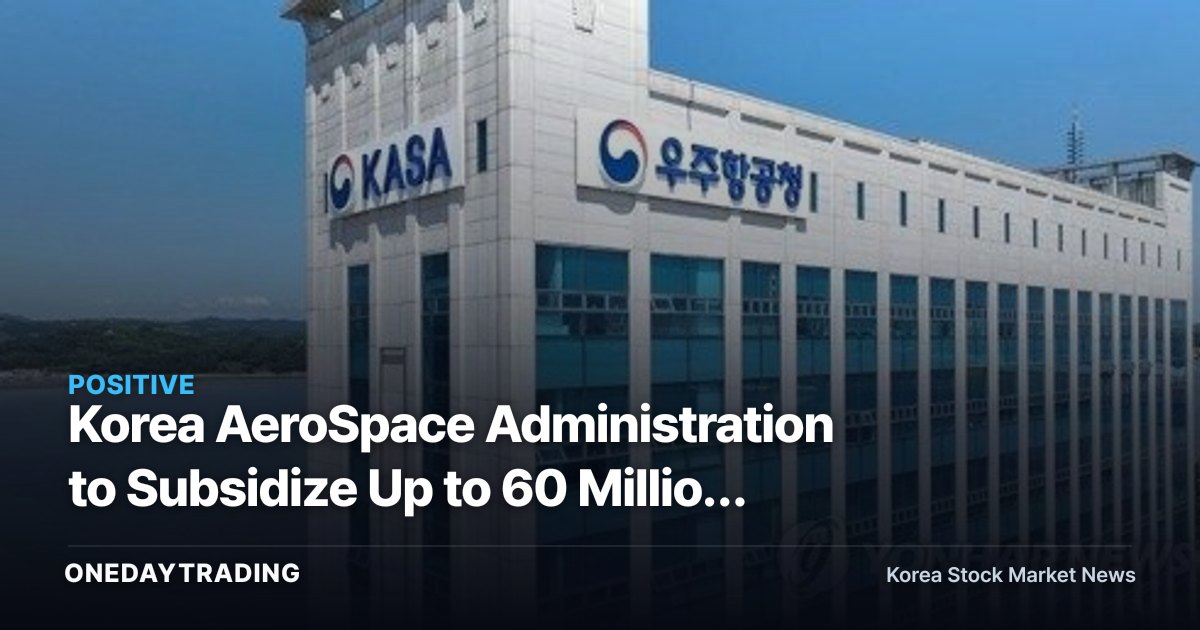
- The Korea AeroSpace Administration (KASA) is accepting applications for participating organizations in its 2026 Space Environment Testing Support Program through July 6.
- It will subsidize up to 60 million won per organization for space environment testing costs — such as vibration and thermal-vacuum testing — currently borne by companies and universities.
- The policy serves as seed money to lower the commercialization barriers for small and mid-sized component makers and satellite startups that have limited access to testing infrastructure.
What's Changing
The core of this program is that the government will shoulder part of the cost of verifying satellite and launch-vehicle components under conditions similar to the actual orbital environment. Space components must withstand vacuum, extreme cold and heat, and the vibration and shock of launch, so they must pass space environment testing before mass production. However, thermal-vacuum chambers and large-scale vibration testing facilities are costly to build and operate, making it difficult for small component makers or university research teams to bear the expense alone.
With the government providing up to 60 million won per organization, components and payloads that previously stalled at the verification stage due to cost can now be demonstrated. Beyond a simple subsidy, this can broaden the pool of verified components in the domestic space supply chain and reduce dependence on overseas certification. As demand grows — through repeated Nuri rocket launches, next-generation launch vehicle development, and low-Earth-orbit communication satellite projects — easing the burden of verification costs works to encourage component makers' entry.
By the Numbers and Context
The support cap of up to 60 million won per organization is not large enough to move any individual company's earnings. That said, given that a single round of space environment testing can run into the tens of millions of won depending on the component and test items, it effectively relieves the out-of-pocket cost of one or two verifications. The policy's real impact lies less in the subsidy amount than in the pipeline that connects verified components to follow-on orders and deliveries. With the application deadline clearly set for July 6, the list and scale of selected organizations will serve as the first indicator of the eventual scope of benefits.
Stocks That Stand to Benefit or Lose
- Hanwha Aerospace: As a core company in the space value chain spanning launch vehicles and engines, it is expected to see indirect benefits from accelerated verification among its partners as the component supply base expands.
- Korea Aerospace Industries (KAI): With its satellite-body and next-generation mid-sized satellite businesses, a larger pool of verified components could translate into improved development efficiency.
- Satrec Initiative: As a specialist in small satellites and payloads, support for component and payload demonstration is directly tied to its path toward securing product reliability.
- AP Satellite: In its satellite communication terminal and component business, it is among the real-demand beneficiaries of eased space environment testing costs.
- Intellian Technologies: In the satellite antenna and communication equipment field, it is a related stock to the expanding demand for low-Earth-orbit satellite component verification.
Risk Check
- With support capped at 60 million won per organization, the direct effect on any individual company's revenue and profit is limited.
- The number of selected organizations and the actual disbursement schedule have not been disclosed, making it premature to pin down which stocks benefit and by how much.
- Space-related stocks are sensitive to policy momentum, so if expectations are priced in ahead of time, valuation pressure could mount.
- Passing verification does not guarantee orders or deliveries, so the time lag between policy and earnings is a variable.
Bottom Line
Subsidizing verification costs is a favorable signal that broadens the base of the domestic space component ecosystem, but with the support scale small and a time lag before earnings impact, this is less a short-term share-price catalyst than a matter to watch alongside selection results and follow-on orders, as part of the continuum of mid- to long-term supply-chain policy.
Hanwha Aerospace Through Real-Time Data
Hanwha Aerospace's latest closing price is 1,122,000 won (-5.63% from the previous day), and the signal light — combining foreign and institutional investor supply-demand (order flow) with news and momentum — is 🟡 Neutral / Wait-and-See. With positive and negative signals mixed, it is a zone to monitor.
- ▲ Order-Flow Continuity — Foreign investors net buyers for 3 consecutive days (+9.2 billion won)
- ▲ News Flow — 13 positive catalysts vs. 3 negative catalysts — positive catalysts dominate
Recent related news is favorable, with 13 positive catalysts and 3 negative catalysts.
※ Price and foreign/institutional investor supply-demand (order flow) data are provided by Korea Investment & Securities (KIS) and are as of the time of publication.
This article is content automatically summarized and analyzed based on the original news. View original (Yonhap News, Industry)