
Key Takeaways
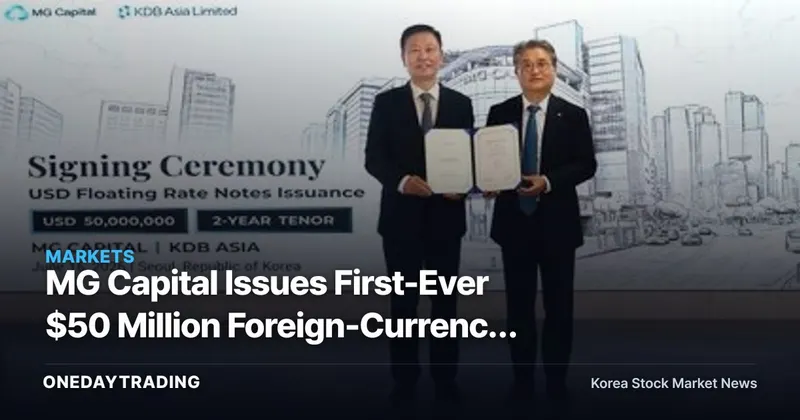
MG Capital has issued its first-ever foreign-currency private placement floating rate note (FRN), worth $50 million. While the amount itself is modest relative to the capital finance industry as a whole, this marks the first time a small or mid-sized capital company—one that had long relied heavily on the domestic bond market—has opened a foreign-currency funding channel. As such, it can be read as a test case for funding diversification.
Since the issuer is unlisted, there is no clearly identifiable listed stock (ticker) that stands to directly benefit. Still, the deal is meaningful as a reference indicator for gauging the broader funding environment, as well as interest rate and exchange rate trends, across capital firms and specialized credit finance companies (yeojeonsa).
What Happened
MG Capital, a subsidiary of the Korean Federation of Community Credit Cooperatives (MG), has issued a foreign-currency private placement FRN worth $50 million. An FRN is a bond whose coupon rate is linked to a benchmark interest rate and periodically reset—unlike a fixed-rate bond, this structure means the issuer and investors share the impact of market rate fluctuations.
The key point is that this is the company's first-ever foreign-currency funding since its founding. It signals that a small or mid-sized capital company, which had previously raised funds mainly through domestic won-denominated corporate bonds and asset-backed securities (ABS), has now expanded its funding channels into the overseas private placement market.
Background and Context
Unlike banks, specialized credit finance companies have no deposit-taking function, so they rely heavily on market-based funding such as bonds and commercial paper. As a result, when the domestic corporate bond market tightens or credit spreads widen, funding costs rise quickly and the burden of refinancing maturing debt increases. Diversifying funding sources is key to reducing this structural vulnerability, and foreign-currency funding is one way to do so.
That said, foreign-currency borrowing entails FX risk and hedging costs, and given the nature of an FRN, interest expenses rise when the benchmark interest rate increases. Ultimately, the real benefit of this issuance depends on how competitive the effective post-hedge funding rate is compared with domestic won-denominated funding.
Market and Stock (Ticker) Impact
- Small and mid-sized capital companies/specialized credit finance firms: This case illustrates the broader trend of funding-channel diversification among non-bank financial firms, suggesting that foreign-currency funding can serve as an alternative when the domestic market tightens.
- Bank-affiliated and major financial holding companies: Holding companies with capital-company subsidiaries are indirectly affected by shifts in the non-bank funding environment. Stable funding costs are favorable for margins in the specialized credit finance segment.
- Exchange-rate- and interest-rate-sensitive funding markets: Foreign-currency FRNs are exposed to the U.S. benchmark interest rate and the won-dollar exchange rate, so changes in hedging costs directly affect the effective funding rate.
- Bond investment demand: As a private placement, accessibility for retail investors is low, but for institutional investors, it offers a clue to shifting demand for floating-rate assets.
Investor Checkpoints
- The spread and maturity structure of the issuance terms — check whether the effective post-hedge funding rate is more favorable than domestic won-denominated funding.
- The direction of the U.S. benchmark interest rate (e.g., SOFR) and the Korea-U.S. interest rate gap — these directly affect the FRN's interest burden and FX hedging costs.
- The level and volatility of the won-dollar exchange rate — these determine the repayment burden on foreign-currency debt and hedging gains or losses.
- Credit spreads on specialized credit finance bonds and refinancing schedules — also worth watching as a broader indicator of funding stress across the capital finance industry.
Outlook
On the positive side, diversifying funding sources acts as a buffer during domestic liquidity-market stress and, over the long term, enhances funding stability. If the first foreign-currency issuance is absorbed smoothly, it could serve as a stepping stone for follow-on issuances and larger funding volumes.
On the other hand, if FX hedging costs rise or U.S. dollar interest rates remain elevated, the cost advantage of foreign-currency funding could disappear. And because the issuer is an unlisted small or mid-sized company, funding conditions could be sensitive to shifts in credit rating and market sentiment. As this is a one-off private placement, it is too early to call it a trend — the next issuances and their terms bear watching.
This article was automatically summarized and analyzed based on the original news report. View original (Yonhap News Agency, Securities)