
Three-Line Briefing
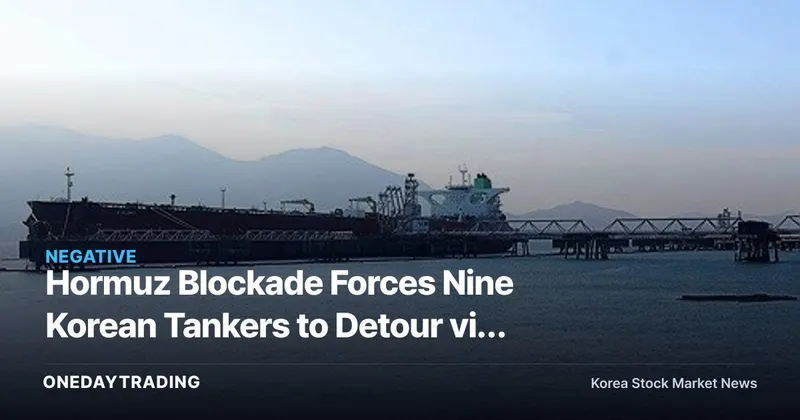
- After war in the Middle East blocked passage through the Strait of Hormuz, a ninth Korean vessel has brought crude oil into the country via the detour route through the Red Sea.
- The closure of this key transit route increases sailing distance and time as well as insurance and freight costs, pushing up the cost of importing crude into Korea.
- Upward pressure on oil prices and rising freight rates affect the profit structures of refining, shipping, airlines, and export manufacturing in differing directions.
What's Changing
The Strait of Hormuz is a critical chokepoint through which a substantial share of the world's seaborne crude oil passes. Korea is heavily dependent on Middle Eastern crude, so when this route is blocked, an immediate redesign of import routes becomes unavoidable. The continued use of the Red Sea as a detour, as in this case, reads as a signal that the shipping pattern itself is being disrupted — not merely a temporary hiccup.
Detour routes lengthen sailing distance and, with it, drive up fuel costs, charter rates, and war-risk insurance premiums. The Red Sea is not a fully secure route either, so some carriers opt for the even longer route around the southern tip of Africa. Ultimately, both the cost and the time required to import the same volume of crude increase.
This shift goes beyond a simple logistics problem. Higher import costs are passed on to domestic gasoline and diesel prices and to industrial energy costs, which in turn affect inflation and the trade balance with a lag. It is a phase in which the management of strategic petroleum reserves by governments and companies, along with efforts to diversify supply sources, is drawing renewed attention.
By the Numbers and Context
The key question is how long the blockade lasts. A short-term disruption can be absorbed through reserves and detour shipping, but a prolonged one could keep oil prices structurally elevated. The very fact that this is the ninth detour shipment since the blockade shows that a situation in which a return to normal routes is difficult has been persisting for some time.
When oil prices rise, refiners can see short-term gains in refining margins and inventory valuation, but higher feedstock costs ultimately have a dual nature in that they slow demand. Conversely, airlines and logistics, where fuel makes up a large share of costs, face a direct increase in cost burdens. Because the same event splits into a positive catalyst and a negative catalyst depending on the industry sector, an approach that weighs each stock's earnings sensitivity is needed.
Winning and Losing Stocks
- S-Oil: A two-sided exposure, with expectations of refining margins and inventory gains during a period of rising oil prices, but a simultaneous increase in the burden of crude import costs.
- SK Innovation: With an integrated refining and petrochemical business structure, it is directly exposed to oil-price volatility, and the swing in earnings is large depending on the direction of margins.
- Korean Air: A losing sector in which rising oil prices and freight rates act as a clear cost-pressure factor, given the high share of jet fuel in its costs.
- HMM: If freight rates jump on Red Sea and Middle East route risks, a knock-on benefit could emerge on the container and bulk freight-rate front.
- GS: A flagship energy holding company linked to energy-price trends through its refining subsidiary.
Risk Check
- If the blockade is resolved quickly, detour costs disappear and the oil-price and freight-rate premiums could unwind rapidly.
- If a sharp gain (surge) in oil prices dampens global demand and the economy, the logic behind refiners' gains weakens.
- If security risks on the Red Sea and Middle East routes themselves increase, even the detour routes become unstable, potentially generating additional costs.
- If a weak won compounds the situation, the burden of crude imports intensifies, placing dual pressure on the trade balance and inflation.
The Bottom Line
The Hormuz blockade and the Red Sea detour are driving up oil prices and freight rates in the short term and benefiting some energy stocks, but the longer they last, the more they bring a bill in the form of import costs and pressure on the economy and inflation — a double-edged issue, and a phase that calls for a balanced response that separates the earnings direction of each industry sector.
This article is content automatically summarized and analyzed based on an original news report. View original (Yonhap News)