
What the KOSPI Rebound Signals
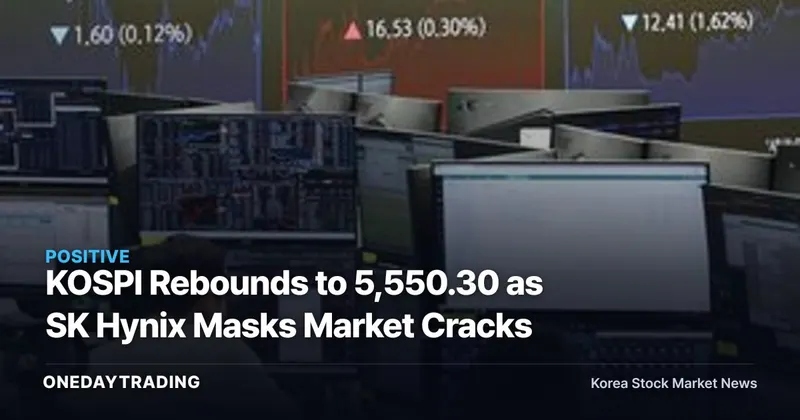
Rather than the KOSPI’s higher close, investors should first examine the concentration of the stocks and funds that drove the rebound—not merely its size. In the market session reported by Infostock Daily on October 23, 2026, the KOSPI closed up 0.30% at 5,550.30, while the KOSDAQ fell 1.62% to 751.69. The fact that the two indexes ended the same day in opposite directions suggests this was not a broad-based market recovery.
The KOSPI opened at 5,403.17, fell as low as 5,305.98 intraday and finished at its session high of 5,550.30. The closing price points to a rising market, but the day’s trajectory reflected both a sudden flight from risk and a late-session recovery in buying. The real message is volatility rather than direction.
What the SK Hynix and Solidigm Decision Means
The suspension of Solidigm’s pre-IPO and initial public offering review means SK Hynix’s overseas subsidiary has stopped considering those financing options. The company disclosed only the decision to halt the review; whether or when it might resume has not been confirmed. There is therefore no basis for interpreting this development as an immediate change in Solidigm’s business performance or SK Hynix’s earnings.
The market reacted immediately to the decision. SK Hynix rose 4.42% on October 23, 2026, while SK Square gained 3.20% and SK advanced 0.87%. Samsung Electronics also rose 0.47% that day. What is currently confirmed is the suspension of the listing review and the resulting share-price reaction; what remains unknown is the decision’s subsequent impact on financing and business operations.
The Divergence Between the KOSPI and KOSDAQ
The KOSDAQ opened at 748.32, fell as low as 732.87 intraday, reached a high of 753.02 and closed at 751.69. Although it rebounded from its low, its closing price was still 1.62% below the previous day. This is why the KOSPI’s positive close alone cannot establish that risk appetite had spread across the broader market.
In the KOSPI market, retail investors purchased a net 28.8 billion won and institutional investors purchased a net 869.4 billion won, while foreign investors sold a net 966.5 billion won. This supply-demand (order flow) structure—institutional buying absorbing foreign selling—helps explain the day’s rebound. However, if foreign net selling continues, the case for interpreting the index gain as a broad improvement in supply-demand (order flow) will weaken. The dollar-won exchange rate stood at 1,324.6 won at 3:30 p.m. that day, down 1.9 won from the previous session’s overnight closing price.
AI Investment Concerns Have Not Disappeared
Meta’s capital expenditures increased 80% year over year in the third quarter of 2026, while free cash flow was negative $2.1 billion. These figures raise questions not about the existence of AI demand, but about whether cash resources can sustainably support expanding investment. If cash flow fails to keep pace as investment grows, the gap between the AI narrative and financial capacity will widen.
Infostock Daily reported that Jensen Huang said, “Demand is explosive, but growth is being constrained by insufficient working capital.” This warns that even with a positive supply outlook, customers’ financing conditions may limit how quickly demand translates into actual orders. SK Hynix’s rebound that day and concerns about AI investment are not necessarily contradictory; they show that company-specific developments and industry fund flow can move independently.
How to Assess Related Stocks and Sectors
- SK Hynix: The company directly announced the suspension of Solidigm’s pre-IPO and initial public offering review. The 4.42% gain reflects the market’s reaction that day, but subsequent price movements are not confirmed in the available data.
- SK Square and SK: They rose 3.20% and 0.87%, respectively, on the same day. The available data do not support extending the interpretation beyond the fact that they moved higher alongside SK Hynix to infer any earnings impact.
- Samsung Electronics: The stock rose 0.47%. This can be viewed as a signal that semiconductor market sentiment had not completely deteriorated that day, but no evidence was presented to characterize it as a direct beneficiary of the Solidigm decision.
- Samsung Biologics and Samsung E&A: They gained 7.71% and 7.94%, respectively. This provides additional evidence that the KOSPI rebound did not depend solely on the semiconductor industry sector, but the reasons for the two stocks’ gains should not be inferred beyond the available information.
Three Developments to Watch Next
- Investors should monitor SK Hynix’s subsequent announcements to see whether Solidigm resumes reviewing a pre-IPO or initial public offering.
- Further data will be needed to determine whether Meta’s increased investment and deteriorating free cash flow intensify concerns about AI investment.
- Investors should watch both whether the KOSPI-KOSDAQ divergence persists and whether foreign net selling reverses.
In the bullish scenario, SK Hynix sustains its rebound and foreign supply-demand (order flow) reverses, allowing the KOSPI’s intraday recovery to broaden across the market. However, if the burden of AI investment increases, positive company-specific decisions alone may not be enough to contain index volatility. The next assessment should focus not on a single higher closing price, but on Solidigm’s next decision, the gap between AI investment and cash flow, and whether the two indexes realign.
KOSPI MetricsAs of 2026-10-25
| Performance | 1 Week -2.08% 1 Month -19.49% |
|---|
Index, commodity and exchange rate figures reflect global market data available at the time of publication.
Key SK Hynix MetricsAs of 2026-10-25
| Period Returns | 1 Week -0.71% 1 Month -31.99% |
|---|---|
| Trading Value · Trading Volume | 93 billion won · 5,910,844 shares |
| Supply-Demand (Order Flow) | Foreign Investors −640.9 billion won net selling Institutional Investors +577 billion won net buying |
Price and supply-demand (order flow) data are real-time figures from Korea Investment & Securities (KIS); supply-demand (order flow) and news-tone aggregates are calculated independently by OneDayTrading.
Upcoming Events to Watch
- 10.28FOMC Policy Rate DecisionHighFederal Reserve monetary policy announcement — interest-rate and dollar direction
- 11.12Index Options ExpirationLowKOSPI 200 options expiration
- 11.26Bank of Korea Monetary Policy BoardHighBenchmark interest rate decision meeting
- 12.09FOMC Policy Rate DecisionHighFederal Reserve monetary policy announcement — interest-rate and dollar direction
This article was automatically summarized and analyzed from the original news report. View the original article (Infostock Daily)