
Summary
The AI rally is no longer a story about a single chip. The fact that Samsung Electronics Chairman Lee Jae-yong, SK Group Chairman Chey Tae-won, and Naver Chairman Lee Hae-jin are set to meet Nvidia CEO Jensen Huang in the United States signals that the upper tier of Korea's AI value chain is once again realigning around Nvidia as its reference point.
Investors should not view this meeting as mere networking. What matters is not the photo op but the sequence within the supply chain. Which stage — HBM supply, foundry cooperation, AI infrastructure demand, or platform services — actually translates into real orders and revenue will determine the next divergence in share prices.
What Happened
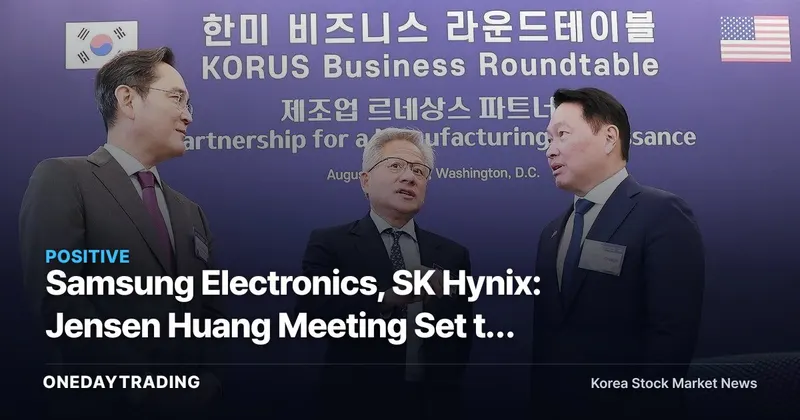
According to Yonhap News Agency's industry desk, Samsung Electronics Chairman Lee Jae-yong, SK Group Chairman Chey Tae-won, and Naver Chairman Lee Hae-jin are scheduled to meet Nvidia CEO Jensen Huang in the United States. It is a lineup in which three figures representing Korea's memory chip business, group-level investment, and internet platform sector will sit at the same table with Nvidia, the de facto standard-setter in AI semiconductors.
The key point here is that Nvidia is not simply a customer. In the AI accelerator market, Nvidia dictates the direction of orders across GPU design, packaging demand, HBM adoption, and the server ecosystem. For memory makers, it sets the benchmark for unit prices and volumes; for platform companies, it sets the benchmark for the infrastructure costs of running AI models.
That said, the meeting itself does not immediately translate into new contracts. If the market has already priced in much of the expected AI cooperation, the value of this news lies less in inflating expectations further and more in being validated through actual yields, supply allocation, and service commercialization timelines.
Structural Background
The AI supply chain runs from materials to equipment, memory, foundry, servers, cloud, and services. The more Nvidia GPUs are sold, the more the bottleneck extends beyond the compute chip alone. HBM paired with the GPU, advanced packaging that binds the chips together, data center power, and enterprise AI services all move in tandem.
It also matters that Samsung Electronics and SK Hynix occupy different positions. SK Hynix is regarded as having heavy exposure to Nvidia's supply chain through HBM, while Samsung Electronics is a comprehensive semiconductor player that can offer memory, foundry, and packaging together. Naver, meanwhile, is not a chip seller but a company that converts AI into services and cloud cost structures. Even though it is the same AI meeting, the path each takes to the bottom line differs.
Impact on Stocks (Tickers) and Industry Sectors
- Samsung Electronics (005930): Its point of contact with Nvidia is read as raising expectations for HBM quality certification and potential foundry cooperation. However, investors should look first at actual mass-production yields and customer certification rather than mere expectations.
- SK Hynix (000660): The longer AI server-related HBM demand persists, the more direct its revenue linkage becomes. The key question is how long its first-mover advantage can be sustained as a price premium and margin.
- Naver (035420): If its in-house AI and cloud services align with Nvidia infrastructure, its competitiveness in services for enterprise clients could increase. Conversely, the burden of GPU costs could delay operating leverage.
- Semiconductor Equipment and Materials: If HBM capacity expansion and advanced packaging investment materialize, demand could spread to back-end process, inspection, and substrate companies. However, orders tend to arrive with a time lag.
Bullish vs. Bearish Scenarios
The bullish scenario is clear. It involves Nvidia expanding cooperation with Korean memory makers within the next-generation AI accelerator supply chain, Samsung Electronics regaining HBM competitiveness, and Naver converting AI services into an actual monetization model. In this case, the AI theme would shift from short-term momentum to upward revisions in earnings estimates.
The bearish scenario also remains open. The meeting carries significant symbolism but is an event without hard numbers. If HBM yields improve more slowly than expected, the competitive landscape within Nvidia's supply chain shifts, or AI infrastructure investment comes to be perceived as a cost burden, share prices could give back the event premium. The point where the narrative and actual shipment figures diverge is the greatest risk.
Investor Action Points
- For Samsung Electronics, watch for mentions of HBM certification, mass-production timelines, and the share of high-value-added memory at the next earnings release and conference call.
- For SK Hynix, check whether rising HBM shipments translate not just into revenue growth but also into defended operating margins.
- For Naver, monitor both the pace at which AI services convert into search, commerce, and cloud revenue, and the burden of GPU costs.
- For the semiconductor sector as a whole, the trigger is whether Nvidia's next-quarter order signals, AI server demand, and advanced packaging investment plans translate into actual orders.
Samsung Electronics (005930) in Real-Time Data
Samsung Electronics's most recent closing price was 259,000 won (0.00% versus the previous day), and the composite signal combining foreign and institutional investor supply-demand (order flow) with news and momentum reads 🟢 Buy-leaning. With foreign investors, institutional investors, and news all positive, the stock (ticker) is worth watching.
- ▲ Dual Buying — Foreign investors +KRW 500.8 billion · Institutional investors +KRW 468.8 billion, buying in tandem
- ▼ Trend Alignment — Short- and medium-term downtrend alignment (today +0.0% · 1 week -9.1% · 1 month -28.6%)
- ▲ News Flow — 5 positive catalysts vs. 2 negative catalysts — positive catalysts lead
Recent related news comprises 5 positive catalysts and 2 negative catalysts, an overall favorable mix.
※ Price and foreign/institutional investor supply-demand (order flow) data are provided by Korea Investment & Securities (KIS) and are as of the time of publication.
This article is automatically summarized and analyzed content based on the original news report. View original (Yonhap News Agency, Industry)