
3-Point Briefing
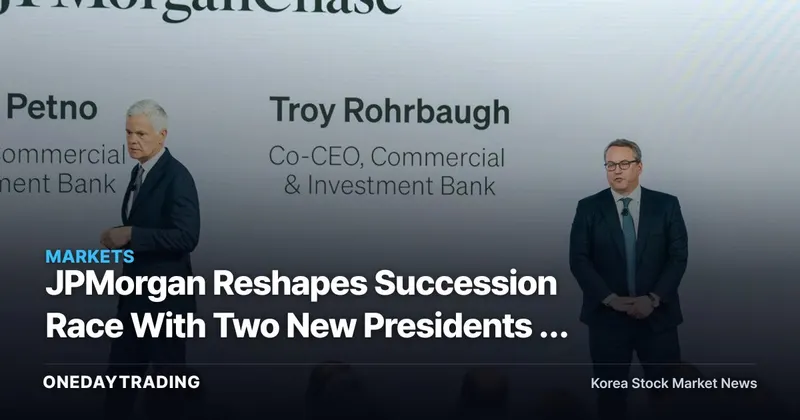
- JPMorgan has elevated two executives to the president role, redrawing the succession landscape for CEO Jamie Dimon.
- Rather than anointing a single heir apparent, promoting multiple candidates to the presidential level is read as a calculated move to ensure management continuity and diversify key-person risk.
- As a governance event at America's largest bank, this development sends an indirect signal to the governance premium priced into global financial stocks and to market sentiment around Korean bank stocks.
What Changes
The crux of this leadership move is less about the promotions themselves and more about the multipolarization of the succession structure. Designating a single successor too early raises the risk of losing other key talent, whereas placing multiple contenders at the same level preserves internal competition while keeping critical personnel in place. For a sprawling, decentralized organization like JPMorgan — spanning consumer banking, investment banking, and asset and wealth management — cultivating divisional leaders to the presidential rank is more conducive to operational continuity than concentrating all authority in one person.
From an investor standpoint, governance events matter because of key-person risk. Dimon has long been the face of JPMorgan's earnings performance and crisis management, and uncertainty around his tenure has itself been a valuation variable. By institutionally making multiple successors visible, the bank creates a buffer against the potential share-price shock that could materialize when a CEO transition actually occurs.
Numbers and Context
JPMorgan is the largest U.S. bank by assets, and its diversification across deposits, cards, trading, and wealth management has earned it a reputation for strong earnings resilience regardless of the rate cycle. That said, this announcement is a personnel and governance event — not an earnings guidance revision or a change in capital policy — so it does not directly affect fundamental metrics such as net interest margin (NIM) or loan-loss provisions. It is therefore more rational to interpret this as a medium-to-long-term adjustment to management risk premium rather than as an immediate directional catalyst for the share price.
Stocks to Watch
- JPMorgan Chase: The primary party. Making the succession path visible is a mitigant of key-person risk, but if the heightened internal competition triggers departures of critical personnel, it could flip back into a source of uncertainty.
- Goldman Sachs, Bank of America, Citigroup: U.S. large-bank governance peers. JPMorgan's stable succession model sets a benchmark for assessing governance quality across the sector.
- KB Financial Group, Shinhan Financial Group, Hana Financial Group: No direct business linkage, but positive global bank market sentiment could indirectly feed through to the valuation of Korean financial holding companies and affect foreign investors' supply-demand (order flow).
- Financial platforms and fintech sector: The competitive pressure on this segment will hinge on where the next generation of JPMorgan's leadership chooses to direct its digital and wealth management strategy.
Risk Check
- If senior executives who lose out in the succession contest defect to rivals, what began as a governance positive could turn into a negative — an organizational capability gap.
- The actual timing of Dimon's departure and the pace of the authority handover remain opaque, leaving room for divergence between market expectations and the real timeline to amplify volatility.
- A governance positive catalyst is not a fundamental one; earnings variables such as NIM compression in a falling rate environment or rising credit costs could easily overshadow it.
- The linkage to Korean bank stocks runs through a psychological and supply-demand (order flow) channel — indirect by nature — and over-reading it as a direct causal relationship carries a meaningful risk of misjudgment.
Bottom Line
Institutionalizing multiple successors is a positive governance signal that reduces key-person risk, but because it is not a positive catalyst for earnings or capital policy, investors should resist reading it as an immediate directional call on the share price — and instead monitor it alongside the next earnings release and any disclosure of Dimon's authority-transfer timeline.
This content was automatically summarized and analyzed based on the original news source. Read original article (Yahoo Finance)