
3-Line Briefing
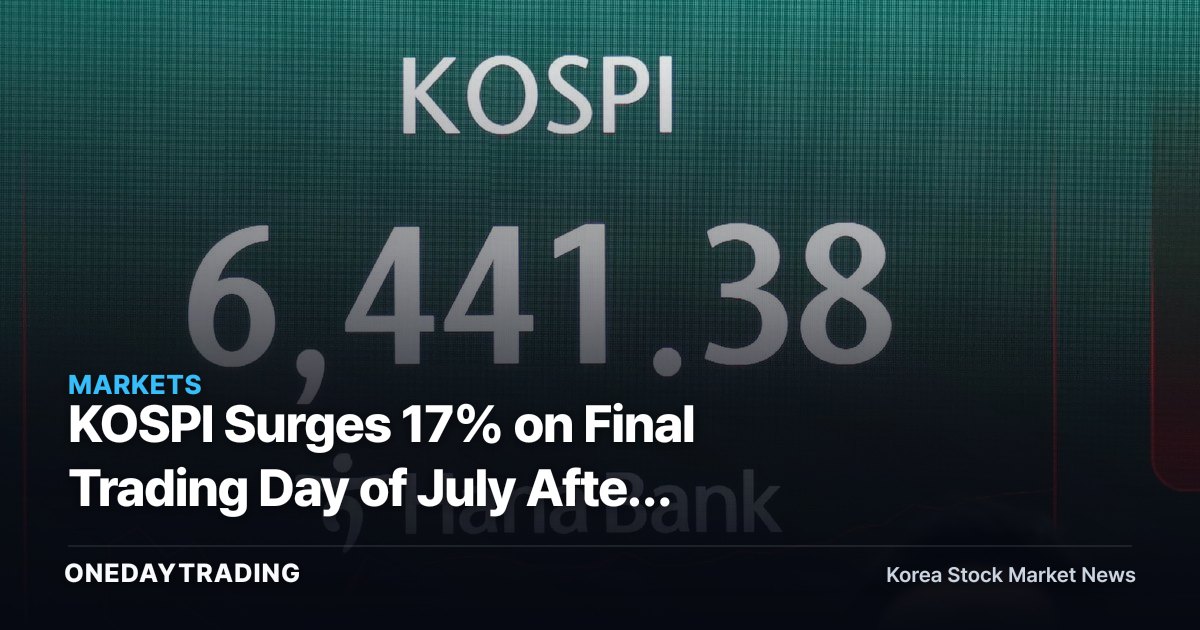
- The KOSPI index continued its decline throughout July, then surged more than 17% in a single session on the last trading day of the month, marking the largest one-day percentage gain on record.
- It was a month of extreme volatility in which a sharp drop (plunge) and a sharp gain (surge) coexisted within a matter of weeks, and market participants are divided over whether the rebound signals a trend reversal or is merely a technical retracement from an oversold condition.
- The key variables that will determine the KOSPI's direction in August come down to earnings season results, the Monetary Policy Board's policy decision, and the level of the KRW/USD exchange rate.
What's Changing
When it comes to an index jumping more than 17% in a single day, where that number occurred matters more than the number itself. If the rebound emerged from a valuation trough created by a month of persistent selling, it is more likely a mechanical retracement from an oversold condition — a combination of short covering and bargain hunting — than a signal of fresh buying interest. The story changes, however, if the rebound coincided with foreign investors and institutional investors turning net buyers. A shift in the supply-demand (order flow) base would mean a valuation re-rating is underway, which would in turn lead to a rotation among industry sector leaders.
What matters most is whether this surge fully offset the month's losses. A record-setting one-day gain is, in itself, evidence of just how compressed the market had become. The larger the decline, the larger the rebound — that's simple arithmetic, not necessarily a sign of improving fundamentals. What the market has already priced in is July's fear; what it has not yet priced in are the variables of August's earnings season and monetary policy.
Reading the Numbers in Context
Setting the record for the largest daily gain is statistically extraordinary in its own right. A one-day rebound of this magnitude typically occurs either after market-wide panic selling has been exhausted, or when a specific catalyst triggers broad program buying across the index. Either way, the surge in volatility is itself a signal. Rising volatility means market participants' valuation expectations are being rapidly recalibrated within a narrow range, and until that recalibration is complete, directional bets on the KOSPI remain a low-probability game.
Stocks to Watch
- Samsung Electronics (005930) and SK Hynix: With the largest weightings in KOSPI market capitalization, these stocks (tickers) see the biggest swings in both the index's sharp drops and sharp gains. They are also the top targets for program buying during a rebound.
- Hyundai Motor and Kia: Highly sensitive to export profitability amid heightened KRW/USD exchange rate volatility, so if the exchange rate level swings again, earnings expectations will move in tandem.
- Financial stocks such as KB Financial Group and Shinhan Financial Group: This is the industry sector most directly tied to monetary policy variables, meaning the Monetary Policy Board's decision feeds straight through into valuation multiples.
- Leveraged and inverse ETFs: A single-day index move of more than 17% can distort returns on leveraged products, which is likely to draw a surge in short-term trading demand.
Risk Check
- If this rebound turns out to be a simple technical retracement without a shift in the supply-demand (order flow) base, volatility could flare up again in early August.
- If the KRW/USD exchange rate pushes higher again, foreign investors could once again turn net sellers.
- If the causes behind July's sharp drop (plunge) have not been fully resolved, the rebound could be reversed depending on earnings season results.
- The very fact that the daily volatility record was broken could itself be a signal of a structural weakening in market liquidity and confidence.
Bottom Line
The KOSPI's record-setting one-day rebound is not proof that fear has lifted — it's a number that shows just how deep that fear ran. The next thing to watch is whether August's earnings season, the Monetary Policy Board's decision, and the exchange rate level fill this rebound with real fundamentals.
This article is automatically summarized and analyzed content based on the original news report. View original (Maeil Business Newspaper, Securities)