
Key Takeaways
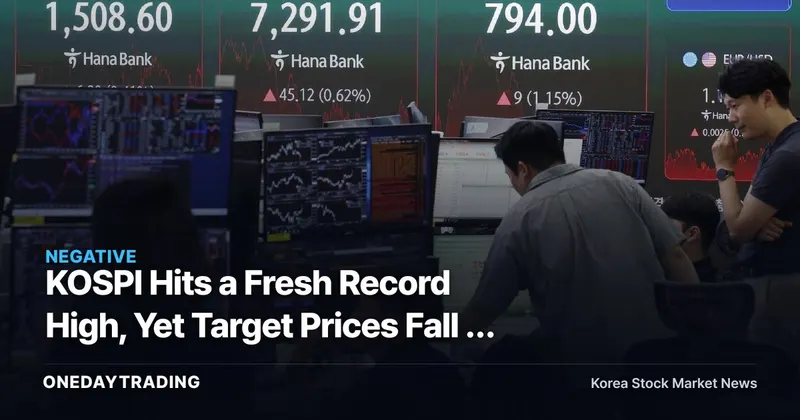
Right after KOSPI set a new all-time high, the tone of brokerage reports shifted. Reports lowering target prices are now outpacing those raising them at a rapid pace. This reversal, emerging right at the start of the second-quarter earnings season, shows that a rising index and a rising earnings outlook are not necessarily the same signal.
What Happened
Since KOSPI broke above its previous record high, a clear pattern has emerged in brokerage reports: the share of target-price upgrades has declined while the share of downgrades has risen. Before the index reached its previous peak, upgrade reports had been driving the trend, but from the moment the index surpassed its record high, downgrade reports began increasing rapidly—starting with the semiconductor sector—and this trend has since spread to secondary batteries and entertainment. The common thread is that target prices are being cut before earnings results are even confirmed.
This sequence reveals what the market has already priced in. During the record-high phase, share prices moved ahead of earnings confirmation, and now the second-quarter earnings season must verify that advance pricing. The fact that analysts are cutting target prices before they even have next quarter's numbers in hand suggests that the pullback from unconfirmed multiple expansion has begun even before the earnings releases themselves.
Background and Context
Index levels and valuation multiples move differently. The fact that KOSPI hit a new record high could reflect either a rise in earnings expectations (EPS) or a higher multiple being paid for the same level of earnings. This wave of downgrade reports suggests that much of the recent rally leans toward the latter. In semiconductors, share prices were driven up by expectations of a memory upcycle; in secondary batteries, by expectations of policy support and ESS momentum; and in entertainment, by expectations tied to comeback and concert schedules—all reflected in share prices before earnings caught up. Earnings are still in the process of catching up to those expectations, and the target-price cuts can be read as analysts preemptively narrowing this gap.
Impact on the Market and Individual Stocks
- Samsung Electronics (005930) · SK Hynix (000660): Semiconductors were the sector where downgrade reports appeared first and most broadly. If memory prices and utilization rates fail to keep pace with consensus, further target-price cuts could follow.
- LG Energy Solution (373220) · Samsung SDI (006400): Expectations of an ESS-driven demand recovery had pushed secondary battery target prices higher, but the rationale for upgrades weakens if the recovery in EV-bound volume—which accounts for the bulk of revenue—continues to lag.
- HYBE (352820) · SM Entertainment (041510): Entertainment is a sector where target prices swing sharply based on comeback and tour schedules. Premiums added without earnings confirmation risk being reversed once settlement season arrives.
- Broader Index: If target-price cuts spread across sectors regardless of industry, further gains in KOSPI would have to depend on the pace of earnings improvement rather than on further multiple expansion in the index itself.
Investor Checkpoints
- Whether second-quarter earnings deliver a surprise versus consensus — particularly worth watching are semiconductor utilization rates and secondary battery order volumes.
- Whether target-price downgrade reports continue after earnings are released, or conclude as pre-earnings positioning that has already run its course.
- The next Monetary Policy Board rate decision and the KRW/USD exchange rate level — a higher discount rate would add further pressure on multiples that have already expanded.
Outlook
In the optimistic scenario, second-quarter earnings deliver a surprise strong enough to push the already-lowered target prices back up. In that case, this wave of downgrades would prove to be a temporary adjustment. The risk scenario is that earnings fail to keep pace with market expectations. In that case, target-price cuts could spread beyond semiconductors, secondary batteries, and entertainment into a broader re-rating of KOSPI's overall multiple. The next Monetary Policy Board decision and the second-quarter earnings calendar will mark the dividing line between these two scenarios.
This content was automatically summarized and analyzed based on the original news article. View original article (Maeil Business Newspaper - Securities)