
At a Glance
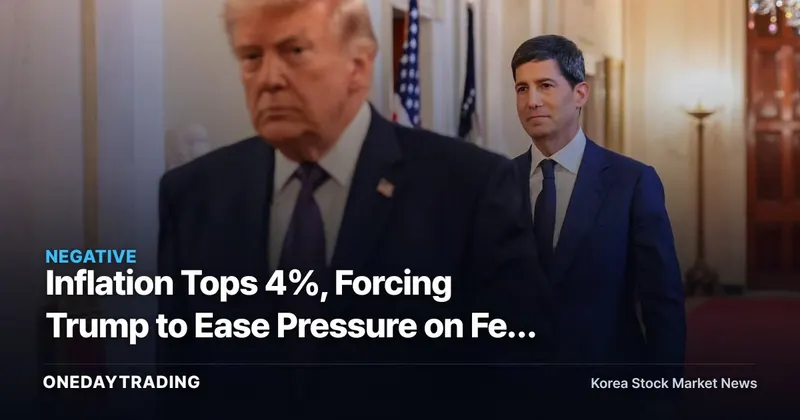
With U.S. consumer inflation running above 4%, the Trump administration's economic team has stepped back, giving incoming Federal Reserve Chair Kevin Warsh greater discretion over rate decisions. The president continues to call for cuts, but with inflation in the 4% range, the case for immediate easing has weakened considerably. For Korean investors, the critical implication is that the higher-for-longer scenario is regaining traction — reshaping the calculus around the KRW/USD exchange rate, foreign investor supply-demand (order flow), and rate-sensitive industry sectors.
Why This Matters Now
A delayed Fed pivot means the U.S.-Korea rate differential stays wide, keeping upward pressure on the dollar. That, in turn, weighs on the won — a tailwind for exporters' translated earnings, but also an incentive for foreign investors to steer clear of won-denominated assets. In other words, the same news acts as a positive via exchange rate effects for export stocks, while simultaneously creating supply-demand (order flow) headwinds for the broader KOSPI.
The especially important mechanism here is that 4% inflation matters structurally. With the gap between actual inflation and the Fed's 2% price stability target this wide, it is difficult to justify a rate cut on political pressure alone. The signal that Warsh is being given discretion paradoxically reads as confirmation that the Fed will move later, guided by data rather than politics. If markets trim their expectations for rate cuts this year, U.S. government bond yields and the dollar could push higher again — a valuation discount factor for growth and technology stocks.
On the other side, the retreat of political interference reduces concerns about Fed independence, which is a positive catalyst for bond market credibility over the medium to long term. The mix of near-term rate cut disappointment (negative catalyst) and institutional trust recovery (positive catalyst) means the net direction will ultimately be determined by where inflation heads from here.
Frequently Asked Questions
- Is a delayed rate cut unconditionally a negative catalyst for Korean equities? It adds supply-demand (order flow) pressure broadly, but export stocks that benefit from exchange rate moves and bank stocks whose net interest margins improve could hold up relatively well — industry sector differentiation is the key.
- What does 4% inflation actually mean? It is double the Fed's 2% target, and regardless of political demands, it undermines the justification for monetary easing.
- Where should I watch the KRW/USD exchange rate? As long as the U.S.-Korea rate differential persists, won weakness pressure is likely to continue. Monitor both the exchange rate level and whether foreign net buying in the KOSPI turns positive.
- Is the Warsh wildcard over? The pressure has not been permanently resolved — it retreated temporarily given the inflation environment. If inflation cools, pressure for cuts could reignite.
Impact on Related Stocks and Sectors
- Banking and financials (KB Financial, Shinhan Financial Group): A prolonged high-rate environment supports net interest margin (NIM) preservation, and delayed cuts defend near-term interest income.
- Large-cap exporters (Samsung Electronics, Hyundai Motor): Won weakness boosts the won-denominated translation of overseas revenue, acting as a positive catalyst for operating profit.
- Growth, tech, and biotech: Rising discount rates erode the present value of future cash flows, making these the industry sectors most exposed to valuation pressure in a higher-rate environment.
- Construction, real estate, and high-dividend stocks: Higher funding costs and diminished relative appeal versus government bonds could trigger capital outflows.
Investment Considerations
- Rather than trading on a single news item, first verify whether upcoming U.S. CPI and PCE releases confirm that inflation is actually cooling.
- Distinguish between a structural won depreciation trend and mere exchange rate volatility; even within export stocks, companies with heavy imported raw-material exposure face a two-sided exchange rate effect.
- Track foreign net buying in the KOSPI and the direction of U.S. 10-year government bond yields as leading supply-demand (order flow) indicators.
- Keep a close watch on the Fed's dot plot, the FOMC calendar, and the risk that Trump's rhetoric could reignite — political variables remain a recurring risk.
Overall Outlook
The optimistic scenario is one in which inflation cools rapidly, giving the Fed room to cut in the second half of the year — allowing exchange rate tailwinds and easing expectations to work simultaneously and improve KOSPI supply-demand (order flow). The downside risk is that 4% inflation proves sticky, rate cuts keep getting pushed out, and dollar strength, foreign investor outflows, and tech valuation headwinds all compound. More than the fact that political pressure has retreated, it is the underlying inflation trajectory — where prices go from here — that will ultimately determine the direction of Korean equities.
본 글은 원문 뉴스를 바탕으로 자동 요약·분석된 콘텐츠입니다. 원문 보기 (CNBC)