
At a Glance
SK Innovation’s shares are being driven by more than a single contract win. With a 9GWh ESS agreement for 2027-2031 layered on top of cash flow supported by resilient refining margins, the market is reassessing the company as a cash-generating diversified energy play rather than simply a refiner.
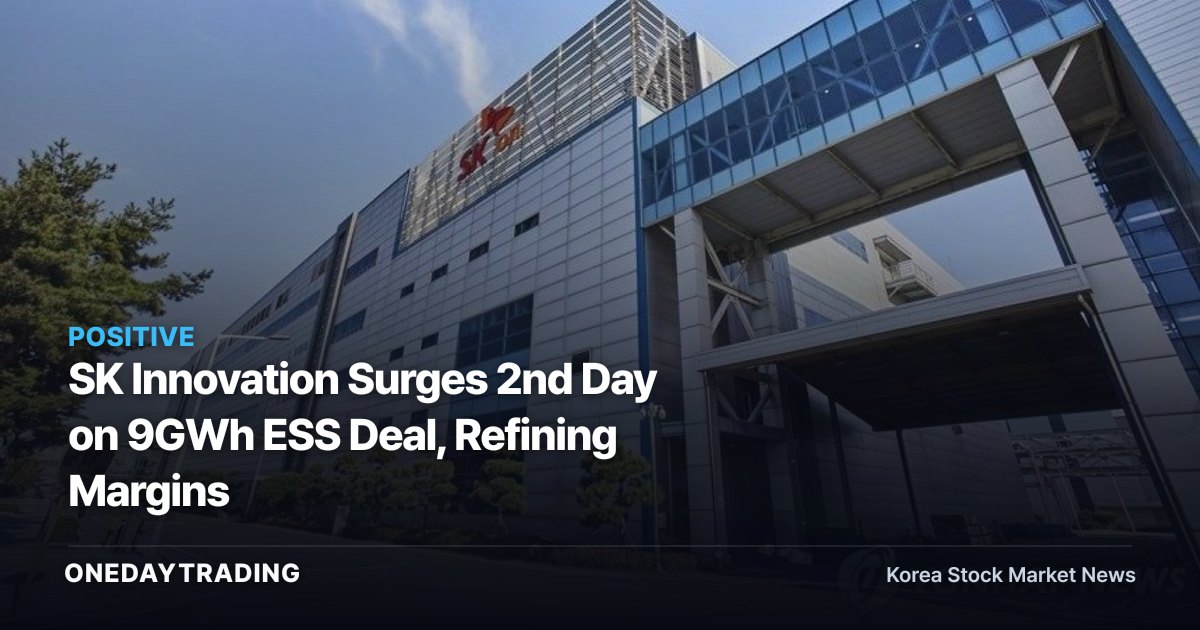
According to the Korea Exchange (KRX), SK Innovation posted a 7.01% sharp gain (surge) from the previous session to 134,200 won as of noon on the 1st. Following a 7.36% rise the previous day, this marked its second consecutive sharp gain (surge). The key driver was that SK On’s U.S. ESS deal established a floor for future revenue, while strong refining margins continued to support current profits.
Why It Matters Now
An ESS, or energy storage system, stores electricity for use when needed. SK On agreed to supply U.S.-based NeoVolta Power with 9GWh of lithium iron phosphate, or LFP, battery cells over five years from 2027 through 2031. The contract is estimated to be worth about 1.5 trillion won. That volume approaches half of the company’s 20GWh order guidance for this year. The market responded less to the deal’s size than to the visibility it provides. Expectations for the battery business had remained high despite the tension between capacity expansion and the demand chasm, but the contract now gives SK On a clear foothold in local U.S. demand.
However, the share-price move has more than one driver. In refining, surging oil prices and renewed tensions surrounding the Strait of Hormuz are keeping refining margins elevated. Shinhan Securities raised its forecast for SK Innovation’s operating profit this year by 7.3% to 9.2187 trillion won and lifted its price target from 190,000 won to 200,000 won. Analyst Lee Jin-myung expects refining operating profit of about 2 trillion won in the second half, following 2.9 trillion won in the first half. The current rally ultimately reflects the simultaneous reassessment of present earnings from refining and future upside from batteries.
It is important to distinguish between what the market has already priced in and what remains underappreciated. Strong refining margins may already be substantially reflected in the shares. By contrast, SK On’s ESS contract will begin generating revenue in 2027, so its immediate impact is more likely to narrow the valuation discount than to change near-term profit and loss. In other words, current earnings support the share price, while future prospects drive the valuation multiple higher.
Key Issues
- More important than the absolute value of SK On’s 9GWh deal is that it represents the company’s first clear entry into the U.S. ESS market. A large, long-term contract improves the quality of the order backlog and increases visibility for the battery division.
- Strong refining margins reflect earnings power created by supply disruptions, not a broad recovery in the refining industry sector. If tensions around the Strait of Hormuz ease and margins retreat, the pace of share-price gains could slow first.
- SK Innovation is not a stock (ticker) driven solely by refining. As the earnings mix among lubricants, refining and batteries changes, the basis for valuing the overall company is also shifting.
- The shares have recovered much of the decline caused by the recent SKIET merger issue, but merger expectations alone offer limited staying power. Ultimately, the numbers must confirm the case.
Impact on Related Stocks and Sectors
- SK Innovation: Refining margins and the ESS order are working simultaneously, supporting both upward earnings revisions and a valuation-multiple reassessment.
- S-Oil: If strong margins persist across the refining industry sector, earnings expectations should move in the same direction. However, faster restoration of refining facilities would reduce the upside.
- GS: With refiners highly sensitive to industry conditions, prolonged supply disruptions would broaden expectations for stronger profitability.
- LG Energy Solution: Expanding North American ESS demand enlarges the addressable market for battery-cell suppliers overall. It is significant as an alternative source of demand that can offset the electric-vehicle chasm.
- Samsung SDI: If ESS becomes established as a growth engine beyond electric vehicles, expectations for a larger share of premium batteries could continue.
Investor Considerations
- Investors should watch whether refining margins remain firm beyond the third quarter. A temporary oil-price spike is different from structural improvement.
- SK On’s 1.5 trillion won contract will begin contributing in 2027. It should not be overstated as a catalyst that immediately changes earnings.
- If USD/KRW moves toward 1,400 won per dollar, cost and inventory-valuation pressures could rise again. Refiners are affected not only by oil prices but also by the exchange rate.
- The next checkpoints are third-quarter earnings and disclosures of additional ESS orders. If the numbers do not follow through, expectations could cool rapidly.
Overall Outlook
If refining margins remain firm and additional ESS orders continue, SK Innovation could pursue further share-price rerating alongside upward revisions to this year’s profit estimates. Conversely, if tensions around the Strait of Hormuz ease and margins weaken, the pace currently priced into the shares is likely to slow first. The stock stands at the intersection of the refining cycle and battery growth. Refining therefore determines the short-term catalyst, while ESS underpins the medium-term thesis.
Frequently Asked Questions
Why does SK On’s ESS contract affect SK Innovation’s share price?
SK Innovation’s valuation reflects both the earnings and expectations of its battery subsidiary, SK On. The figures—9GWh, 1.5 trillion won and 2027-2031—are more than headline news; they improve visibility into future revenue. The market is currently prioritizing the secured long-term volume over concerns about losses in the battery business.
How long can strong refining margins last?
Margins could remain elevated if Middle East tensions and supply disruptions persist. However, the current strength could fade if facilities return to operation more quickly or the geopolitical risk premium declines. Refining margins should therefore be assessed through actual spread data rather than news headlines.
Should investors focus on refiners or battery stocks now?
Both matter, but their roles differ. Refining and lubricants currently generate the profits, while batteries help reduce the discount applied to future value. Investors should monitor whether refining profit in the next quarterly earnings maintains the first-half pace of 2.9 trillion won and whether SK On secures additional ESS orders.
SK Innovation Key MetricsAs of 2026-09-01
| Period Returns | 1 Week +6.88% 1 Month +20.90% |
|---|---|
| Trading Value · Trading Volume | 257.9 billion won · 1,911,349 shares |
| Supply-Demand (Order Flow) | Foreign Investors Net buying of 18 billion won (3 consecutive days) Institutional Investors Net buying of 36.6 billion won |
| Recent News Tone | Positive Catalysts 4 · Negative Catalysts 5 |
Real-time price and supply-demand (order flow) data are provided by Korea Investment & Securities (KIS), while supply-demand (order flow) and news-tone figures are calculated independently by One Day Trading.
Supply-Demand (Order Flow) and Momentum Assessment🟢 Buying Advantage
Foreign investors, institutional investors and momentum are positive, making the stock worth watching.
- ▲Order-Flow ContinuityForeign investors posted net buying for 3 consecutive days (+18 billion won)
- ▲Joint BuyingForeign investors +18 billion won · institutional investors +36.6 billion won in combined buying
- ▲Trend AlignmentShort- and medium-term uptrends aligned (day +6.5% · 1 week +6.9% · 1 month +20.9%)
Upcoming Dates to Watch
- 09.10Futures and Options ExpirationMediumQuadruple witching — watch for volatility and supply-demand (order flow) disruptions
- 09.16FOMC Policy-Rate DecisionHighFederal Reserve monetary-policy announcement — direction of interest rates and the dollar
- 10.08Index Options ExpirationLowKOSPI 200 options expiration
- 10.22Bank of Korea Monetary Policy BoardHighBenchmark interest rate decision meeting
This article was automatically summarized and analyzed from the original news report. View the original article (Maeil Business Newspaper Securities)