
At a Glance
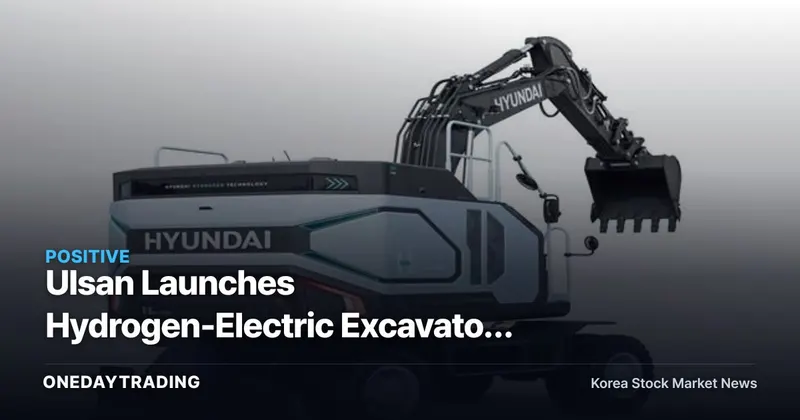
Ulsan City has begun a commercialization pilot to convert the power source of excavators—key equipment on construction sites—from diesel to hydrogen-electric. This should be read not as a one-off eco-friendly campaign, but as a signal that hydrogen mobility, which had until now been confined to passenger cars and buses, is extending its front line into industrial heavy equipment.
From an investment standpoint, the key is less about excavator manufacturers themselves and more about the scalability of downstream demand flowing into hydrogen powertrains and charging infrastructure. That said, since this is still at the pilot stage, it makes more sense to approach it as a medium-term theme rather than an immediate earnings variable.
Why It Matters Now
Construction equipment operates for long hours and requires high output, so battery electrification alone has clear limits. Because of charging time and weight constraints, hydrogen fuel cells or hydrogen engines have been discussed as the realistic alternative, especially for larger equipment. Ulsan has the most advanced hydrogen production and pipeline infrastructure in Korea, so the pilot's credibility and scalability are viewed more favorably than similar pilot projects in other local governments.
On the policy side, aging diesel equipment at construction sites is also a direct target of fine-dust and carbon emissions regulations. If public-sector projects gradually introduce bonus points or mandates for zero-emission equipment, the initial market is likely to be opened first by institutional demand. This is favorable for related companies, since policy-driven demand is more predictable than voluntary private-sector demand.
On the other hand, the fact that hydrogen unit costs, charging station density, and equipment prices remain higher than diesel is a constraint that will slow the pace of commercialization. It's important to separate the idea that a successful pilot does not automatically translate into mass production or revenue.
Frequently Asked Questions
- Why hydrogen for excavators? Large heavy equipment needs high-output operation over long periods, which runs into battery charging time and weight limitations—making hydrogen, with its fast refueling and long operating time, a compelling alternative.
- Will this show up in earnings right away? This is currently at the pilot stage, so technology validation and the formation of policy-driven demand come before revenue. It will only become an earnings variable once mass-production timelines and order volumes are confirmed.
- Who benefits most directly? Companies supplying hydrogen engine/fuel cell powertrains and hydrogen tanks/charging infrastructure may see a larger expansion in downstream demand than excavator manufacturers themselves.
- What are the risks? Hydrogen prices, a shortage of charging stations, higher upfront costs versus diesel, and delays in policy implementation are the key variables that will determine the pace of commercialization.
Related Stocks (Tickers) and Sector Impact
- HD Hyundai Infracore As a manufacturer that has been developing both excavators and hydrogen engines, it sits at the direct intersection of the shift to zero-emission heavy equipment.
- HD Hyundai Construction Equipment With a lineup that includes excavators and other construction machinery, it stands to benefit from a shift in its product portfolio as demand for eco-friendly equipment grows.
- Doosan Bobcat Centered on small construction equipment, it is within the scope of the shift toward eco-friendly power, but with a large share of revenue coming from North America, the impact of domestic Korean policy is likely limited.
- Hydrogen tank and materials stocks (tickers) Companies like Iljin Hysolus, which make high-pressure hydrogen tanks, could see broader downstream demand as the need for storage capacity for heavy equipment grows.
- Hydrogen infrastructure and heavy industry Companies such as Hyosung Heavy Industries, which build charging stations and hydrogen supply facilities, are tied to the infrastructure investment that is a prerequisite for equipment adoption.
Investment Considerations
- Piloting and commercialization are two different things. Until mass-production timing, unit costs, and order volumes are confirmed, investors should be cautious of theme-driven volatility.
- Since hydrogen unit costs and charging infrastructure density will determine economic viability, keep an eye on government subsidies and infrastructure budget trends.
- Construction equipment makers are sensitive to global infrastructure investment cycles and exchange rates, so it's important to distinguish between the eco-friendly theme and core business conditions.
- Many related stocks (tickers) may already reflect some hydrogen-related expectations, which could create valuation burden.
Overall Outlook
If institutional demand and Ulsan's infrastructure advantage align, zero-emission heavy equipment could form an initial market by using public-sector projects as a springboard, with the benefits spreading across powertrains, hydrogen tanks, and charging infrastructure. However, if even one of the three variables—unit cost, infrastructure, or policy pace—lags, commercialization will be delayed. The next things to watch are the announcement of pilot results, whether zero-emission equipment mandates are adopted in public-sector procurement, and disclosures of hydrogen powertrain orders from related companies.
This article is automatically summarized and analyzed content based on the original news source. View Original (Yonhap News Industry)