
Summary
The fact that Argentina holds the world's second-largest shale gas reserves is less about energy prices and more about the value of having more sourcing options. For Korea Gas Corporation and the refining, chemical, and battery value chains, this reads not as an immediate earnings driver but as a variable that could lower mid-to-long-term costs and the supply-chain risk premium.
The core of this South American tour goes beyond simply widening the pool of resource-import sources. If the resumption of Mercosur trade negotiations, the modernization of the Korea-Chile FTA, and critical minerals cooperation move forward together as a package, the supply-chain uncertainty that has weighed on valuations in the energy, battery, and shipbuilding sectors could ease somewhat.
What Happened
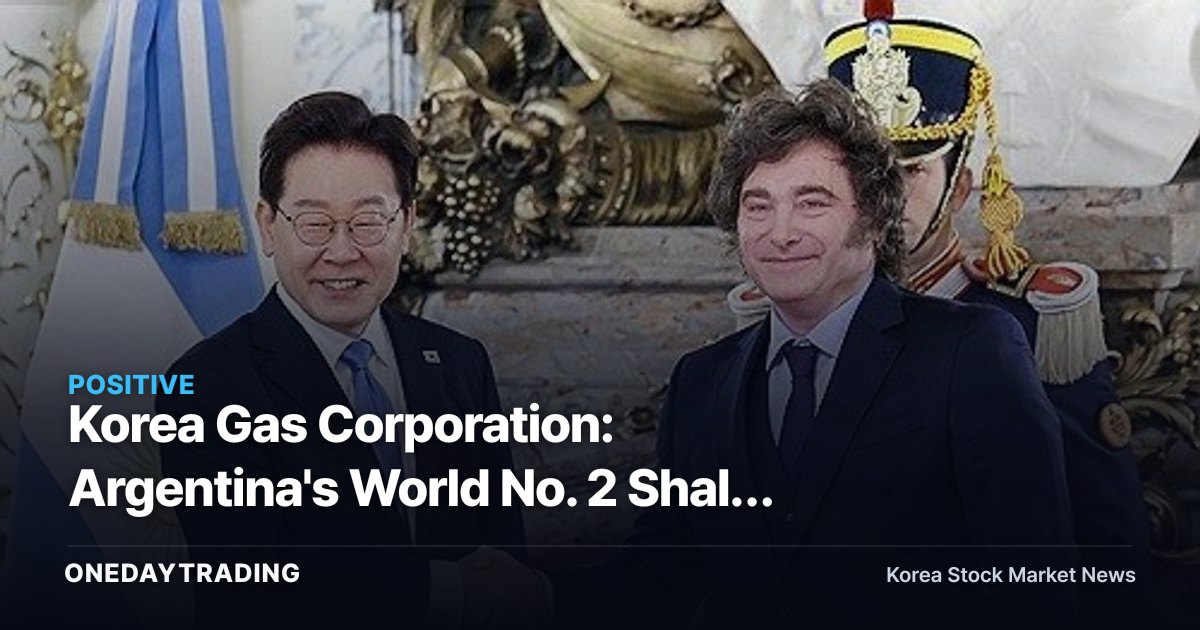
During his tour of the United States and three South American countries, President Lee Jae-myung stated that relations between Korea and South America have entered a new phase. The countries visited were Brazil, Chile, and Argentina. According to the presidential office, Brazil was presented as holding the world's second-largest rare earth reserves, Chile the world's largest copper and lithium reserves, and Argentina the world's second-largest shale gas reserves as well as the world's top exporter of soybean oil.
On the surface, this is a diplomatic itinerary. But markets look past diplomatic language to the actual commodities involved. Shale gas affects power generation, city gas, and petrochemical feedstock prices, while lithium, copper, and rare earths affect the cost curves of batteries, power grids, and electronic vehicle components. The resilient supply chain the president referred to functions, for domestic companies, much like an insurance premium that reduces dependence on any single region.
The resumption of Mercosur trade negotiations falls in the same category. What matters more than lower tariffs is the predictability of contracts. Energy and mineral projects only generate cash flow when exploration, infrastructure, transport, and long-term purchase agreements are all in place. Without a rules-based trade framework, companies may see the resources but still delay investment decisions.
Structural Backdrop
Rising power demand in the AI era, the restructuring of battery supply chains, and expanding protectionism all point to the same conclusion: an uninterrupted supply of raw materials is now valued more highly than a cheap one. Korea is strong in manufacturing and exports but vulnerable to external variables in energy and critical minerals. South America holds the complementary assets that can offset this weakness.
What the market has not yet fully priced in, however, is the pace of these agreements. Presidential remarks set the direction, but share prices move only once purchase agreements, joint ventures, investment approvals, and transport infrastructure are confirmed. We are still at the early stage of expectations. For multiples to expand, this diplomatic agenda needs to translate into long-term corporate contracts.
Stock (Ticker) and Sector Impact
- Korea Gas Corporation (KOGAS): Cooperation on Argentine shale gas broadens the options for diversifying LNG and gas procurement. More sourcing options could improve negotiating leverage during periods of sharp gain (surge) in prices, but the actual impact will depend on whether long-term supply contracts are actually signed.
- POSCO Holdings: Cooperation on South American critical minerals ties into the narrative of securing lithium and other mineral feedstock. A valuation-chain premium is added once this extends to mining rights, processing, and battery materials.
- LG Energy Solution: A stable supply of raw materials such as lithium and copper lowers cost volatility for cell makers. However, near-term selling prices are tied to customer contract structures, so it is premature to assume that cost stability will directly translate into wider margins.
- Samsung SDI: As demand for high-value-added batteries and ESS grows, the stability of critical mineral sourcing becomes more important. Supply-chain diversification is a factor that can lower the risk premium in order-negotiation processes.
- HD Korea Shipbuilding & Offshore Engineering: If South American energy development expands into export projects, expectations for demand in LNG carriers and offshore facilities would rise. However, actual orders require resource-development decisions and financing to be secured first.
Bull vs. Bear Scenarios
The bullish scenario is clear. If the resumption of Mercosur negotiations is locked into an actual trade schedule, and long-term purchase agreements for Argentine gas or South American critical minerals are disclosed, the discount rate applied to energy and battery-materials stocks would decline. In that case, the market would be pricing in cost stability and order prospects — not just a theme.
The bearish scenario also deserves attention. Resource development is exposed to politics, permitting, exchange rates, and logistics as variables. Argentina offers compelling resources, but it is a market where policy continuity and the financial environment still need to be verified. If expectations get priced in first and contracts are then delayed, the supply-chain theme could cool off quickly. What the market has already bought is the direction; what it has not yet bought are the numbers.
Investor Action Points
- Watch for joint statements, MOUs, and company-specific contract disclosures during the South American tour, which runs through August 3.
- Check whether the resumption of Mercosur trade negotiations translates into a concrete working-level schedule. Without a set timeline, the theme's staying power will be weak.
- For Korea Gas Corporation, track long-term supply contracts, procurement unit prices, and receivables trends together in the next earnings report.
- For battery stocks, actual disclosure of lithium prices, customer orders, and named material-procurement contracts matters more than announcements of mineral cooperation alone.
Korea Gas Corporation: Real-Time Data Snapshot
Korea Gas Corporation's most recent closing price was 34,450 won (0.00% versus the previous session), and the composite signal — combining foreign investors/institutional investors order flow with news and momentum — reads 🔴 Caution. Since foreign investors and institutional investors are net negative, caution is warranted right now.
- ▼ Dual selling — foreign investors −900 million won and institutional investors −500 million won, selling in tandem
※ Price and foreign/institutional order-flow data are provided by Korea Investment & Securities (KIS) and are current as of the time of publication.
This article was automatically summarized and analyzed based on the original news report. View original (Yonhap News, Industry)