
At a Glance
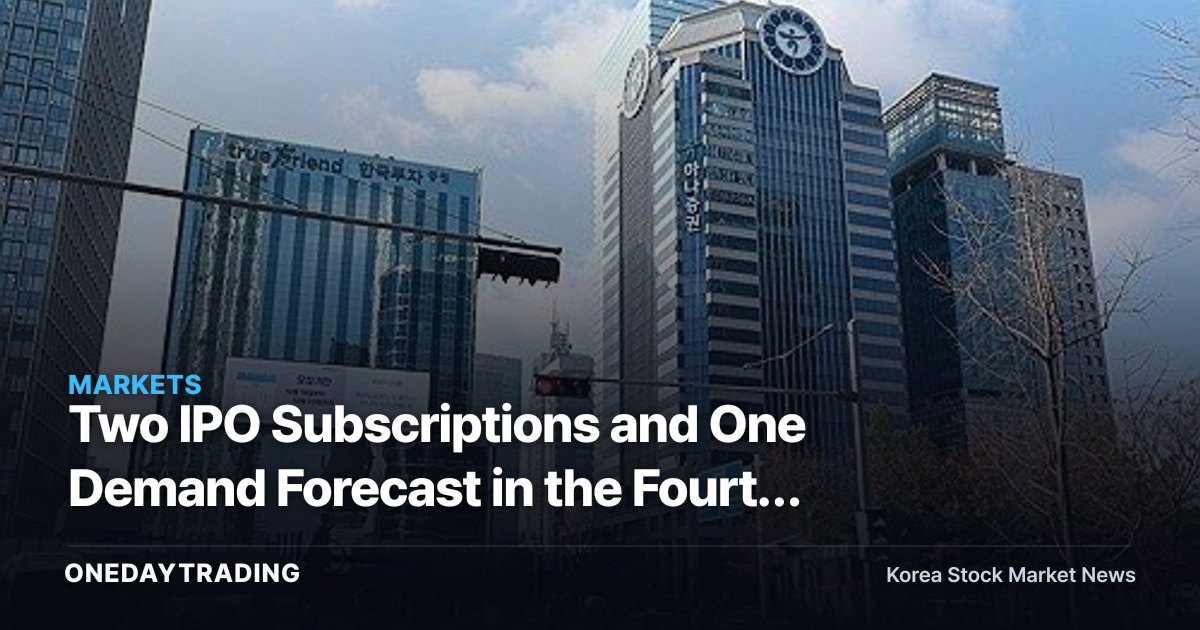
In the fourth week of June, Korea's IPO market has a relatively quiet schedule: no companies are newly listing, with two general public-offering subscriptions and one institutional demand forecast. It has the character of a lull, with major deals absent, but the offer-price determination process and subscription competition ratios serve as leading indicators for gauging the IPO mood in the second half.
Why It Matters Now
An IPO calendar may look like a simple schedule of events, but for investors it carries two pieces of information. First, demand-forecast results are a yardstick for how far institutional investors are willing to accept current valuations. The demand-forecast competition ratio and where the offer price is finalized (at the top or bottom of the indicative range) reflect the strength of the market's risk appetite.
Second, IPO issuance volume and frequency are directly tied to brokerages' IPO underwriting fee revenue. When the number of listings falls or offering sizes shrink, the contribution from underwriting earnings weakens; conversely, when major deals cluster, investment banking (IB) division profits improve. A stretch like this week, with no new listings, has weak short-term momentum in itself, but whether the stocks (tickers) entering demand forecasting prove popular influences the price expectations for the subscription pipeline that follows.
Frequently Asked Questions
- If there are no new listings, are there no investment opportunities? The absence of new listings only means there are no opportunities to trade listing-day volatility; subscriptions and demand forecasts are separate events. Participating in a subscription is itself an act of investing.
- Why does the demand forecast matter? Because the institutional demand-forecast competition ratio and the mandatory lock-up commitment ratio determine the offer price and the early supply-demand (order flow) after listing.
- What signal does a quiet week send? It may simply be a scheduling gap around quarter-end, but it could also be a sign of caution, with issuers delaying their schedules while reading the market mood.
- What should you check before subscribing to an IPO? The basics are to check the offer-price band, the institutional commitment ratio, and the proportion of freely tradable shares immediately after listing.
Impact on Related Stocks and Sectors
- Brokerage industry sector: IPO underwriting fees feed into IB division earnings. The greater the issuance frequency and size, the greater the benefit; when they shrink, the contribution weakens.
- Brokerages underwriting large IPOs: The stronger a house's deal track record, the more sensitively its earnings are linked to the issuance cycle.
- IPO funds and high-yield funds: Products that leverage priority IPO allocations have returns that hinge on subscription popularity.
- KOSDAQ small- and mid-cap stocks: New listing supply acts as a benchmark for comparing the supply-demand (order flow) and valuations of existing stocks in the same industry sector.
Points to Watch When Investing
- It is hard to label a quiet schedule itself as a positive catalyst or a negative catalyst. Judgment should rest on the demand-forecast results of individual deals.
- Even with a high subscription competition ratio, a large volume of freely tradable shares immediately after listing can amplify early volatility.
- Keep in mind that if the offer price is finalized at the top of the indicative range, there may be limited room for further upside after listing.
- When investing in brokerage stocks, IPO momentum should be viewed alongside other variables such as trading value and the interest-rate environment.
Overall Outlook
If major deals resume in the second half and demand forecasts prove popular, a virtuous cycle is possible in which brokerage IB division earnings and IPO-investing sentiment improve together. However, the risk persists that, should interest-rate and stock-market volatility rise, issuers will delay their schedules, leading to a contraction in issuance. Checking the competition ratio and where the offer price is finalized for the stocks (tickers) entering demand forecasting this week provides a clue for reading the strength of the IPO cycle ahead.
This article is content automatically summarized and analyzed based on the original news report. View original (Yonhap News, Securities)