
At a Glance
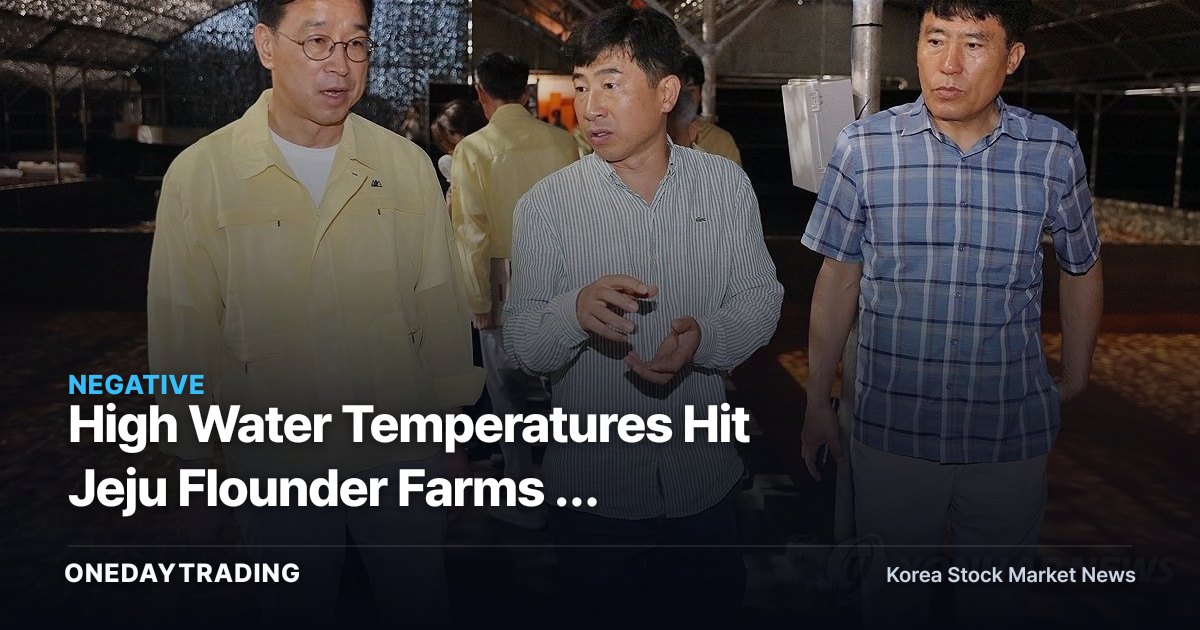
High water temperatures aren't a revenue problem for flounder farms — they're a variable that shakes both production costs and survival rates at once. Jeju Governor Wi Seong-gon's visit to a damaged farm on the 1st, along with his remarks on possible regulatory improvements for using brackish groundwater, signals that Jeju's fisheries industry is beginning to treat climate risk as a capital-investment issue rather than a one-off disaster.
Let's break it down. What the press release tells us is that a field inspection took place and regulatory improvements are under review. What the data doesn't yet show is the scale of fish deaths, recovery costs, insurance coverage ratios, and the extent of cash-flow damage at individual farms.
Why It Matters Now
For land-based flounder farming, water-temperature management is essentially the profit-and-loss statement. As water temperature rises, fish stress and mortality risk increase, and the use of oxygen supply and circulation equipment goes up. Even with the same production volume, electricity and maintenance costs rise first. As the number of shippable fish declines, revenue follows downward. That's why high-water-temperature damage isn't simply a natural disaster — it's an event that compresses farms' margin structure.
The review of brackish groundwater use matters to investors because of the direction of the cost curve. In a structure that draws directly from seawater, recurring high temperatures require investment in cooling, oxygen supply, and backup tanks. Conversely, if brackish groundwater with relatively stable temperatures can be used within a regulatory framework, some farms would gain a means of defending survival rates. However, this effect won't show up in earnings immediately — it must first clear hurdles around securing water sources, permitting, water-quality management, and equipment-conversion costs.
What the market has already priced in is the seasonality of summer seafood-supply anxiety. What remains underpriced is the rise in Jeju aquaculture's fixed costs. At this stage, with damage figures not yet disclosed, it's difficult to immediately adjust earnings estimates for related listed companies. But if production disruptions at fish farms persist, pressure will flow in sequence to wholesale prices, food-service input costs, and raw-material procurement costs for seafood processors.
Frequently Asked Questions
- Why is flounder the key focus? Flounder is the flagship species at Jeju's land-based fish farms. High water temperatures affect mortality rates and management costs before growth rates, hitting both shippable volume and production costs at the same time.
- Why was brackish groundwater brought up? It's an alternative aimed at reducing dependence on high-temperature seawater and securing temperature stability. Since regulatory improvement is now under review, permitting and regulation are the real bottleneck.
- Will seafood prices rise right away? That's hard to say definitively. Damage scale, inventories, and supply from alternative producing regions all need to be considered together. That said, if fish deaths and shipment delays are confirmed, the likelihood of price pass-through increases.
- Are all related stocks (tickers) beneficiaries? No. Seafood processors could see margins squeezed by rising raw-material costs, while feed and equipment makers only benefit if farms actually have the capital to invest and place orders.
Related Stocks (Tickers) and Sector Impact
- Dongwon Industries. Seafood supply anxiety could be favorable for prices, but procurement costs and inventory management move in tandem. It's an oversimplification to call it a direct beneficiary of aquaculture damage.
- CJ Seafood. For seafood processed-food companies, the speed of pass-through to selling prices when raw-material costs rise is the key issue. Supply terms with major distribution channels will determine margin resilience.
- Sajo Seafood. Given its exposure to seafood distribution and processing, it's sensitive to supply-disruption news. Rising prices are good for revenue per unit, but could inflate cost burdens first.
- Aquaculture feed and equipment makers. If responding to high water temperatures becomes a recurring investment need, demand should emerge for oxygen supply, recirculating filtration, and temperature-control equipment. Paradoxically, though, the greater the damage to fish farms, the less capital they have available to invest.
Investment Considerations
- Damage scale and mortality figures. This news did not present a specific damage figure. Follow-up tallies from Jeju Province and marine and fisheries authorities should be checked first.
- Pace of regulatory improvement. Use of brackish groundwater is still under review. The actual scope of approval, water-quality standards, and intake restrictions need to be finalized before the investment and cost-savings impact can be calculated.
- Pricing power. If seafood processors cannot pass rising raw-material costs on to their selling prices, margins will erode before revenue does.
- Recurrence of climate risk. If high water temperatures recur every year, the burden of preventive equipment investment becomes more important than disaster-recovery costs — and this is where the gap widens between small-scale farms and large operators.
Overall Outlook
The optimistic scenario is clear: if regulatory improvements for using brackish groundwater are quickly finalized and farms strengthen their temperature-management systems, volatility in Jeju's flounder supply should decrease. In that case, seafood distributors and processors would benefit from more stable raw-material procurement.
The trigger for the downside scenario is the damage tally. If mortality figures come in larger than expected, or if regulatory improvement stalls at the review stage, the market is more likely to see cost pressure before any seafood price increase. The next indicators to watch are Jeju Province's follow-up damage assessment, changes to ordinances and permitting related to brackish groundwater use, and summer wholesale flounder prices. Right now is not a stage for picking beneficiary stocks (tickers) — it's a stage for determining who can absorb the costs.
Dongwon Industries in Real-Time Data
The most recent closing price for Dongwon Industries is 5,460 won (+1.11% versus the prior session), and the signal combining foreign investors/institutional investors supply-demand (order flow) with news and momentum reads 🟡 Neutral / Wait-and-see. With positive and negative signals mixed, this is a stock (ticker) to watch closely.
- ▼ 52-Week Range Position — Near 52-week low, at the 12% mark
※ Price and foreign/institutional investors supply-demand (order flow) data are provided by Korea Investment & Securities (KIS) and reflect the time of publication.
This article is automatically summarized and analyzed content based on the original news report. View original (Yonhap News Industry)