
Key Takeaways
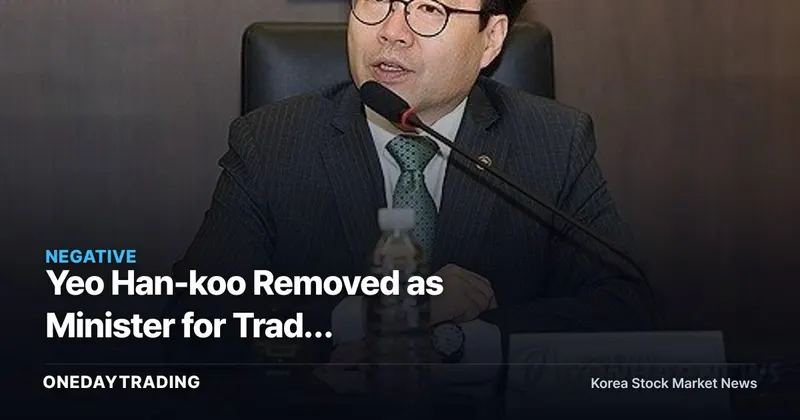
Yeo Han-koo, Minister for Trade Negotiations at the Ministry of Trade, Industry and Energy, has been removed from his position. Given that he was the figure who led working-level negotiations during last year's Korea-US tariff talks, this personnel move reads not as a routine reshuffle but as a signal aimed at the operating structure of the trade negotiation line itself. The key question is the direction of the successor appointment and how large a gap it will leave in the ongoing negotiation track.
What Happened
According to a Yonhap News report, Minister for Trade Negotiations Yeo Han-koo has been removed from his post. He had served as the working-level commander on major trade issues, including last year's Korea-US tariff negotiations. The Minister for Trade Negotiations is the post within the Ministry of Trade, Industry and Energy responsible for overseeing external negotiations, standing on the front line of tariff and non-tariff barrier talks in direct contact with counterpart negotiating teams.
This dismissal carries added weight because the negotiations are still ongoing. The fact that the working-level official who sat at the negotiating table has been replaced is itself a variable the market needs to read, separate from the question of any one individual's career. The timing and identity of the successor could change both the pace and tone of the negotiations.
Background and Context
Since last year, Korea has been negotiating with the United States over items with heavy exposure to US exports amid Washington's tariff policy tightening. The figure who led those working-level negotiations was none other than Minister Yeo Han-koo. Because trade negotiations are not resolved in a single agreement but involve ongoing compliance checks and follow-up rounds, continuity in the working-level team is treated as a variable nearly as important as the negotiation outcome itself.
Impact on the Market and Stocks (Tickers)
- Industry sectors with high exposure to US exports, such as automobiles, steel, and semiconductors, are sensitive to continuity in the negotiating line. If the detailed implementation terms of the tariff agreement are reopened for review following the change in working-level staff, earnings guidance uncertainty for these sectors could increase.
- The KRW/USD exchange rate is a key indicator that reacts to uncertainty in trade policy. The longer the negotiation vacuum lasts, the greater the exchange rate volatility, which directly affects the valuations of export-oriented stocks.
- Sectors such as oil refining and chemicals, whose cost structures hinge on the outcome of tariff and non-tariff barrier negotiations, also need to watch the successor appointment and any announcement on negotiating stance.
- Across financial markets broadly, the impact of this leadership change in trade policy on external credibility indicators warrants monitoring. How the counterpart country interprets the change in working-level staff could itself alter the schedule for the next round of talks.
Investor Checkpoints
- The timing of the announcement of the next Minister for Trade Negotiations and the explanation given for the background
- The schedule for the next round of Korea-US tariff negotiations and the content of official government briefings
- Short-term movement in the KRW/USD exchange rate, particularly whether the 1,300 won level holds
- Whether negotiation-related variables are reflected in the earnings guidance of industry sectors with heavy exposure to US exports
Outlook
On an optimistic view, if this personnel change turns out to be a move to accelerate the negotiations as they approach a final stage, the market could interpret it as a resolution of uncertainty rather than a new risk. If the government swiftly confirms a successor and makes clear there will be no change in negotiating stance, this trade-related risk is likely to be absorbed as a short-term event.
The picture changes, however, if the vacuum in the working-level team drags on. It takes time for the negotiating counterpart to rebuild rapport with a new counterpart, and in the meantime, compliance checks or follow-up negotiation schedules could be pushed back. In that case, the risk could be priced into the market in the form of won weakness and erosion of the valuation premium on export stocks. The next indicators to watch are the announcement of the successor and the level of the KRW/USD exchange rate at that time.
This article was automatically summarized and analyzed based on the original news report. View original (Yonhap News, Industry)