
At a Glance
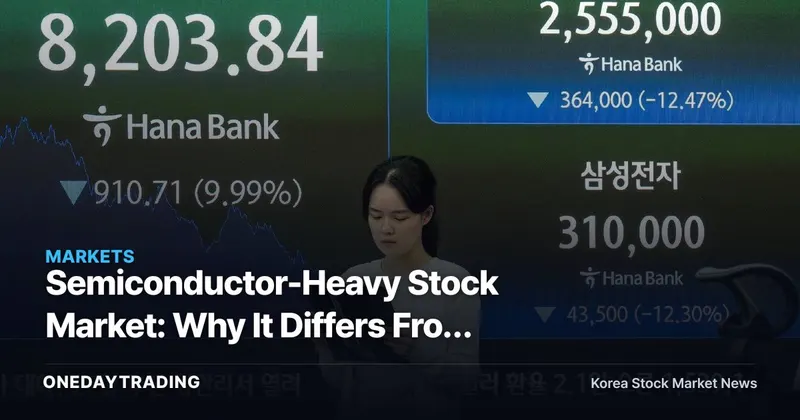
This year's KOSPI rally has relied heavily on a single semiconductor axis, and Samsung Electronics (005930) ceding the No. 1 spot in KOSPI market capitalization for the first time in 25 years and 7 months is not a mere ranking shuffle — it shows that the center of gravity among market-leading stocks is being reshuffled within the memory cycle.
Concentration itself doesn't necessarily signal a bubble collapse, but it's worth noting that the more the index's resilience is tied to a handful of stocks, the greater the volatility risk becomes.
Why It Matters Now
When an index is driven by one or two stocks (tickers) in a single industry sector, the risk grows that the entire index will correct in tandem if that sector's earnings estimates waver. With the semiconductor sector's weight in KOSPI now overwhelming, this means demand for AI-server high-bandwidth memory (HBM) and DRAM price trends are directly tied to the index's direction.
Behind the crack in Samsung Electronics' long-held No. 1 market-cap position lies its relative standing in the HBM competitive landscape. Even when the memory industry overall is thriving, share-price performance diverges within the same sector depending on who secures high-value-added products first.
The lesson of the dot-com bubble isn't that the underlying technology itself was fiction — it's that stocks whose valuations inflated on expectations alone, detached from earnings, were the ones that collapsed. Today's semiconductor rally differs in tone in that it's underpinned by an actual earnings foundation — real AI investment and memory demand — but in segments where expectations have already been priced in, even a single signal of earnings deceleration can trigger a sensitive reaction.
Frequently Asked Questions
- Is today's semiconductor concentration the same as the dot-com bubble? It differs in that it's backed by an actual earnings foundation, but it shares the volatility risk that comes with heavy dependence on a small number of stocks.
- What does Samsung Electronics losing the No. 1 market-cap spot signify? It's a signal that, even within a memory upcycle, share prices diverge based on competitiveness in high-value-added products such as HBM.
- If the concentration eases, what would rise? Rotation could flow into overlooked industry sectors (materials, industrials, domestic-demand plays) where earnings improvement is confirmed, though this isn't guaranteed.
- What are the key indicators for retail investors to check? DRAM and HBM price trends, quarterly earnings guidance, and foreign net buying flows.
Related Stocks and Sector Impact
- SK Hynix — The key stock (ticker) benefiting disproportionately within the memory cycle thanks to its early lead in HBM.
- Samsung Electronics — Whether it can catch up in HBM and restore foundry utilization rates will determine whether it reclaims the No. 1 market-cap spot.
- Semiconductor equipment/materials suppliers (e.g., Hanmi Semiconductor) — A structure in which expanded investment in HBM back-end processes translates into rising downstream demand and, in turn, earnings.
- The KOSPI index itself — With such a heavy semiconductor weighting, the memory industry cycle dictates the index's direction.
- Overlooked domestic-demand and materials sectors — There's hope for rotational buying if the concentration eases, but this hinges on confirming earnings momentum.
Points to Watch for Investors
- The more index gains are concentrated in a small number of stocks, the bigger the index-wide impact of any negative catalyst hitting one of them.
- In segments where AI-related expectations are already priced in, a downward revision to earnings estimates can quickly trigger a correction.
- Memory prices are highly cyclical, so investors should keep in mind the potential for increased volatility following a short-term sharp gain.
- Changes in competitors' HBM qualification and mass-production schedules can quickly shift the competitive standing between stocks (tickers).
Overall Outlook
If AI infrastructure investment continues and HBM demand stays firm, the semiconductor-led rally can extend on the back of genuine earnings support. That said, an index structure so dependent on a handful of stocks is also a factor that can amplify any correction if memory prices soften or earnings estimates are revised down. Investors should use next quarter's earnings guidance, HBM supply-contract disclosures, and DRAM spot-price trends as yardsticks for confirming the substance behind the earnings, taking an approach that checks both the intensity and durability of this concentration.
SK Hynix: A Real-Time Data Snapshot
SK Hynix's most recent closing price was 2,580,000 won (+0.98% from the previous day), and the signal combining foreign/institutional supply-demand (order flow) with news and momentum reads 🟡 Neutral / Wait-and-see. With positive and negative signals mixed, this is a segment to watch closely.
- ▼ Supply-Demand (Order Flow) Continuity — Foreign investors have been net sellers for four straight days (−3.63 trillion won)
- ▲ Trend Alignment — Short- and medium-term trends aligned to the upside (+1.0% today · +8.3% over 1 week · +33.0% over 1 month)
- ▲ 52-Week Range Position — In the upper 52-week range at 86% — near 52-week-high territory
Recent related news skews favorable, with 19 positive catalysts versus 14 negative catalysts.
※ Price and foreign/institutional supply-demand (order flow) data are provided by Korea Investment & Securities (KIS) and reflect the time of publication.
This article is auto-summarized and analyzed content based on the original news report. View original (Maeil Business Newspaper, Securities)