
Three-Line Briefing
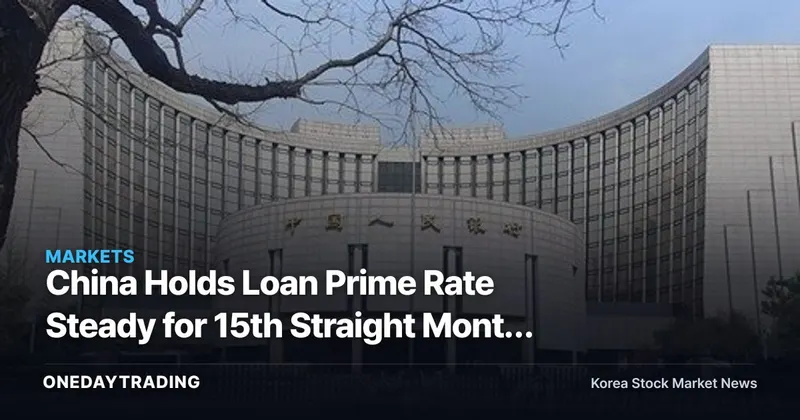
- The People's Bank of China (PBOC) kept the 1-year loan prime rate (LPR) at 3.0% and the 5-year rate at 3.5%, extending the streak of unchanged rates to 15 consecutive months.
- The hold matched market expectations, but given that there was room to cut, it signals the PBOC's priorities are tilted toward protecting bank margins and stabilizing the yuan rather than stimulating growth.
- Domestic stocks (tickers) linked to Chinese consumption and infrastructure demand — cosmetics, duty-free, steel, and petrochemicals — remain indirectly exposed through the KRW/CNY exchange rate channel.
What's Changing
The loan prime rate is the lowest lending rate Chinese banks offer to top-tier corporate borrowers, effectively serving as China's benchmark interest rate. Since the 1-year rate anchors general corporate lending and the 5-year rate underpins long-term credit such as mortgages, a frozen rate means borrowing costs for Chinese households and businesses have stayed unchanged. The real issue isn't direction — it's duration. Over these 15 months, China's inflation and property indicators have continued to flash weak signals, yet the PBOC has held off from acting.
It would be premature to read this as China abandoning stimulus altogether. In practice, the PBOC has been relying more heavily on indirect tools — reserve requirement ratio adjustments, reverse repo operations, and special government bond issuance — rather than the LPR as its main policy signal. Keeping the LPR frozen reflects a judgment that further cuts could undermine bank system soundness given already-thin net interest margins, compounded by concern that a widening rate gap would intensify capital outflow pressure on the yuan. Since markets had already priced in the PBOC's limited room to maneuver, this hold itself came as no surprise.
Numbers in Context
The current levels — 3.0% for the 1-year rate and 3.5% for the 5-year rate — are already sharply lower compared to the pre-2019 era, when rates sat in the 5% range. In other words, the PBOC has steadily cut rates over recent years, and it isn't so much out of room to cut further as it has reached a point where further cuts would carry side effects outweighing the benefits. As long as this assessment holds, Chinese monetary policy is likely to shift from broad-based easing toward targeted support for specific sectors such as real estate and local government debt.
Stocks to Watch
- Amorepacific — Since cosmetics demand depends on an organic recovery in Chinese consumer spending power rather than policy stimulus, a prolonged rate hold pushes back the timeline for a rebound in China-driven revenue.
- Hotel Shilla — Duty-free revenue is directly tied to Chinese inbound tourism demand, and delays in stimulating China's domestic consumption also slow the recovery in outbound travel spending.
- POSCO Holdings — China's property and infrastructure investment is a key pillar of steel demand; if the property market management stance implied by the LPR hold persists, oversupply of Chinese steel and pricing pressure could continue.
- Lotte Chemical / LG Chem — With China's petrochemical self-sufficiency rising alongside slowing demand, China's accommodative yet limited monetary policy is a backdrop that slows any recovery in spreads.
Risk Check
- An LPR hold does not mean an end to monetary easing — stimulus can continue through indirect tools such as reserve requirement ratio cuts or special government bond issuance.
- If the yuan weakens further, the KRW/USD exchange rate tends to come under corresponding pressure, which could undermine expectations for FX-driven gains among domestic exporters.
- With China's property market risks still unresolved, the frozen 5-year rate points to underlying fragility in the long-term credit market.
- The PBOC's next move will also hinge on whether the policy rate spread with the U.S. Federal Reserve widens or narrows going forward.
Bottom Line
The PBOC's 15-month rate hold isn't a signal that it has given up on growth — it signals that the channel for easing has shifted away from rates toward other tools. The next indicators to watch are whether the reserve requirement ratio is adjusted later this month and at what level the KRW/CNY exchange rate begins to move again.
This article was automatically summarized and analyzed based on the original news report. View original (Yonhap News Securities)