
Key Takeaways
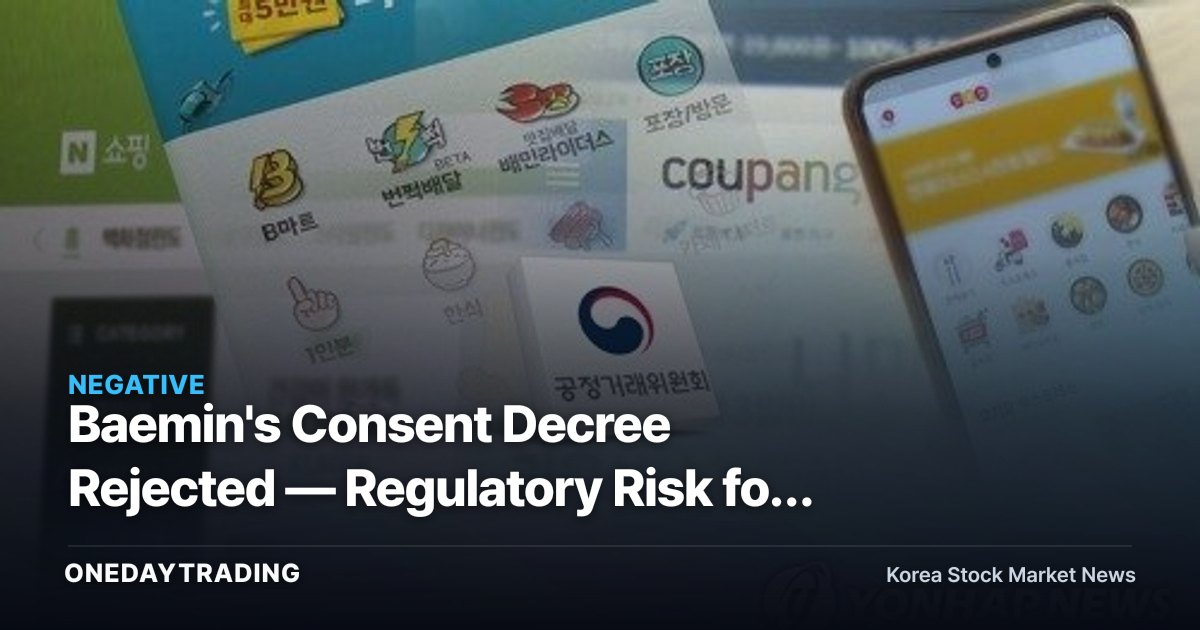
The Fair Trade Commission (FTC) has rejected the consent decree filed by Woowa Brothers, the operator of Baedal Minjok (Baemin), meaning the dispute over commission fees will now proceed to a formal sanctions process rather than voluntary remediation. With regulatory uncertainty rising once again across the delivery platform industry sector, this carries significance beyond a routine administrative procedure from an investor's standpoint.
At its core, this signals that the platform's small-merchant cooperation proposal failed to meet the regulator's standards, suggesting that institutional pressure on commission and settlement structures is likely to persist going forward.
What Happened
On the 18th, Woowa Brothers stated that it found the rejection of the consent decree it had filed with the FTC regrettable from the standpoint of fair market competition. A consent decree is a system under which a case is closed without determining whether a violation occurred, provided the business voluntarily proposes corrective measures and the authorities accept them.
The company had proposed a support package worth roughly 300 billion won for small merchants, but the FTC appears to have judged the package insufficient to close the case through a consent decree. As a result, the case will move to a formal review, entering a stage where the existence of a violation and the level of sanctions will be formally contested.
Background and Context
Delivery platform commission fees have long been an area where small-merchant and self-employed business groups, along with political circles, have continually raised concerns. With listing commissions, delivery cost burdens, and settlement methods all intertwined, a wide gap has persisted between the voluntary cooperation proposals offered by platforms and the level expected by regulators and small merchants.
Woowa Brothers is controlled by Germany's Delivery Hero, and within Korea its market-share competition with Coupang Eats is intensifying. Because the regulatory environment shapes the profit structure and cost burden of platforms across the board, this decision acts as a variable common to the entire industry sector.
Impact on the Market and Stocks
- Delivery Hero: As Baemin's parent company, Korea is a key profitable market within the group. If the possibility of regulation or sanctions on the commission structure advances to a formal review, additional uncertainty will be added to the profitability outlook for its Korean operations.
- Coupang: At a stage where it is lifting its delivery market share through Coupang Eats, if commission regulation pressure intensifies across the industry, this could become a constraint on its pricing policy and margin design.
- Platform and internet sector broadly: If a precedent is set that a voluntary cooperation proposal fell short of the regulator's standards, other platforms' regulatory compliance costs and policy risk premiums could rise in tandem.
- Small-merchant-linked payment and POS businesses: If the commission and settlement system changes, merchant cost structures will be affected, potentially altering downstream demand.
Investor Checklist
- Track the FTC's formal review schedule and the timing at which the level of sanctions—such as fines and corrective orders—is finalized.
- Check how guidance for the Korean segment's revenue and profitability is adjusted in Delivery Hero's quarterly earnings.
- Examine references to margins and commission policy for the delivery (Coupang Eats) segment in Coupang's quarterly reports.
- Follow the progress of legislative and regulatory discussions on platform commission fees in the National Assembly and the government.
Outlook
On the optimistic side, if the platform presents a revised cooperation proposal during the formal proceedings, or if the level of sanctions is set lower than the market expects, uncertainty could ease and investment sentiment toward the sector could recover. The very fact that the regulatory outline becomes clearer also has the effect of improving predictability over the long term.
In the opposite scenario, however, if the formal review drags on and sanctions proceed alongside institutional reform, structural pressure could accumulate on the platforms' commission-based profit model. In a phase where market-share competition and regulatory costs overlap, both short-term earnings volatility and sensitivity to policy variables could increase, so rather than concluding decisively in one direction, an approach of reviewing the situation at each stage of the process is warranted.
This article is content automatically summarized and analyzed based on the original news report. View original (Yonhap News, Industry)