
At a Glance
The bottleneck in the ETF market is not simply administrative delay. It signals that the exchange has begun re-pricing, at the listing review stage, the volatility risk created by single-stock leveraged products.
After products based on Samsung Electronics (005930) and SK Hynix (000660) were listed on May 27, the market first checked the cost of post-listing management rather than product diversification. This cost trickles down to asset managers' launch speed, brokerages' sales intensity, and even the intraday supply-demand (order flow) of large-cap semiconductor stocks.
Why It Matters Now
What this issue really reflects isn't slowing ETF growth, but a rising review premium. If the exchange's response to the single-stock leveraged ETF market turmoil is causing asset managers' new ETF listing reviews to back up, the market is now demanding clear risk disclosure and liquidity-management structures ahead of managers who can simply launch new products quickly.
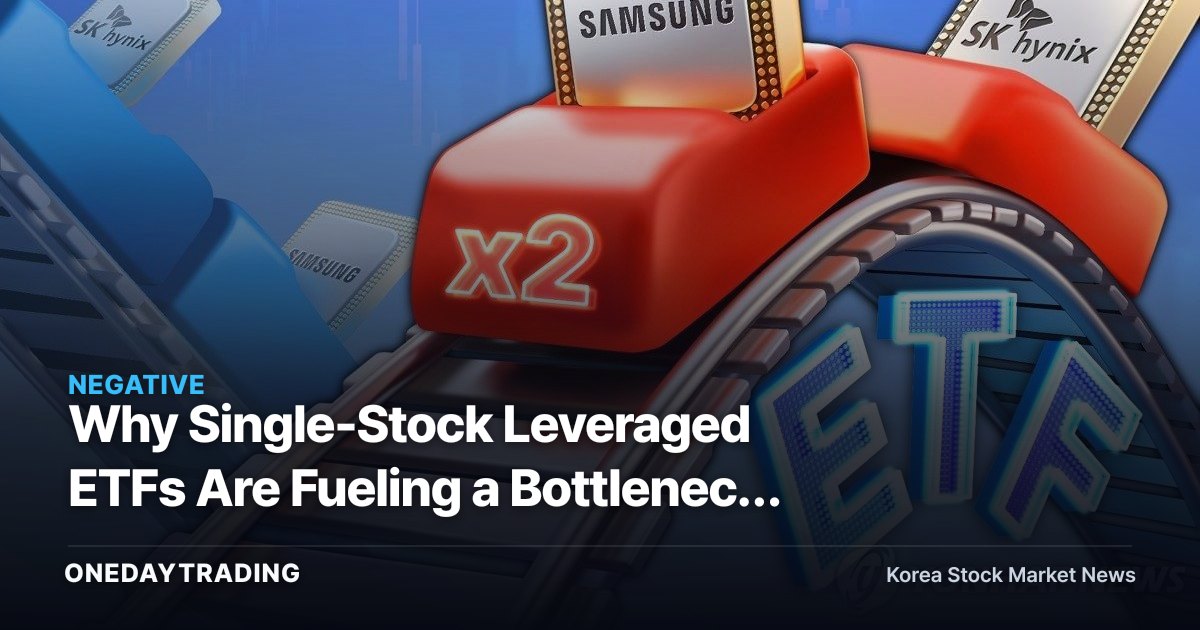
Single-stock leveraged products differ from ordinary ETFs at the structural level. Diversification benefits are weak, and the products track roughly twice a single stock's daily return. This is why financial regulators have warned of potential losses of up to 60% in a single day and require a minimum deposit of 10 million won plus one hour of basic education and one hour of advanced education. Even if the underlying share price returns to its starting point, daily rebalancing and volatility decay mean an investor's profit and loss may not return to breakeven.
The initial lineup of listed products was not small, either. Eighteen single-stock leveraged and inverse exchange-traded products based on Samsung Electronics and SK Hynix launched all at once — 16 ETFs and 2 ETNs. When 2x products are layered on top of the two stocks (tickers) with the highest trading value on the Korean market, pre-close rebalancing orders and retail investors' short-term trading can pile up in the same direction. The review bottleneck is the regulatory system's response — an effort to scrutinize this mechanical order flow more closely in advance.
For asset managers, this cuts both ways. Competition on fees among single-stock leveraged ETFs has been fierce. Some products priced fees as low as 0.0901% annually, below the average fee for existing equity leveraged ETFs. But a strategy of growing scale through low fees becomes shaky the moment review delays and stricter risk disclosure requirements attach to it. As the time to listing lengthens, the first-mover advantage also shrinks.
FAQ
- Why is the exchange review backed up? Since the single-stock leveraged ETF turmoil, the list of items requiring review has grown to include product structure, liquidity provision, investor disclosure, and the volatility impact on underlying assets.
- What does this mean for Samsung Electronics (005930) and SK Hynix (000660) share prices? Short-term supply-demand (order flow) volatility may grow more than fundamentals do. In particular, pre-close rebalancing trades are a channel that amplifies the perceived volatility of the underlying share price.
- Are investor protection measures sufficient? The 10-million-won minimum deposit, two hours of prior education, and exclusion from margin trading serve as entry barriers. However, they cannot fully prevent the negative compounding effect that occurs in sharp-drop (plunge) or sideways markets.
- Is this a negative catalyst for ETF industry growth? In the short term, it's a factor delaying launch schedules and dampening marketing. In the long term, it could serve as a filter that raises the credibility of high-risk products.
Impact on Related Stocks and Sectors
- Samsung Electronics (005930). It is the core underlying asset for single-stock leverage. As product assets grow, intraday supply-demand (order flow), rather than the semiconductor industry cycle, is increasingly likely to exaggerate share price movements.
- SK Hynix (000660). In a range where HBM and AI-semiconductor expectations are already priced in, a concentration of leveraged-product flows can rapidly amplify both upside and downside moves.
- Mirae Asset Securities. Expansion of the ETF and ETN ecosystem is favorable for brokerage and product sales, but the review bottleneck slows the pace of new product launches.
- Kiwoom Securities. For a brokerage with a high share of retail investors' short-term trading, rising trading value is a positive factor. However, complaints about high-risk products and suitability regulations could turn into costs.
- Financial holding company-affiliated asset managers. KB- and Shinhan-affiliated asset managers have gained an opportunity to expand their product lineups, but if fee competition and review delays operate at the same time, their contribution to profit could be limited.
Points to Watch for Investors
- Single-stock leveraged ETFs are not products for long-term holding. Even if the underlying share price moves sideways, losses can accumulate due to the daily compounding structure.
- Investors should watch the tracking-error (premium/discount) rate together with trading volume. In periods when the market price diverges from net asset value, even calling the right direction can result in a loss at the execution price.
- Investors need to distinguish days when pre-close supply-demand (order flow) outweighs Samsung Electronics (005930) and SK Hynix (000660) earnings. Mixing up interpretation of the semiconductor industry cycle with derivative-product order flow clouds judgment.
- The next new ETF listing schedule and the pace of exchange review are the key indicators to watch. If the bottleneck persists, competition among asset managers will shift from a race for speed to a contest of management capability.
Overall Outlook
The optimistic scenario is clear. If the exchange refines its review standards and asset managers demonstrate the ability to manage rebalancing and tracking error, single-stock leveraged ETFs could retain high-risk, short-term demand within the domestic market that would otherwise have flowed overseas. For highly liquid stocks (tickers) like Samsung Electronics (005930) and SK Hynix (000660), derivative demand could also create a new price-discovery function.
The trigger for the downside scenario is volatility. If large-cap semiconductor stocks suffer a sharp drop (plunge) or pre-close order concentration repeats, the market will calculate the cost of market stability before product innovation. The key indicators to watch next are when the exchange's ETF listing review bottleneck eases, the number of new product approvals, and the share of Samsung Electronics (005930) and SK Hynix (000660) trading value concentrated in the late session.
Samsung Electronics (005930): Real-Time Data
Samsung Electronics (005930)'s most recent closing price was 262,500 won (+26.81% versus the prior session), and the signal combining foreign investors/institutional investors order flow with news and momentum reads 🟢 Buy-leaning. Foreign investors, institutional investors, news, and momentum are all positive, making the stock worth watching.
- ▲ Dual buying — foreign investors +2,099.9 billion won and institutional investors +935.0 billion won bought in tandem
- ▲ News flow — 14 positive catalysts vs. 1 negative catalyst — positive catalysts dominate
Recent related news skews favorable, with 14 positive catalysts versus 1 negative catalyst.
※ Price and foreign/institutional investor order-flow data are provided by Korea Investment & Securities (KIS) and reflect figures as of publication time.
This article is automatically summarized and analyzed content based on the original news report. View original (Yonhap News Agency, Securities)