
Summary
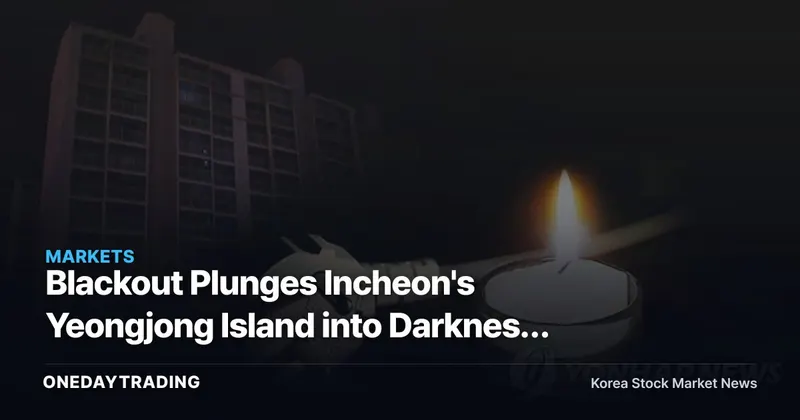
A power outage struck Yeongjong Island in Incheon, cutting electricity to roughly 25,000 households. Authorities restored supply using emergency generation vehicles and other temporary measures, but the root cause and a timeline for permanent restoration have yet to be announced. What the market should focus on is not the blackout itself, but the fact that the restoration so far has been only an emergency stopgap.
What Happened
Yeongjong Island is home to Incheon International Airport, integrated resort complexes, and new residential developments. Because it is connected to the mainland via undersea transmission cables and a land-bridge grid, its backup power routes are more limited than those of mainland urban centers. The fact that roughly 25,000 households lost power simultaneously suggests that the backup grid is thin enough for a single substation or distribution line failure to cascade across the entire area.
The response authorities have offered so far is temporary power supply using emergency generation vehicles — in other words, an emergency measure rather than a formal grid restoration. The key issue in this incident is that the precise cause of the failure and the timeline for permanent restoration have not yet been disclosed. If the cause turns out to be aging equipment failure, the risk of recurrence remains; if it stems from construction-related damage or a one-off external factor, it is more likely to be an isolated incident. At this point, both possibilities remain open.
Structural Background
Yeongjong Island has seen rapid growth in power demand in recent years amid a steady stream of resort openings and new-town apartment move-ins. The key question is whether distribution grid expansion is keeping pace with that demand growth. In a structure where development outpaces infrastructure reinforcement, there is a constant risk that localized failures like this one can escalate into large-scale blackouts. This is not a problem unique to Yeongjong Island — it is a structural risk shared by many newly developed districts nationwide, and illustrates what can happen when grid investment lags behind the pace of urban development.
Stock (Ticker) and Industry Sector Impact
- Korea Electric Power Corporation (KEPCO) — As the operator of the distribution grid, KEPCO bears the restoration costs and responsibility for this incident. If the cause is confirmed to be aging equipment, pressure to expand maintenance budgets could intensify.
- Power equipment makers such as LS ELECTRIC, HD Hyundai Heavy Industries (Hyosung Heavy Industries), and Iljin Electric — These companies stand to benefit if demand rises for replacing substations, switchgear, and circuit breakers. However, this would only translate into actual revenue once the government and KEPCO finalize real orders.
- Resort and mixed-use facility operators on Yeongjong Island — These operators may have faced business disruption and customer compensation costs during the outage. The near-term revenue impact hinges on how long the blackout lasted and whether facilities had their own backup power.
- Emergency power and ESS (energy storage system) companies — This incident could refocus attention on demand for dedicated backup power at commercial facilities and apartment complexes.
Bullish vs. Bearish Scenarios
In the bullish scenario, KEPCO and the government use this incident as a catalyst to allocate actual budget toward replacing aging distribution infrastructure and reinforcing backup grids in new towns. In that case, order pipelines for power equipment makers would be confirmed on a quarterly basis. Conversely, if the cause is concluded to be a simple equipment error or external damage and the incident is closed out as an isolated event, any thematic rally in related stocks is likely to fade within a day or two. The fact that the cause has not even been confirmed at this point means the grounds for betting on any specific stock based on this issue alone remain thin.
Investor Action Points
- Monitor the timing and content of the official cause announcement from KEPCO and the Ministry of Trade, Industry and Energy.
- Check whether grid reinforcement plans for new towns, including Yeongjong Island, get incorporated into future policy documents such as the Basic Plan for Electricity Supply and Demand.
- Review power equipment makers' quarterly order backlogs and KEPCO order disclosures to determine whether this translates into actual revenue.
- Watch for any disclosures of outage-related losses from resort and commercial facility operators on Yeongjong Island.
KEPCO by the Real-Time Data
KEPCO's most recent closing price was KRW 34,250 (0.00% vs. the previous day), and the signal combining foreign/institutional order flow with news and momentum reads 🔴 Caution. With both foreign investors and institutional investors positioned negatively, caution is warranted at this time.
- ▼ Dual-side selling — foreign investors −KRW 7.4 billion and institutional investors −KRW 10.0 billion, selling in tandem
- ▼ Trend alignment — short- and medium-term trend skewed to the downside (intraday +0.0% · 1-week −12.5% · 1-month −9.0%)
- ▼ 52-week position — near the 52-week low, at the 0% mark
※ Price and foreign/institutional order-flow data are provided by Korea Investment & Securities (KIS), as of the time of publication.
This article was automatically summarized and analyzed based on the original news report. View original (Yonhap News, Industry)