
Summary
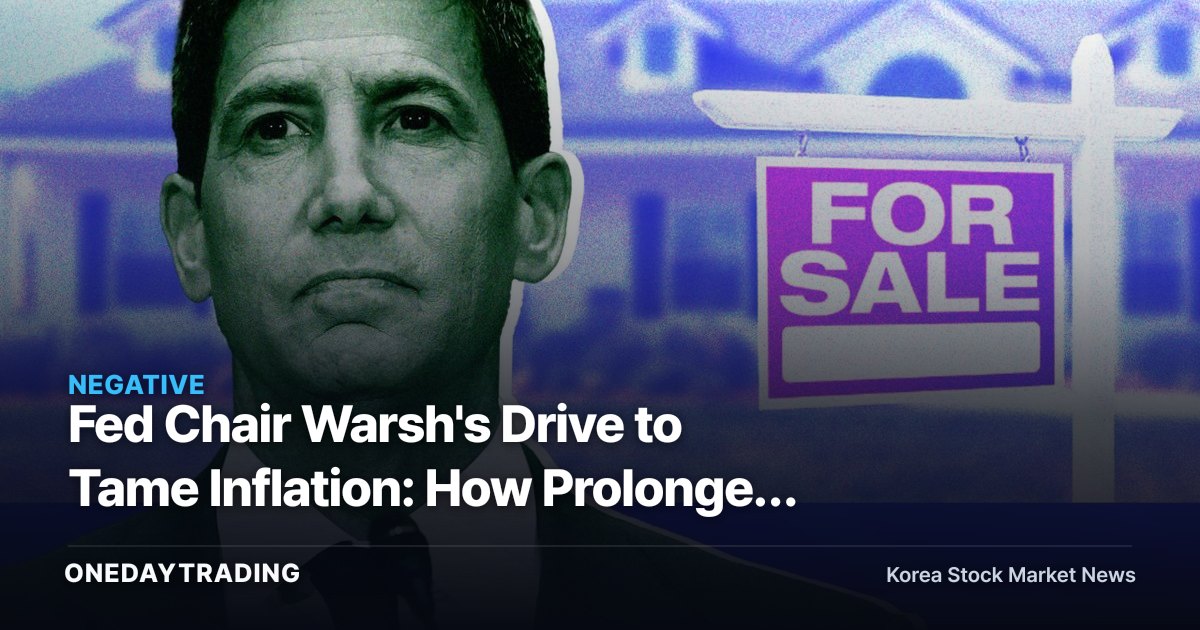
With newly appointed Fed Chair Kevin Warsh putting inflation control at the top of his policy agenda, the drop in mortgage rates that homebuyers had been hoping for is likely to remain out of reach for the time being. Even amid assessments that the Fed has entered a new chapter, the structural problem of housing affordability remains unchanged.
This trend is not confined to issues within the United States. The longer elevated U.S. long-term interest rates and dollar strength persist, the more the Korean stock market may see a divergence in which the fortunes of banks and exporters split from those of construction and growth stocks.
How It Unfolded
The Fed chair placing greater emphasis on price stability means that the rapid rate-cut path the market had anticipated is retreating. When the policy rate is kept high, the U.S. long-term government bond yields linked to it cannot easily come down, and because mortgage rates are priced off these long-term yields, the burden of home loan costs is unlikely to ease much.
Housing purchasing power is a function of home prices, interest rates, and income. When home prices linger near their peak and loan rates also stay high, monthly repayment burdens grow and the buying capacity of genuine end-users weakens. The crux of this issue is that even if the chair changes and the tone of monetary policy shifts, the environment as felt in terms of housing affordability is not much different from the past.
Structural Background
Prolonged high interest rates aimed at curbing inflation raise the discount rate across asset prices broadly. When the rate applied to convert the value of future cash flows into present terms rises, the more a growth stock relies on distant future profits, the greater the valuation pressure it faces. Conversely, the financial industry—where interest rates themselves are a source of profit—and exporters that benefit from a strong dollar are placed in a relatively favorable environment.
From Korea's standpoint, the higher U.S. rates are kept, the more likely downward pressure on the won will persist. This is favorable for exporters' won-translated revenue, but it simultaneously carries the double-edged nature of foreign investor capital outflows and burdens on domestic demand and real estate.
Stock and Sector Impact
- Banks and Financials: Prolonged high rates are favorable for defending loan-deposit spreads and net interest margins. Banking holding companies such as KB Financial Group and Shinhan Financial Group have a structure in which their interest-income base strengthens when rates are held above a certain level.
- Autos and Large-Cap Exporters: The strong dollar driven by firm U.S. rates can work favorably for the won-translated earnings of companies with large overseas revenue shares, such as Hyundai Motor and Samsung Electronics.
- Construction and Real Estate: If the burden of loan rates persists, housing demand slows, which is negative for end-market demand at construction firms with large housing and presale exposure, such as Hyundai Engineering & Construction.
- Growth, Bio, and Platform Stocks: A rising discount rate comes back as a direct burden on the valuations of growth stocks whose profit realization lies far in the future.
Bull vs. Bear Scenarios
The bull case argues that if inflation actually settles onto a stable track, rate uncertainty diminishes, and—after a certain time lag—expectations for monetary policy normalization could revive, restoring appetite for risk assets. Bank stocks and exporters have room to demonstrate their earnings strength first in that process.
On the bear side, if high rates last longer than expected, consumption and employment cool, and one must be wary of a flow in which a contracting housing market spreads into construction and domestic demand. Banks, too, cannot be deemed unilateral beneficiaries: if rates are held too high, the risk of loan delinquencies and non-performing loans rises, which can offset improvements in interest income.
Investor Action Points
- Watch for shifts in signals about the timing of rate cuts in the dot plot and the chair's remarks at the next Fed monetary policy meeting.
- Track the U.S. 10-year government bond yield and the won-dollar exchange rate together to check whether the favorable environment for exporters and bank stocks persists.
- In banking holding companies' quarterly earnings, look at net interest margin alongside the delinquency rate, and assess whether improvements in interest income are not offset by deteriorating soundness.
- For construction firms, gauge the intensity of end-market demand slowdown through presale results, unsold-inventory trends, and housing-related policy variables.
KB Financial Group Through Real-Time Data
KB Financial Group's latest closing price is 158,300 won (-2.94% from the previous day), and the signal light combining foreign and institutional investor supply-demand (order flow) with news and momentum is 🔴 Caution. With foreign investors, institutional investors, news, and momentum all negative, caution is warranted right now.
- ▼ Dual Selling — Foreign investors −22.9 billion won and institutional investors −10.6 billion won selling in tandem
- ▼ News Flow — 4 positive catalysts vs. 11 negative catalysts — negative catalysts dominate
Recent related news stands at 4 positive catalysts and 11 negative catalysts, a negative picture.
※ Price and foreign/institutional investor supply-demand (order flow) data are provided by Korea Investment & Securities (KIS), as of the time of publication.
This article is content automatically summarized and analyzed based on the original news. View Original (MarketWatch)