
At a Glance
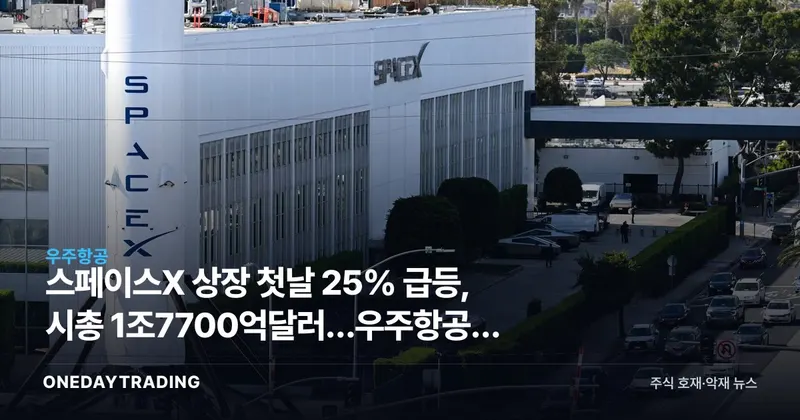
SpaceX, led by Elon Musk, locked in a fixed price of $135 per share just ahead of its listing, giving it a market capitalization of roughly $1.77 trillion. On its first trading day Friday, the stock jumped more than 25%, with retail investors piling into the offering in a frenzy of demand. That said, some market participants voiced caution, calling the valuation irrational.
Why It Matters Now
SpaceX has driven the commercialization of the space industry on two pillars: its reusable Falcon rockets and its Starlink satellite internet service. While the company had long commanded an astronomical valuation as a private firm, this IPO establishes an actual public-market price — a development that carries significant weight, as it sets a valuation benchmark for the aerospace sector as a whole.
The fixed price of $135 per share and the $1.77 trillion market capitalization are extremely high by traditional earnings-based valuation measures. Even so, the more-than-25% surge on day one reflects expectations for Starlink subscriber growth, falling satellite launch costs, and the next-generation Starship launch vehicle. At the same time, doubts are mounting over whether the fixed price adequately reflects fair value and whether the volatility right after listing is excessive.
From a Korean investor's standpoint, the key issue is the ripple effect on the domestic aerospace and satellite communications value chain, rather than direct subscription to the offering. If global market sentiment toward space investment improves, the warmth could spread to related components, satellite antenna, and launch-vehicle materials companies.
Frequently Asked Questions
- What does the fixed price of $135 mean — instead of a book-building process, the price was pinned in advance, which means volatility could spike depending on supply-demand (order flow) immediately after listing.
- Is a market capitalization of $1.77 trillion expensive — relative to current revenue and profit, it is high enough to fuel a legitimate overvaluation debate, with expectations for future Starlink and Starship growth already priced in.
- Why did retail investors pile in — the symbolic appeal of the Musk brand and the space theme, combined with hopes for a first-day surge, stoked short-term, overheated subscription demand.
- Can I buy it directly from Korea — since it is listed on a U.S. exchange, you can trade it through an overseas-stock account, but you must also weigh the burden of exchange rate and volatility.
Related Stocks & Sector Impact
- SpaceX — the central player in this listing; with its first-day surge and overvaluation debate both in the spotlight, it sets the direction for the entire space theme.
- Intellian Technologies — a satellite communications antenna company expected to be a direct beneficiary of the spread of low-Earth-orbit satellite internet such as Starlink.
- AP Satellite — with its satellite terminal and components business, it could benefit from expanded investment in space infrastructure.
- Hanwha Aerospace — a flagship Korean aerospace stock in launch vehicles and engines, influenced by improving sector investment sentiment.
- Hanwha Systems — its satellite and defense communications businesses could reflect expectations for an expanding space value chain.
Points to Watch When Investing
- An early post-listing surge may be a short-term overheating of supply-demand (order flow), so chasing the highs carries significant volatility risk.
- A substantial part of SpaceX's value rests on future growth expectations, so confirmation of earnings visibility is needed.
- Korean aerospace stocks may merely move in sympathy with the theme, so investors should scrutinize the actual link to orders and revenue.
- When investing in overseas stocks, be sure to check for exchange rate fluctuations and differences in trading hours and taxes.
Overall Outlook
Viewed optimistically, the SpaceX listing is a watershed signaling that the space industry has moved beyond the experimental stage to become a full-fledged subject of capital-market valuation; if Starlink subscribers and launch demand grow steadily, there is room to justify the valuation. In that case, a trickle-down effect to domestic satellite and components companies can also be expected. On the risk side, however, the criticism that a $1.77 trillion market capitalization excessively front-loads future growth remains valid, and profit-taking and heightened volatility could emerge after the first-day surge. Ultimately, a prudent strategy of phased entry — confirming the substance of earnings and orders rather than chasing short-term thematic enthusiasm — is advisable.
This article is content automatically summarized and analyzed based on the original news. View Original (CNBC)