
Summary
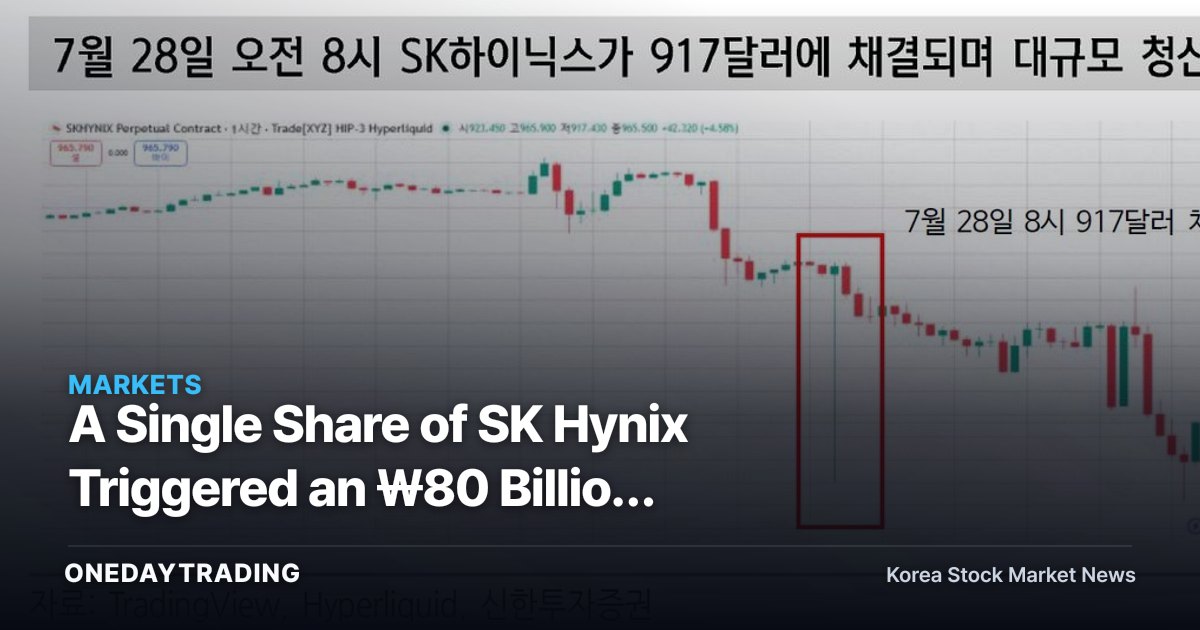
The real issue isn't a single-share trade in SK Hynix — it's how an overseas digital-asset derivatives oracle interpreted one Korean stock price. A distorted pre-market opening price on Nextrade triggered roughly $60 million — around ₩80 billion — in liquidations on Hyperliquid.
From Han-gyeol Jeong's perspective, this incident is not a negative catalyst for the semiconductor stock (ticker). It's a warning sign that tokenized equities and decentralized derivatives exchanges still haven't properly absorbed the microstructure of the underlying spot market.
How It Unfolded
An abnormal price formed for SK Hynix on the pre-market session of Nextrade, Korea's alternative trading system (NXT). According to reports, this distorted opening price fed into related pricing on Hyperliquid, and a single-share trade was amplified into a large-scale forced liquidation on an overseas crypto derivatives market.
The liquidation was reportedly around $60 million — roughly ₩80 billion. In the spot equity market, this would be close to a temporary pricing glitch. But in a digital-asset market wired with leverage and automated liquidation engines, it becomes a loss-crystallizing event. When a bad price feed comes in, positions get unwound first — explanations come later.
Trade.xyz has said it will compensate for the abnormal price move. That matters: a willingness to compensate can partially restore investor trust, but it also amounts to the platform acknowledging a vulnerability in its pricing mechanism.
Structural Background
The weakest link in tokenized equities and on-chain derivatives isn't liquidity — it's the reference price. Order-book depth and execution methods differ across pre-market, regular session, and after-hours trading. When a price generated in a thin-liquidity window like Nextrade's pre-market is fed directly into a leveraged product, noise from the spot market gets magnified into derivatives-market losses.
The flip side of fast execution and high accessibility on platforms like Hyperliquid is risk concentration. When the price feed, collateral valuation, and liquidation logic all move in the same direction, investors have little chance to avoid forced liquidation. This episode shows that oracle design, anomaly-detection filters, and the scope of exchange liability mattered far more than SK Hynix's memory-chip business conditions.
Impact on the Stock (Ticker) and Industry Sector
- SK Hynix: This is not a direct negative catalyst tied to the company's earnings, HBM demand, or the broader semiconductor industry sector. That said, the episode confirms SK Hynix has enough liquidity and investor interest to be used as an underlying asset for tokenized products on global platforms.
- Alternative trading systems: As pre-market price discovery grows in scale, the quality control of opening prices becomes more critical. The risk that thin execution can spill over into external markets raises the burden on surveillance systems.
- Digital-asset derivatives exchanges: Whether or not compensation is paid matters less than whether safeguards are put in place to prevent recurrence. Without excluding anomalous prints, incorporating multiple price sources, and adding liquidation-delay mechanisms, institutional capital won't flow in easily.
- Tokenized equity markets: Products built on Korean large-cap stocks as underlying assets could keep growing. But unless real stock-exchange rules and the 24-hour structure of crypto markets are properly reconciled, growth will be capped by regulatory and trust costs.
Bullish vs. Bearish Scenarios
The bullish scenario is straightforward: if Trade.xyz executes compensation quickly and Hyperliquid and related platforms roll out improvements to their price feeds, this could be filed away as a one-off incident. In that case, the tokenized equity market could actually move toward more robust infrastructure under the pressure of institutionalization.
The bearish scenario is the opposite: if compensation is delayed or the reference-pricing methodology remains opaque, investors will price in platform risk with a steeper discount. The $60 million liquidation isn't just a loss figure — it's a number that shows a single bad price input can shake an entire book of leveraged positions.
Action Points for Investors
- SK Hynix share price: Rather than reading this as a negative catalyst for semiconductor fundamentals, investors should separately track regular-session trading volume, foreign-investor supply-demand (order flow), and earnings guidance related to HBM.
- Platform announcements: Watch the scope and timing of Trade.xyz's compensation and whether Hyperliquid actually revises its price feed. Rule changes matter more than statements.
- Leverage management: Even when the underlying asset is a blue-chip stock, tokenized equity derivatives carry a separate layer of liquidation risk. Products that reference pre-market or after-hours prices warrant a larger collateral buffer.
- What to watch next: As domestic ATS trading expands, tokenized equity products multiply, and financial regulators set market-surveillance standards, monitor whether the probability of a similar incident recurring actually declines.
SK Hynix by the Numbers (Real-Time Data)
SK Hynix's most recent closing price was ₩1,358,000 (-3.07% from the previous session), and the composite signal — combining foreign/institutional investor order flow with news and momentum — reads 🔴 Caution. Foreign-investor flow, news, and momentum are all negative, warranting caution right now.
- ▼ Order-flow continuity — Foreign investors have been net sellers for 4 straight days (−₩1,242.5 billion)
- ▼ Trend alignment — Short- and medium-term downtrend aligned (same-day -3.1% · 1-week -25.8% · 1-month -48.4%)
Recent related news skews negative, with 8 positive-catalyst articles versus 9 negative-catalyst articles.
※ Price and foreign/institutional investor order-flow data is provided by Korea Investment & Securities (KIS), as of the time of publication.
This article was automatically summarized and analyzed based on the original news source. View original (Maeil Business Newspaper Securities)