
Summary
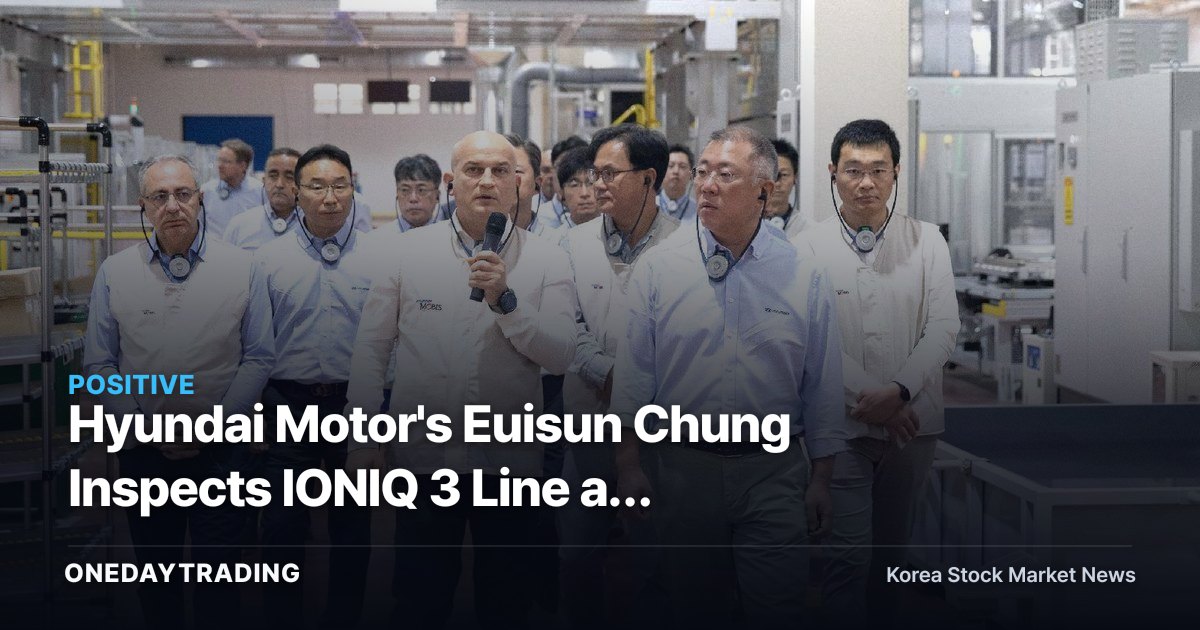
Factory visits by automaker chairs are common, but what Executive Chair Euisun Chung examined at the Turkey plant amounts to far more than a photo opportunity — it's the blueprint for Hyundai's second-half push into Europe's small EV segment. If IONIQ 3's mass-production quality falls short of expectations, the European small-EV campaign will slip, delaying the broader electrification-mix improvement plans of Hyundai Motor and Kia across Europe. Conversely, if the line runs as planned, it becomes the first real proof point that locally produced vehicles can deliver price competitiveness against low-cost Chinese EVs.
What Happened
The site Chairman Chung inspected is the Izmit plant operated by Hyundai Assan, a joint venture between Hyundai Motor and Turkey's Kibar Group. The plant has long served as Hyundai's core European production base for compact models such as the i10, i20, and Bayon, and this time the inspection focused on the mass-production line for the compact electric vehicle IONIQ 3. The chairman personally walking the line suggests Hyundai has entered the final stage of checking for quality variance or process bottlenecks ahead of the second-half launch.
The reason Hyundai Motor Group builds its small EVs in Turkey isn't simply about labor costs. Turkey's customs union with the EU allows vehicles produced there to enter the European market tariff-free. This makes it easier to secure price competitiveness than shipping finished vehicles from Korea, and increasing the share of European-sourced parts can further lower the cost ratio. Chairman Chung's inspection was, in effect, a check on how well this structural advantage can be translated into actual mass production.
Structural Backdrop
Europe's EV market is currently seeing its fiercest competition in the low-cost small EV segment. As Chinese brands expand their European presence using price as their main weapon, European countries are simultaneously weighing tariffs and subsidy measures to protect their domestic automakers. For Hyundai, IONIQ 3 is the first model to go head-to-head with Chinese EVs in this low-price segment. The key variable isn't brand power but cost. If Turkish production fails to actually deliver cost competitiveness, sales targets will be undercut by price tags no matter how closely the chairman oversees the line.
Stock (Ticker) and Industry Sector Impact
- Hyundai Motor: The success or failure of the new European small EV is directly tied to its European electrification mix and market share.
- Kia: Sharing the same platform and parts ecosystem, Kia is affected by whether Hyundai's European small EV lineup expands.
- Hyundai Mobis: Supply volumes of core electrification components (drive motors, power conversion units, etc.) are linked to the pace of small EV mass production for Europe.
- Hyundai Wia: Investors should also watch whether Hyundai Wia benefits from expanded Turkish production within the drivetrain and parts supply chain.
Bullish vs. Bearish Scenarios
In the bullish scenario, IONIQ 3 enters second-half mass production as planned and captures both price and quality advantages in Europe's small EV market. This would signal an improving European electrification mix for Hyundai Motor and Kia, and show they aren't losing ground to Chinese brands in the low-price segment. In the bearish scenario, reduced EV subsidies in Europe or a broader consumption slowdown could combine to keep small EV demand from growing as expected. Even with tariffs avoided through local production, insufficient demand could lead to weak utilization rates and inventory burdens. The symbolism of the chairman's visit and the actual sales trajectory should be viewed as separate matters.
Investor Action Points
- Watch for the official second-half launch date of IONIQ 3 and disclosures on initial European sales volumes.
- Track changes in Hyundai Motor and Kia's European EV sales mix and average selling price in quarterly earnings.
- Monitor the EU's tariff policy toward Chinese EVs and the timeline for changes in national EV subsidy programs.
- Continue checking for disclosures or reports on utilization rates and capacity expansion at the Hyundai Assan plant.
Hyundai Motor by the Numbers: Real-Time Data
Hyundai Motor's most recent closing price was 388,000 won (0.00% versus the previous day), and the composite signal combining foreign/institutional investor order flow with news and momentum reads 🟢 Buy-leaning. With both foreign investor flows and news sentiment positive, the stock (ticker) is worth watching.
- ▲ Order-flow continuity — Foreign investors have posted net buying for 3 consecutive days (+42.4 billion won)
- ▼ Trend alignment — Short- and medium-term trends are aligned to the downside (+0.0% intraday · -3.2% over 1 week · -20.4% over 1 month)
Recent related news skews favorable, with 2 positive catalysts and 0 negative catalysts.
※ Price and foreign/institutional investor order-flow data are provided by Korea Investment & Securities (KIS) and reflect figures as of publication.
This article is automatically summarized and analyzed content based on the original news report. View original article (Maeil Business Newspaper)