
Summary
Nvidia’s August 2026 earnings release shows that AI semiconductor demand has not broken down; rather, memory prices are entering a phase that is resetting the lower bound for margins.
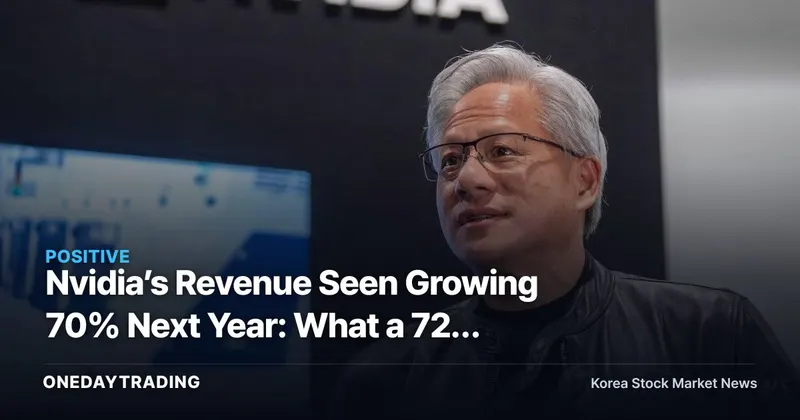
Yoon Jae-ho’s view is clear. The number that turned the stock around was not second-quarter revenue of $96.22 billion, but Nvidia’s supply-chain control, reflected in its ability to guide simultaneously for 70% revenue growth next year and a 72~73% gross margin.
What Happened
Nvidia reported second-quarter revenue of $96.22 billion in an earnings announcement carried by Yonhap News on August 27, 2026. Revenue rose 106% from the same period last year and exceeded the $92.17 billion market estimate compiled by LSEG by more than $4 billion.
Earnings per share came in at $2.22, above the market estimate of $2.10. Gross margin was 75%, and operating margin was 66.5%. Yet Nvidia shares closed the regular session down 1.59% at $209.66. What investors initially focused on was not the growth rate, but third-quarter margin pressure.
The tone shifted during the conference call. After Nvidia said revenue could grow by about 70% in the next fiscal year and suggested margins could remain in the 72~73% range even after higher memory prices, the stock rebounded 4.7% in after-hours trading to $219.53.
Structural Background
HBM, or high-bandwidth memory, is a key component placed next to AI accelerators to move large volumes of data in a short period of time. As Nvidia sells more GPUs, HBM demand rises almost linearly, and as system-level sales expand after Blackwell, memory and packaging costs account for a larger share of total costs.
What matters here is how Nvidia defends its 72~73% margin. If memory prices post a sharp gain (surge), even fabless Nvidia cannot avoid cost pressure. However, Nvidia has chosen a structure in which it locks in volume first through large-scale supply-chain commitments and passes part of the price increase on to customers. For HBM suppliers such as SK hynix and Samsung Electronics (005930), this means better volume visibility, while for cloud customers it means higher AI server investment costs.
Impact on Stocks and Industry Sectors
- Nvidia: Guidance for 70% revenue growth next year signals that demand for AI accelerators still exceeds supply. However, when margins move down from 75% to 72~73%, a revenue surprise does not immediately translate into a re-rating of profitability.
- SK hynix: If rising HBM prices are enough to move Nvidia’s margins, memory suppliers still have bargaining power. The key question is how much higher HBM volume, alongside the commodity DRAM price cycle, can lift operating margin.
- Samsung Electronics (005930): Entry into the HBM supply chain and the pace of quality approvals are the key variables. Even if Nvidia demand is strong, the benefit will remain embedded in the stock only when the share of advanced HBM shipments and yields are confirmed.
- Micron: Its 3.8% gain in after-hours trading shows that the broader memory industry sector is being revalued as a bottleneck in the AI server cost structure.
- Broadcom and AMD: AI infrastructure names rose together, but the logic differs. If Nvidia succeeds in passing through prices, later-stage accelerator and ASIC companies may also face the counterpressure of customers becoming more cost-sensitive.
Bullish vs. Bearish Scenarios
The bullish scenario is straightforward. If Nvidia grows revenue by 70% in 2027 despite supply constraints and passes HBM price increases on to customers, the AI server value chain returns to a volume-driven market. In that case, earnings estimates for HBM suppliers, advanced packaging companies, and data-center networking firms would likely rise first.
The trigger for the bearish scenario is customer ROI, not margins. If cloud operators cannot recover higher AI server purchase costs through their own service revenue, orders will slow. Even if Nvidia raises prices, if customer returns on investment are not visible, the 72~73% margin may hold, but the 70% revenue growth rate would come under pressure first.
Investor Action Points
- Investors should look at Nvidia’s next-quarter revenue guidance together with the lower end of its gross margin range. If revenue rises but the margin floor moves lower again, it means cost pass-through power has weakened.
- For SK hynix and Samsung Electronics (005930), investors should check comments on HBM shipment volume, average selling prices, and customer qualification during quarterly earnings calls. AI demand turns into profit only for volumes that clear yield requirements.
- Investors should watch whether after-hours strength in memory-related stocks such as Micron and SanDisk carries over into regular session trading volume. A short-term reaction and an upgrade to industry-cycle estimates are separate events.
- Cloud customer CAPEX guidance is the next confirmation metric. If the pace of data-center investment by Amazon, Meta, and Google slows, Nvidia’s supply-shortage narrative will be discounted.
Frequently Asked Questions
Why did Nvidia shares rebound after hours?
Nvidia shares fell 1.59% in the regular session on August 26, 2026, but rose 4.7% in after-hours trading after the company’s outlook for 70% revenue growth next year was disclosed. Investors placed more weight on long-term demand and pricing pass-through power than on third-quarter margin pressure.
Is rising HBM pricing a positive catalyst for SK hynix?
Rising HBM prices are a factor that can improve average selling prices for high-bandwidth memory suppliers such as SK hynix. However, actual profit will depend on advanced HBM yields, customer approvals, and the terms of long-term supply contracts.
Is Nvidia’s 72~73% margin a bad signal?
Nvidia’s 72~73% margin outlook acknowledges pressure from the prior 75% level. However, the fact that the company presented both 70% revenue growth and low-70% margins despite a sharp rise in memory costs suggests this is more a phase of cost reallocation than a collapse in demand.
This article is automatically summarized and analyzed based on the original news report. View original article (Yonhap News Securities)