
At a Glance
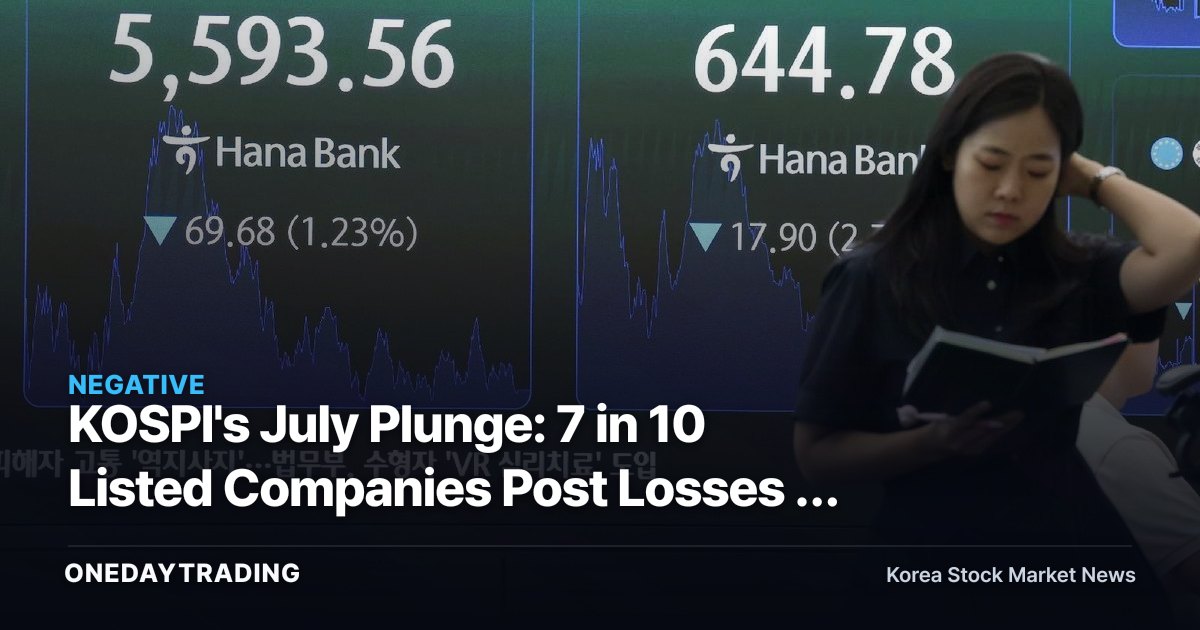
Seven out of ten companies listed on the KOSPI and KOSDAQ posted negative returns last July. According to a Maeil Business Newspaper report, this ranks as the worst performance since the global financial crisis. The fact that only a small number of stocks rose is a signal of just how broad the market's risk-aversion was — more telling than the price change rate of the index alone.
Why It Matters Now
The index return and the distribution of individual stock returns tell different stories. Even if the index holds up on the strength of a handful of large-cap names, when 70% of listed companies are in negative territory, it means a broad-based valuation reset is already underway beneath the surface. While a few leading stocks carry the index, the rest of the market may simultaneously be facing rising discount rates and downgraded earnings expectations.
This kind of asymmetry tends to emerge when interest rate and exchange rate variables haven't yet been fully priced in by the market. A handful of leading stocks can be cushioned by earnings momentum or favorable supply-demand (order flow), but the broader universe of stocks is the first — and hardest — hit when discount rates, meaning valuation multiples, rise. The wider the gap grows between the index's resilience and the chill felt across individual stocks, the more volatility can build as that gap eventually closes.
Frequently Asked Questions
- Q. The index didn't fall as much, so why did so many stocks decline? A. While a small number of large-cap stocks by market capitalization propped up the index, it's likely that rising discount rates and an exodus in supply-demand (order flow) spread broadly across small- and mid-cap stocks.
- Q. Will this trend continue this month? A. It's too early to say, since whether it persists depends on whether the main driver of the decline was interest rates, the exchange rate, or an outflow of foreign investor supply-demand (order flow).
- Q. What does this mean in practical terms for retail investors? A. Judging market conditions by the index alone can be misleading. If your holdings moved differently from the index, it's worth separately checking the cause — valuation, supply-demand (order flow), or industry sector — for each position.
Related Stocks and Sector Impact
- Large-cap leading stocks: The handful of stocks that propped up the index likely did so on the strength of earnings momentum or foreign net buying. If that support weakens, downward pressure on the index itself would intensify.
- Small-, mid-cap, and KOSDAQ stocks: This segment likely accounted for the largest share of decliners, consistent with the tendency for less liquid stocks to fall further during periods of rising discount rates.
- High-valuation growth stocks: Sectors with higher multiples are more sensitive to shifts in interest rates and discount rates, making them especially vulnerable to this kind of broad-based correction.
- Dividend and defensive stocks: With relatively lower earnings volatility, this group serves as a useful contrast, having potentially seen more limited declines during the sell-off.
Investment Considerations
- Don't judge portfolio risk by the index's price change rate alone — check the distribution of declines across individual stocks separately.
- The appropriate response strategy going forward depends on whether the main driver of this decline was interest rates, the exchange rate, or downgraded earnings expectations.
- Keep in mind that when a few large-cap stocks are propping up the index, there can be a disconnect between the index and how the market actually feels.
- Which industry sectors led the decline still requires further confirmation through follow-up data.
Overall Outlook
In the optimistic scenario, this sharp drop (plunge) marks an early end to the valuation reset, creating an incentive for bargain hunting. However, it remains unclear whether the sheer breadth of the decline — with the vast majority of listed companies in negative territory — represents a one-off correction or the early stage of a sustained capital outflow. The next Monetary Policy Board decision, the KRW/USD exchange rate level, and whether foreign net buying resumes will be the next checkpoints determining whether this asymmetry persists or reverses.
This article was automatically summarized and analyzed based on the original news report. View Original (Maeil Business Newspaper Securities)