
Key Takeaways
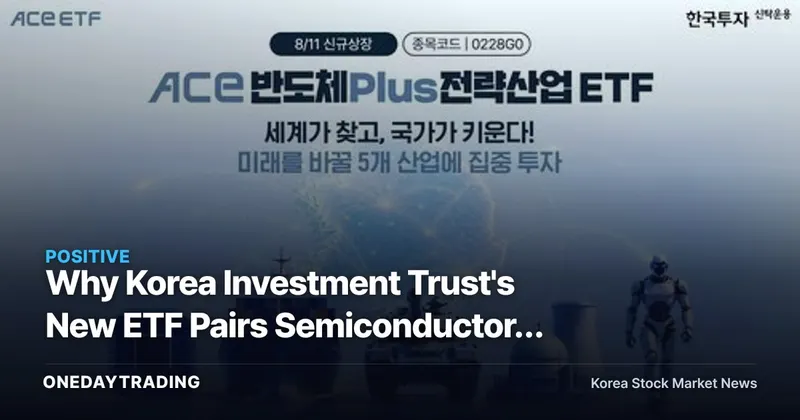
This isn't just another ETF added to the shelf. The launch of Korea Investment Trust Management's ACE Semiconductor PLUS Strategic Industry ETF looks more like a signal that the AI semiconductor rally is broadening from a single-sector move into a basket of national strategic industries.
The fund invests across five domestic strategic industries, including semiconductors. What matters most to investors isn't that "semiconductor" leads the name, but that the product is designed to pair the semiconductor cycle with industries that benefit from power, manufacturing, and policy tailwinds.
What Happened
Korea Investment Trust Management has launched the ACE Semiconductor PLUS Strategic Industry exchange-traded fund, which invests in semiconductors and other domestic strategic industries. The key figure highlighted in the original report is five industries. In other words, this is not a single stock (ticker) or a single industry sector play — it's a strategic-industry basket built around semiconductors as its core axis.
The market is reading this news two ways. First, from the asset manager's perspective, it's an attempt to capture fund flow into domestic growth industries by expanding the ETF lineup. Second, from the investor's perspective, it opens a channel to buy broadly into AI infrastructure demand within the domestic stock market — demand that large-cap semiconductor stocks (tickers) such as Samsung Electronics and SK hynix alone don't fully capture.
The character of semiconductor ETFs is also shifting. In the past, such products mainly tracked memory pricing and capex cycles. Now they extend to AI servers, high-bandwidth memory (HBM), power infrastructure, and strategic manufacturing. Semiconductors are being reclassified — not as an end product, but as the starting point of industrial policy.
Background and Context
Semiconductors are no longer just a question of process nodes or HBM stacking generations. As AI data centers expand, demand for GPUs and memory follows, and behind that comes power grids, cooling, components, equipment, and materials. The reason this ETF bundles five strategic-industry pillars together is that this chain of demand is hard to capture through a single stock (ticker).
That said, launching an ETF is product design aimed at demand, not proof of demand itself. Actual performance will be determined by the earnings, order backlogs, utilization rates, and fund inflows of the underlying holdings. In a stretch where narrative arrives before earnings, valuations can easily run ahead of fundamentals.
Market and Stock Impact
- Korea Financial Holdings: The expansion of the ETF lineup at its asset-management affiliate, Korea Investment Trust Management, broadens the base for asset-management and fund fees. However, for a single ETF to meaningfully move the holding company's earnings, growth in net assets and sustained long-term balances would need to be confirmed.
- SK hynix: This is the first stock (ticker) that comes to mind when domestic semiconductor investment demand flows back in through ETFs. The more HBM and AI server memory demand holds up, the more likely it is to sit at the center of thematic fund flow.
- Samsung Electronics: As a large-cap spanning memory, foundry, and finished devices, it's read as a default holding candidate for ETF-driven fund flow. The key question is how much of the AI memory demand it can convert into profitability.
- Hanmi Semiconductor: Equipment makers are more sensitive to capex and customers' capacity-expansion decisions than to end demand itself. ETF inflows help supply-demand (order flow), but actual share performance hinges on order announcements and the pace of equipment revenue recognition.
- Strategic industries broadly: Sectors like defense, power equipment, nuclear power, and shipbuilding — where policy and order intake are closely linked — run on a different cycle than semiconductors. Diversifying across sectors within the ETF can lower volatility, but performance may be diluted if the lead sector loses momentum.
Investor Checkpoints
- Early-stage net assets: Watch how quickly net assets grow in the first one and three months after listing. Even a strong theme has limited market impact if fund flow doesn't follow.
- Portfolio weighting: Check whether the semiconductor weighting is high and whether diversification across strategic industries actually functions as intended. The portfolio matters more than the name.
- Semiconductor earnings season: HBM revenue, memory pricing, and inventory trends at SK hynix and Samsung Electronics are the primary variable for ETF performance.
- Strategic-industry order intake: For defense, power equipment, nuclear, and shipbuilding, order backlogs and margin guidance matter more than share price movements alone.
Outlook
The bullish scenario is straightforward: if AI semiconductor demand holds up and domestic strategic industries receive both order intake and policy support, this ETF could tap a wider set of return drivers than a plain semiconductor product. Semiconductors would lead from the front, with power, defense, and shipbuilding supporting from behind.
The bearish scenario should also be kept in view. The more industries an ETF bundles together, the less clear it can become to investors what exactly they're buying. If concerns about a semiconductor peak, valuation pressure in strategic industries, and thin early-stage liquidity all converge, even a good theme gets priced in slowly. The next things to watch are net-asset trends after listing, the actual underlying holdings, and next quarter's shipment volumes and margins at the large-cap semiconductor names.
Korea Financial Holdings, as Seen Through Real-Time Data
Korea Financial Holdings' most recent closing price is ₩192,500 (-0.72% versus the previous session), and the composite signal — combining foreign and institutional investor supply-demand (order flow) with news and momentum — reads 🟡 Neutral / Wait-and-See. With bullish and bearish signals mixed, this is a period to watch closely.
- ▼ Trend Alignment — Short- and medium-term downtrend alignment (Today -0.7% · 1 Week -2.2% · 1 Month -13.5%)
Recent related news shows 1 positive catalyst and 0 negative catalysts, a favorable mix.
※ Price and foreign/institutional investor supply-demand (order flow) data are provided by Korea Investment & Securities (KIS) and are accurate as of the time of publication.
This article was automatically summarized and analyzed based on the original news report. View original article (Yonhap News, Securities)