
Key Takeaways
A benchmark interest rate of 3% is a number that forces investors to recalculate the dividend premium of preferred shares. When the expected return on deposits and bonds rises, preferred shares, which rely on fixed dividends, get pressured before common shares.
So what the market is focused on now is not the share price itself, but relative value. Samsung Electronics and Hyundai Motor preferred shares have weakened more than their common shares not because dividends got worse, but because the yield on safer substitutes for dividends rose faster.
What Happened
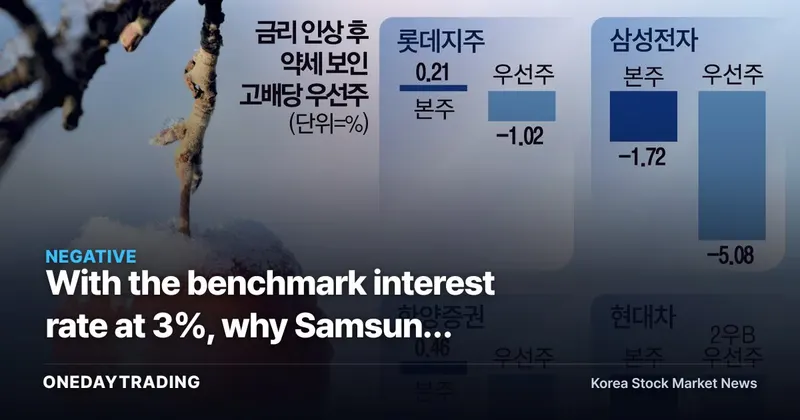
As the Bank of Korea raised the benchmark interest rate to around 3%, preferred shares quickly fell out of favor. As reported by Maeil Business Newspaper, the backdrop for the sharper decline in leading preferred shares such as Samsung Electronics and Hyundai Motor is the weakening appeal of dividends.
Preferred shares compete directly with rates because they pay dividends. When rates rise, the expected return on bank deposits, bonds, and short-term money market products also rises, and the market demands a larger incremental reward from preferred shares. As a result, even the same dividend requires a lower share price to reach equilibrium.
That does not mean preferred shares have become fundamentally weaker. It only means that this is a period in which substitute yields matter more than the absolute dividend amount. If additional hikes continue, the discount on preferred shares could widen further. On the other hand, once the market becomes convinced that rates have peaked, prices could react first.
Background and Context
Preferred shares are traditionally supported by money seeking stable dividends. But when the Bank of Korea’s 3% benchmark interest rate overlaps with expectations of further U.S. hikes, investors start to question again why they should keep money tied up in preferred shares. The market is already aware of rising rates, but there is still room for further relative value adjustment across dividend stocks.
In this structure, preferred shares wobble before common shares. Common shares have other drivers such as earnings growth, treasury share cancellations, and changes in governance structure, but preferred shares are centered on cash dividends. That is why preferred shares, which once looked defensive, start to follow a price mechanism similar to long-duration bonds during a rising-rate environment.
Impact on the Market and Stocks
- Samsung Electronics preferred: If dividend yield is re-rated against deposit rates, the price may be less elastic than the common share. As the flagship large-cap preferred share, it tends to reflect changes in supply-demand (order flow) first.
- Hyundai Motor preferred: In this phase, rate sensitivity matters more than the auto industry backdrop. Even if dividend expectations hold, the premium shrinks when substitute yields rise.
- Kia preferred: The same logic applies to automaker preferred shares. In this market, the relative comparison between rates and dividends matters more than earnings.
- Financial sector preferred shares: Bank and securities preferred shares are strongly associated with dividends, but in a 3% benchmark interest rate environment they compete directly with deposits. If the rebound after the ex-dividend date is sluggish, market sentiment could weaken.
- Dividend stock ETF: Products with a high weight in preferred shares have difficulty avoiding the relative-value drag of the underlying holdings. In a rising-rate phase, the duration of the constituents matters more than the index itself.
What Investors Should Watch
- Check whether the Bank of Korea raises the benchmark interest rate again at its next rate-setting meeting. If there is another hike, the discount on preferred shares could widen further.
- Also watch the U.S. rate path. If expectations of further U.S. hikes continue, global safe-asset yields will rise and the relative appeal of domestic dividend stocks will weaken.
- Watch the valuation gap of flagship preferred shares such as Samsung Electronics preferred and Hyundai Motor preferred versus their common shares. Rates tend to move prices before earnings do.
- Changes in deposit rates and government bond yields also matter. How much the expected dividend yield on preferred shares exceeds those levels will determine the short-term floor.
Outlook
The optimistic scenario is clear. If the rate-hiking cycle stops and the market becomes convinced that rates have peaked, the dividend appeal of preferred shares will return. In that case, a narrowing discount would come first, followed by a recovery in trading value.
On the other hand, if rate hikes continue, preferred shares could remain under pressure for longer. If dividends stay unchanged while the return on substitute investments rises, the price adjustment will last longer as a relative-value issue rather than an earnings issue. In the end, this market is not really about preferred shares themselves, but about the comparison framework created by a 3% interest rate.
Frequently Asked Questions
Why do preferred shares weaken first when rates rise?
Preferred shares have a strong fixed-dividend character, so they are compared directly with deposits, bonds, and money market products. When the benchmark interest rate rises, investors apply a higher discount rate to the same dividend, which means the share price must be lower to balance out.
Common shares have additional drivers such as earnings growth and treasury share cancellations, but preferred shares are centered on dividends, so their defensive cushion is relatively smaller. That is why preferred shares move more sharply in a rising-rate environment.
Why are Samsung Electronics and Hyundai Motor preferred shares weaker than their common shares?
The key is the relative comparison of dividend appeal. Even within the same company, preferred shares are often bought for dividends, so as rates rise they come under downward price pressure before common shares.
This is why the share price can remain weak even if earnings are not bad. The market looks first at the yield on alternatives that can replace dividends, rather than at the company’s absolute earnings.
When could preferred shares rebound now?
There is room for a rebound if expectations for further rate hikes fade. In particular, if the Bank of Korea keeps the benchmark interest rate unchanged and U.S. rate pressure eases, the comparison benchmark that has been weighing on preferred shares will soften.
That said, dividend stocks usually recover more slowly than they surge. The next indicators to watch are the rate-setting meeting result, government bond yield trends, and the valuation gap of Samsung Electronics preferred and Hyundai Motor preferred versus their common shares.
KOSPI Index IndicatorsAs of 2026-08-31
| Recent trend | 1 week -0.93% 1 month +12.70% |
|---|
Index, commodity, and exchange rate data are based on global markets and reflect values at the time of publication.
Samsung Electronics Key IndicatorsAs of 2026-08-31
| Period return | 1 week -8.70% 1 month +23.26% |
|---|---|
| Supply-demand (order flow) | Foreign investors −5,003억 net selling Institutional investors −4,273억 net selling |
| Recent news tone | positive catalyst 6 · negative catalyst 6 |
Price and supply-demand data are real-time values from Korea Investment & Securities (KIS), and supply-demand and news-tone aggregates are calculated by OneDayTrading.
Upcoming Schedule
- 09.10Futures and options simultaneous expirationModerateQuadruple witching — watch for volatility and supply-demand (order flow) distortions
- 09.16FOMC policy rate decisionHighU.S. Federal Reserve policy announcement — rate and dollar direction
- 10.08Index options expiration dateLowKOSPI200 options expiration
- 10.22Bank of Korea rate-setting meetingHighBenchmark interest rate decision meeting
This article is automatically summarized and analyzed based on the original news report. View original article (Maeil Business Newspaper Securities)
<