
Key Summary
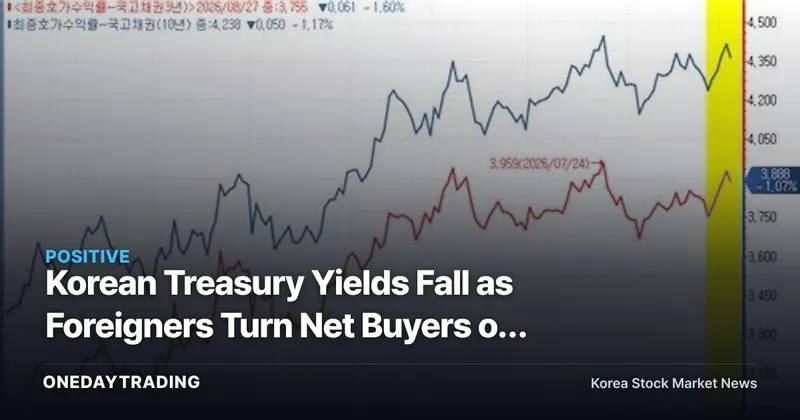
The direct trigger for the across-the-board decline in Korean Treasury yields on September 3 was foreign investors’ shift to net buying of Treasury futures. This should be read not merely as a rebound in bond prices, but as a signal that a major supply-demand (order flow) player steering won-denominated rates has changed positions.
When yields fall, bond prices rise, and lower discount rates are favorable for financial and growth-stock multiples. However, it is too early to call this a trend reversal until it is clear whether foreign buying extends to cash Treasuries and won assets more broadly.
What Happened
According to Yonhap News securities coverage, Korean Treasury yields fell across all maturities in Seoul’s bond market on September 3. Foreign investors switched to net buying in the Treasury futures market. Treasury futures are contracts that trade the future price of Korean government bonds, so foreign buying represents a bet on lower yields and higher prices.
Futures order flow moves faster than the cash market. When foreign investors buy futures, hedging transactions by securities firms and banks follow; if this leads to cash Treasury purchases, downward pressure on yields intensifies. Conversely, if the futures positioning is only a short-term reversal, the move may last just one day without stronger cash demand or changes in the real economy.
Background and Context
Bond yields reflect the benchmark interest rate path, inflation, growth, and the volume of government bonds issued all at once. Foreign investors’ exchange-rate outlook and global rate direction also matter. Even if Treasury futures prices rise and generate profits, a weaker won creates FX losses for foreign investors, so this net buying may reflect both expectations for lower yields and their assessment of won volatility.
Part of the market’s expectation for easier domestic monetary policy is already priced in. What has not yet been priced in is whether foreign investors’ order flow will persist for more than several days and whether cash buying will expand enough to absorb the burden of Treasury issuance. For lower yields to persist, not just policy expectations but also inflation and growth data must support the case for declining rates.
Impact on the Market and Stocks
- Korean Treasuries and bond funds: Continued foreign net buying of Treasury futures could provide further support to short- and medium-term government bond prices. However, weak demand at the next Treasury auction could revive issuance pressures and push yields higher.
- Bank stocks: Lower rates affect funding costs and bond valuation gains and losses. A sharp decline can create valuation gains on held bonds, but falling lending rates can also pressure net interest margins. For KB Financial and Shinhan Financial, investors should assess the pace of the decline and loan competition alongside the rate level.
- Securities stocks: More bond trading and valuation gains on held Treasuries would benefit the trading and investment earnings of large brokerages such as Mirae Asset Securities. Yet lower rate volatility has the opposing effect of reducing trading-profit opportunities.
- Growth stocks: Lower discount rates raise the present value of future earnings, easing some multiple pressure on internet and biotech stocks (tickers) on KOSDAQ. Stocks without supporting earnings are unlikely to sustain a re-rating on lower rates alone.
- Won-sensitive exporters: If foreign bond buying leads to a stronger won, the exchange-rate benefit for exporters such as Samsung Electronics and Hyundai Motor could diminish. Conversely, if won weakness persists, bond buying and FX gains for exporters could occur together.
Investor Checklist
- Check whether foreign investors’ cumulative net buying of Treasury futures remains intact on the next trading day. Continuity over three to five trading days matters more than a single day’s net buying.
- Compare the declines in three-year and 10-year Korean Treasury yields. A sharp drop concentrated in long maturities reflects growth and fiscal concerns, while a decline led by short maturities points primarily to monetary-policy expectations.
- If the won-dollar exchange rate rises and won weakness broadens, the durability of foreign bond buying may weaken. A stable or declining exchange rate would broaden the supply-demand (order flow) base for lower yields.
- Compare Bank of Korea Monetary Policy Board comments with subsequent inflation and growth data. If inflation exceeds expectations, expectations for rate cuts could retreat quickly.
Outlook
The optimistic scenario is one in which foreign futures buying spreads to cash Treasuries and won assets, while slowing inflation and economic weakness are confirmed at the same time. In that case, lower Korean Treasury yields could translate into bond valuation gains for banks and brokerages and lower discount rates for growth stocks.
The opposite scenario is one in which the exchange rate surges again or Treasury issuance exceeds market expectations. If foreign investors return to net selling futures, yields would rebound, and growth-stock multiples that had already priced in lower rates could be the first to correct. The next inflection points are the Bank of Korea Monetary Policy Board meeting, the consumer-price release, and the won-dollar exchange-rate level.
Frequently Asked Questions
Why do bond investors profit when Korean Treasury yields fall?
Korean Treasury yields and bond prices move in opposite directions. When yields fall, the prices of existing bonds paying higher interest rise, creating valuation gains.
Does foreign net buying of Treasury futures affect the stock market?
It can. Lower rates reduce the discount rate applied to stocks, supporting growth-stock valuations, but if foreign buying also strengthens the won, exporters’ exchange-rate gains may shrink.
How can investors tell whether this rate decline is a trend?
They should assess the continuity of foreign futures positions, cash Treasury auction results, the won-dollar exchange rate, and Bank of Korea policy signals together. If all four indicators remain aligned, there is stronger evidence that the move is more than short-term supply-demand (order flow).
KOSPI Index IndicatorsAs of 2026-09-03
| Period trend | 1 week -3.36% 1 month +5.15% |
|---|
Index, commodity, and exchange-rate data are based on global market benchmarks and reflect values at publication.
KB Financial Key IndicatorsAs of 2026-09-03
| Period returns | 1 week +5.83% 1 month +5.39% |
|---|---|
| Trading value · trading volume | 270.5 billion won · 1,523,951 shares |
| Supply-demand (order flow) | Foreign investors −25.7 billion won net selling (5 straight days) Institutional investors +66.0 billion won net buying |
| Recent news tone | 2 positive catalysts · 10 negative catalysts |
Price and order-flow data are real-time values from Korea Investment & Securities (KIS); order-flow and news-tone aggregates are calculated independently by Oneday Trading.
Upcoming Events to Watch
- 09.10Futures and options expirationModerateQuadruple witching — watch for volatility and order-flow disruption
- 09.16FOMC policy-rate decisionHighU.S. Federal Reserve monetary-policy announcement — direction of rates and the dollar
- 10.08Index options expirationLowKOSPI200 options expiration
- 10.22Bank of Korea Monetary Policy BoardHighMeeting to decide the benchmark interest rate
This article is automatically summarized and analyzed based on the original news report. View original (Yonhap News Securities)